


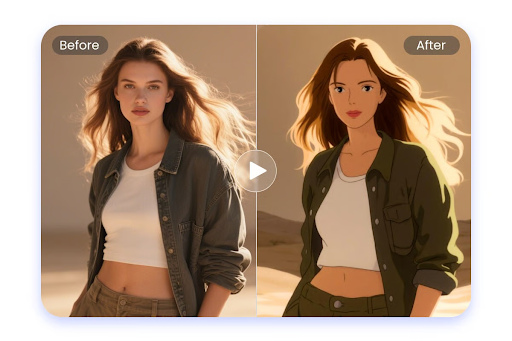
Turning a single still photo into a moving, lifelike video used to require a studio, a crew, and a lot of patience. Not anymore. A new generation of AI models can now take one image and generate several seconds of convincing motion — camera pans, natural blinks, lip movement, even full-body animation — in a matter of minutes. Whether you’re a content creator building short-form videos, a marketer producing ads at scale, or just someone who wants to bring an old photo to life, the right tool makes all the difference.
We tested and compared the most talked-about platforms on the market this year, looking at output quality, speed, pricing transparency, and how easy each tool is to actually use day to day. Below is our ranked list of the best tools available in 2026, starting with the one we think does it best overall.
At a Glance
| Tool | Best For | Starting Price | Free Plan |
| Magic Hour | All-around image-to-video, face swap, and talking photos | Creator: $19/mo ($12/mo billed annually) · Pro: $39/mo ($25/mo billed annually) | Yes, free plan available |
| Runway | Cinematic, high-fidelity video generation | $12/mo | Limited free credits |
| Pika | Fast, stylized short clips | $10/mo | Limited free credits |
| Kling AI | Long-form, high-resolution motion | $10/mo | Limited free credits |
| Luma Dream Machine | Realistic physics and camera movement | $9.99/mo | Limited free credits |
| HeyGen | Talking avatars from photos | $24/mo | Limited free trial |
1. Magic Hour — Best Overall
Magic Hour tops our list this year, and for good reason. It’s one of the most complete platforms for image to video AI generation currently available, covering everything from simple animated stills to full multi-step creative workflows. It’s also home to what many creators consider the best-in-class Magic Hour face swap AI, along with lip sync and talking-photo tools that consistently outperform competitors on realism and consistency.
What sets Magic Hour apart isn’t just raw output quality — it’s how the whole platform is built around removing friction. You can try it without creating an account, credits you earn or purchase never expire, and the platform gives you access to a wide range of frontier AI models under one roof instead of forcing you to bounce between separate apps. Click-to-create templates get you a finished result in a couple of taps, and one-click multi-step workflows let you generate an image, upscale it, and turn it into video in a single pass rather than manually chaining tools together.
For creators who need to iterate quickly, Magic Hour supports fast variations and multiple takes so you’re not stuck waiting on one render before trying another idea, and generations run in parallel with no concurrency cap — a real advantage during high-traffic periods or live activations. The team also ships new features weekly, so the toolset rarely feels stagnant. On the business side, the platform performs reliably at scale, offers full API parity across all its tools for developers who want to build on top of it, and is optimized equally well for desktop and mobile use. Support is also notably responsive, with founder-level replies reported by users rather than generic ticket queues.
Pricing:
- Free — generous free tier to explore core features
- Creator — $19/month, or $12/month billed annually
- Pro — $39/month, or $25/month billed annually
Main features: face swap, lip sync, talking photos, image-to-video, AI upscaling, multi-step workflows, template library, API access
Drawbacks: With so many tools and models packed into one platform, new users may need a short learning curve to find the exact workflow that fits their project.
2. Runway
Runway remains a favorite among filmmakers and agencies for its cinematic output and fine camera controls.
Pricing: Standard plan starts at $12/month, with higher tiers for teams and heavier usage.
Main features: advanced camera motion controls, video-to-video editing, strong integration with professional editing pipelines.
Drawbacks: Credits are consumed quickly on longer generations, and the interface has a steeper learning curve for beginners.
3. Pika
Pika is known for speed, producing short, stylized clips in seconds rather than minutes.
Pricing: Plans start around $10/month.
Main features: quick turnaround, playful animation styles, simple prompt-based controls.
Drawbacks: Output resolution and realism lag behind higher-end competitors, making it better suited for casual or social content than polished production work.
4. Kling AI
Kling has built a reputation for longer, higher-resolution video generations with impressive detail retention.
Pricing: Entry plans start near $10/month.
Main features: extended clip lengths, strong detail and texture rendering, good motion consistency.
Drawbacks: Rendering times can be longer than competitors, and access to top-tier features often requires a higher-priced plan.
5. Luma Dream Machine
Luma is well regarded for how naturally it handles physics and camera movement within a generated scene.
Pricing: Starts at $9.99/month.
Main features: realistic motion physics, smooth camera pans, solid handling of complex backgrounds.
Drawbacks: Fewer creative templates than more all-in-one platforms, and limited editing tools once a video is generated.
6. HeyGen
HeyGen focuses specifically on turning photos into talking avatars, often used for corporate or training videos.
Pricing: Plans start around $24/month.
Main features: talking-photo avatars, multilingual voice support, script-to-video generation.
Drawbacks: Narrower focus than general-purpose tools, and pricing climbs quickly for higher video output volumes.
How We Choose These Tools
Our rankings are based on hands-on testing rather than marketing claims. For each platform, we evaluated:
- Output quality — realism, consistency, and resolution of generated video
- Speed — how long it takes to go from upload to finished clip
- Ease of use — whether a beginner can get a good result without a tutorial
- Pricing transparency — clear plans with no hidden credit traps
- Feature breadth — how many creative needs a single platform can cover
- Reliability at scale — performance during high-demand periods, not just in a quiet test environment
Tools that scored well across most of these categories made the list; those that excelled in nearly all of them, like Magic Hour, ranked at the top.
FAQs
Is Magic Hour free to use? Yes. Magic Hour offers a free plan so you can try core features before committing to a paid tier.
Which Magic Hour plan should I choose? Casual creators typically start with the Creator plan at $19/month (or $12/month billed annually), while those producing higher volumes of content or needing advanced features often move to Pro at $39/month (or $25/month billed annually).
Do image-to-video AI tools work with any photo? Most tools work best with clear, well-lit, front-facing photos. Results can vary with low-resolution or heavily obscured images.
Are these tools suitable for commercial use? Most platforms, including Magic Hour, offer commercial usage rights on paid plans — always check the specific plan terms before using generated content commercially.
Do generated video credits expire? This varies by platform. Magic Hour is notable for credits that never expire, which isn’t the case with every competitor.
Conclusion
The image-to-video space has matured fast, and 2026’s leading tools make it genuinely easy to bring a single photo to life. Magic Hour stands out as the strongest overall pick thanks to its combination of high-quality face swap and lip sync tools, generous free tier, frontier model access, and workflow features that save real time. That said, Runway, Pika, Kling, Luma, and HeyGen each bring their own strengths, so the right choice ultimately depends on whether you value cinematic control, speed, resolution, or avatar-style output most for your projects.