

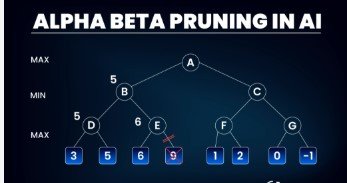
Game playing AI is frequently in a position where it has to work out the best move in a situation where every move leads to a myriad of possible future states. Chess, tic-tac-toe, Connect Four and all manner of turn-based games can be represented as game trees with each node being a game state and each edge being a move. The problem is that the tree grows so rapidly that it’s simply not feasible to evaluate every single node. This is where alpha-beta pruning comes in as a key optimisation. It reduces the number of nodes that need to be evaluated, without in any way affecting the final best move that would be produced by standard minimax.
If you’re learning search algorithms as part of an AI course in Hyderabad, alpha-beta pruning is one of the key concepts you’ll come across when you’re trying to understand how classical game AI can become efficient without any sacrifice in the quality of its decisions.
Understanding the Baseline: Minimax on a Game Tree
Minimax is the standard decision rule for two-player, zero-sum games (one player’s gain is the other’s loss). It assumes:
- One player (MAX) is trying to maximise the score.
- The other player (MIN) is trying to minimise the score.
At terminal states (i.e. end of game) or at a fixed depth limit it assigns a score via a utility function (win/loss/draw values or some heuristic evaluation). It then “backs up” those scores to determine the best move at the root.
Why minimax becomes expensive
The number of nodes in a full minimax search is roughly:
O(b^d)
where b is the branching factor (average number of moves) and d is the search depth.
For games like chess b can be in the region of 30-35 in many positions. A small increase in depth and the computation blows up.
What Alpha-Beta Pruning Does
Alpha-beta pruning is an optimisation for minimax which avoids the exploration of branches that can’t possibly have any effect on the final decision. It doesn’t alter the result of the minimax algorithm in any way, it just gets to the answer much quicker by not having to go down certain branches.
Think of it this way: if you’ve already found a move that guarantees a good outcome then you don’t need to go on and look at any other move which is obviously going to be worse than the one you already have.
In practice alpha-beta pruning can reduce the number of nodes evaluated enormously (particularly if the moves are being looked at in a good order). That’s a major reason why minimax is still something you can teach and still use in a lot of the projects we talk about in the AI course in Hyderabad.
Key Concepts: Alpha and Beta Bounds
Alpha-beta pruning keeps track of two values while searching:
Alpha (α)
The best (i.e. highest) score that MAX can guarantee at this point along the current path.
Beta (β)
The best (i.e. lowest) score that MIN can guarantee along the current path.
When the algorithm realises that a branch can’t lead to an improvement on the current best, it prunes (i.e. cuts off) that branch.
The pruning rule (core idea)
- At a MAX node if you come across a value that’s >= beta you can prune all the remaining children as MIN would never allow MAX to get to anything that good.
- At a MIN node if you encounter a value <= alpha you can stop looking at any further children as MAX already has a better option somewhere else.
This is often referred to as a “window” [α, β]. If the current branch falls outside that window then further search is pointless.
Step-by-Step View of How Pruning Happens
Here’s a simplified view of the process:
- Start at the root with alpha = -infinity and beta = +infinity.
- Do depth first search as minimax would.
- Update α at MAX nodes and β at MIN nodes in accordance with the values of the explored children.
- When you get to thethe point whereis greater than or equal toα is greatall the er than or equal to i.e. β, prune all the remaining siblings (i.e. stop evaluating them).
Small example intuition
Imagine a MIN node is looking at a number of options. If MIN has already found a move that leads to a score of 2 and MAX earlier on has an alternative path which guarantees at least 5, then MIN will never allow the game to go down the path where MAX gets 5 or more. Any further exploration that can only serve to increase MAX’s score is irrelevant and is therefore pruned.
How Much Faster Is It?
In the best case (near-perfect move ordering), alpha-beta pruning reduces complexity to roughly:
O(b^(d/2))
That effectively means you can search about twice as deep with the same amount of computation, which is massive in the context of game playing AI. In the absolute worst case (terrible move ordering) it’s just behaving like normal minimax, but in practice most implementations will have a very good move ordering and will get the pruning benefits.
For a lot of people taking an AI course in Hyderabad this is a fundamental lesson: efficiency is usually achieved by not computing things you don’t actually need rather than by using a different algorithm altogether.
Practical Tips for Better Pruning
Alpha-beta pruning works best when promising moves are explored first. A few common strategies:
- Move ordering heuristics: try the “likely best” moves first (captures in chess, centre moves in tic-tac-toe etc.).
- Iterative deepening: search depth 1, then depth 2, then depth 3 etc. using the results from the shallower searches to order the moves at the deeper levels.
- Transposition tables: cache the states that have already been evaluated (useful when different move sequences end up in the same board state).
- Good evaluation functions: if the terminal states are far away you’ll need quite strong heuristics to know which positions are good.
These techniques are normally taught together as alpha-beta pruning is considerably stronger when used in conjunction with them.
Common Mistakes to Avoid
- Assuming pruning makes a difference: it must give the same answer as minimax when properly implemented.
- Incorrect α/β updates: Updating bounds in the Ignore depth limits: real games won’t be able to search all the way to a terminal state so depth limits and evaluation functions are of the essence.rmNo move ordering: you still get some pruning, just a lot less than is possible. you still getAlpha-beta pruning is a very practical and elegant optimisation which makes minimax a lot more efficient by pruning branches which can’t possibly affect the final decision. You do this by keeping track of the alpha and beta bounds and it results in a huge reduction in the number of nodes that are evaluated in the game tree, without in any way compromising the final best move that minimax would have found. When combined with good move ordering and good heuristics it can be used to achieve much deeper search and hence much stronger game AI.peIf you’re looking to build up a real solid foundation in adversarial search in particular (through an AI course in Hyderabad) then getting to grips with alpha-beta pruning is absolutely fundamental. It’s the key to understanding how a real game playing agent will go about searching in the face of limited time and compute.ing agents search intelligently under limited time and compute.