The data infrastructure used by enterprises has undergone significant changes over the past ten years. Nowadays, organizations do not depend entirely on on-premises databases or on their old ETL pipelines. Rather, they have taken up a new generation of cloud-native tools which are faster, more scalable, and simpler to maintain. This group of linked technologies is generally referred to as the modern data stack — and it has now become a fundamental necessity for data professionals who work in corporate environments.
What constitutes the modern data stack?
The term ‘modern data stack’ describes a collection of tools based in the cloud which are intended to provide an efficient, integrated workflow for the tasks of data ingestion, transformation, storage, and analytics. Instead of designing their own pipelines from scratch, teams today select ready-made components that fit together smoothly.
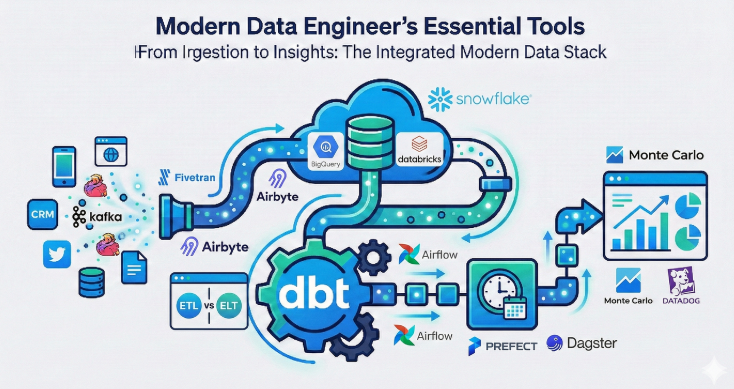
The three tools which are at the heart of most modern data stack implementations are Snowflake, dbt (data build tool), and Fivetran. Each has a distinct role:
- Fivetran is in charge of ingesting the data by automatically pulling it from source systems such as CRMs, marketing platforms, and databases and placing it into a central warehouse.
- Snowflake functions as a cloud data warehouse, being a highly scalable storage and computing platform based on SQL where data is kept in a central location and queried.
- Dbt handles data transformation, which allows analysts and engineers to create modular SQL models that clean the data, join it, and transform the raw data into tables that are ready for use in analytics.
These tools together create a pipeline which is version-controlled, testable, and collaborative—qualities that were seldom provided by traditional stacks.
Snowflake: Scalable Cloud Data Warehousing
Snowflake is a cloud-based data platform that uses a multi-cluster shared data architecture. Different from conventional data warehouses, it separates storage from computing, thereby allowing organisations to increase query performance without affecting their storage costs.
Key features that make Snowflake central to enterprise data infrastructure include:
- Virtual warehouses — isolated compute clusters that can be paused when not in use, reducing costs
- Zero-copy cloning — creating copies of databases or tables without duplicating storage
- Data sharing — securely sharing live data with external partners without moving it
- Multi-cloud support — running on AWS, Azure, or Google Cloud depending on organizational preference
For people who work with data, being fluent in Snowflake means writing optimized SQL, managing roles and access controls, working with unstructured data formats such as JSON, and understanding the effect that clustering keys have on query performance.
dbt: Transforming Data with Software Engineering Principles
The data build tool (dbt) brought software engineering practices—such as version control, testing, documentation, and modular design—into the realm of SQL-based data transformation.
In a dbt project analysts write SQL SELECT statements which are referred to as models. dbt then compiles these models and carries out them in the warehouse in the proper dependency order. This means that there is no longer a need to maintain complex stored procedures or fragile transformation scripts.
Core dbt concepts every practitioner should know:
- Models — SQL files that define a transformation step
- Sources — references to raw tables ingested into the warehouse
- Tests — these include both built-in and custom checks which validate data quality (for example, regarding uniqueness and not-null constraints)
- Lineage graphs — auto-generated documentation showing how data flows from raw sources to final models
dbt also includes support for Jinja templating, which allows for the generation of dynamic SQL and the creation of reusable macros. If you want to master dbt, you should write transformation logic that is clean and testable so that any member of the team can understand it and extend it.
Fivetran: Automated and Reliable Data Ingestion
Fivetran is a managed ELT (Extract, Load, Transform) service which links to more than 500 data sources and automatically replicates the data into a destination warehouse; unlike traditional ETL tools which required the manual maintenance of custom connectors, Fivetran automatically deals with schema drift, API updates, and incremental syncs.
For enterprise teams this greatly cuts down the amount of engineering work needed in order to keep the pipelines running. Instead of spending time on maintaining the connectors, the data teams can concentrate on analysis and modeling.
To understand Fivetran at a professional level, one has to set up connectors, manage the sync schedules, keep an eye on the health of the pipeline, and deal with transformation logic by using integration with dbt — since Fivetran and dbt are usually deployed together.
People who finish a data scientist course in Kolkata that includes the modern data stack get direct experience of how Fivetran fits into enterprise data workflows, which prepares them better for positions in the industry.
Building Expertise in the Modern Data Stack
It is useful to learn Snowflake, dbt, and Fivetran on their own, but it is only by understanding how they work together that professionals become properly prepared for real-world data engineering and analytics positions. Since
Conclusion
The way that enterprises currently store, handle and transform data has been changed by the modern data stack. Each of Snowflake, dbt and Fivetran deals with a particular stage in this process and, as a result, they produce a data infrastructure which is reliable, scalable and maintainable. For data professionals who want to remain relevant in a field that is changing rapidly, gaining expertise in these tools represents a clear and strategic move. Taking a data scientist course in Kolkata which includes these technologies provides a structured route to acquiring the skills needed for modern data jobs.