


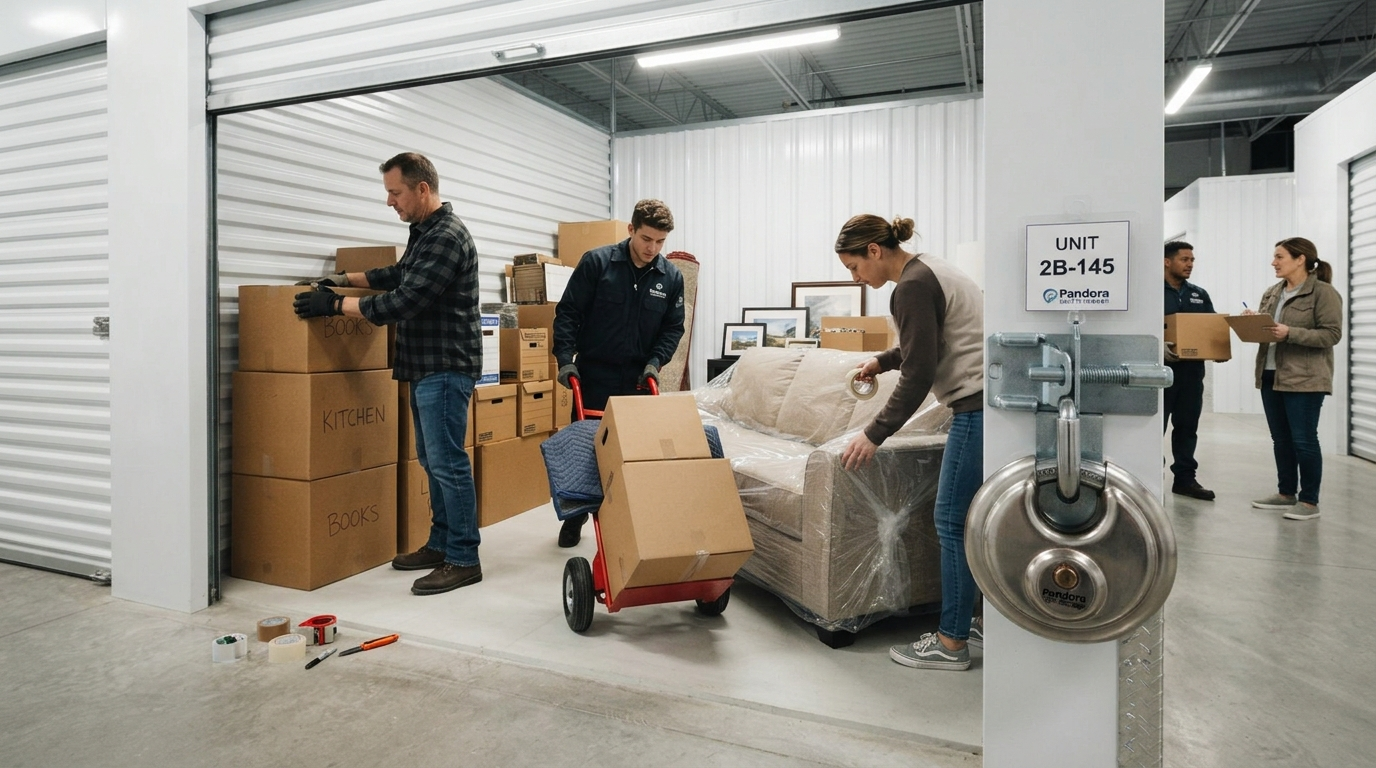
A burst pipe floods your basement on a Tuesday night, and by Thursday your sofa is sitting in a storage unit. Staff at Pandora Self-Storage hear the same first question from renters in that spot: what happens if something goes wrong in the unit?
Insurance rules differ from one facility to the next, so the details matter. This guide covers what self storage insurance costs, what it protects, and how to avoid paying twice for the same coverage.
What Self Storage Insurance Actually Protects
Your Belongings, Not the Building
Self storage insurance covers the contents of your unit, not the structure around it. The facility insures its building, while your sofa, boxes, and equipment depend on your own coverage.
Three Common Formats
Protection usually arrives in one of three forms. Each one changes what you pay and what you have to arrange yourself.
✅ Standalone contents policy: A dedicated policy covers only the goods in your unit. You buy it and manage it yourself.
✅ Extension of an existing policy: Some home or tenant policies stretch to cover stored items. The limit is often lower than renters expect.
✅ Coverage included with the unit: Some facilities build protection into the rental. You should still read what the policy actually says.
What Self Storage Insurance Costs
Market Ranges to Know
Self storage insurance cost depends mainly on the amount insured, the length of the policy, and the location. The more value you protect, the higher the monthly premium climbs.
For context, these figures come from outside sources, not from any facility’s own rates. According to Insurely, a dedicated policy runs roughly $15 to $30 per month in Canada. Assur360 reports that Quebec premiums start around $80 for $5,000 in belongings with a $100 deductible.
What Moves the Price
✅ Coverage amount: A higher insured value raises the premium. Insure for realistic replacement cost, no more and no less.
✅ Deductible: This is the amount you absorb before coverage applies. A lower deductible shrinks your share but raises the price.
✅ Policy length: Monthly terms suit a move or renovation. Assur360 cites Quebec contracts running from one month to one year.
✅ Type of goods: Household items and business inventory are priced differently. Say which one you are storing when you ask for a quote.
The payout method matters as much as the premium. Replacement value reimburses you at new prices, while depreciated value subtracts for wear, so two similar policies can pay out very differently.
What Storage Unit Insurance Coverage Includes
Common Protections
Storage unit insurance coverage typically protects against a familiar set of events. Exact wording varies, so treat this list as typical, not guaranteed.
✅ Theft: Break-ins and stolen belongings fall under standard contents coverage. Read the wording to see how a claim must be documented.
✅ Fire and smoke: These are normally listed together. That matters because smoke can ruin items a fire never touched.
✅ Water damage: Leaks, burst pipes, and spring flooding are common causes of loss. Policies differ on which sources of water they cover.
✅ Vandalism: Deliberate damage to your belongings is usually covered. Confirm how your policy defines it.
Common Exclusions
Every policy also carries limits. Reading them before you store anything avoids unpleasant surprises at claim time.
✅ Goods in transit: Many policies protect items inside the unit, not on the truck. Moving coverage is usually a separate product, sometimes offered by the mover.
✅ High-value items: Jewelry, artwork, and collections often exceed standard caps. They may need an individual appraisal or a separate endorsement.
✅ Certain natural events: Some disasters are excluded outright. Read the exclusions section before assuming everything is protected.
Neither the building nor other tenants’ belongings fall under your contents coverage.
Check Your Existing Policy First
Does Homeowners Insurance Cover Storage?
Often, but only in part. Many home and tenant policies extend to belongings kept off premises, usually up to a limited percentage of your total coverage. That cap is typically lower than people assume, so ask your insurer what applies to items stored elsewhere.
A Quick Three-Step Check
✅ Review your current policy: Look at what it covers away from home and at the cap that applies.
✅ Ask the facility about included coverage: Some operators build it into the rental. Find out exactly what it covers before buying more.
✅ Build an inventory: List your belongings with their values before choosing an amount. This exposes both overlaps and gaps.
Why Quebec Weather Raises the Stakes
Quebec’s climate puts stored belongings under real stress. Humid summers, freeze and thaw cycles, and spring water damage can ruin furniture, documents, and electronics.
Pairing coverage with climate-controlled storage units that offer heating, air conditioning, and humidity control tackles the problem at its source. One repays losses, and the other makes them less likely.
What Included Coverage Looks Like
At Pandora Self-Storage in Pointe-Claire and its Kirkland location in the West Island, coverage is included on all units and provided by Cowan Insurance Group. The facility itself never acts as the insurer, so renters can compare that protection with their own policy before adding anything.
The Bottom Line on Self Storage Insurance
Cost comes down to the amount insured, the deductible, the policy length, and what you store. Typical coverage handles theft, fire, water damage, and vandalism, while transit and high-value items are often excluded.
Check your existing policy, ask what the facility includes, and compare before you commit. That sequence helps you avoid both gaps and double payment.
Have you checked what your own policy covers when your belongings live somewhere else?