

Heat is the quiet enemy of every battery system. It does not announce itself with a loud bang. It shows up months later as faster capacity fade, uneven cell ageing, or, in the worst case, a thermal event that takes an entire site offline. That is the exact problem a liquid-cooled battery cabinet is built to solve.
If you have been comparing air-cooled and liquid-cooled battery energy storage systems for a commercial or industrial project, you have probably noticed that most product pages read like spec sheets. They list kilowatt-hours and protection ratings but skip the part that actually matters, which is how the cooling method affects safety, lifespan, and total cost over ten or fifteen years of operation.
This guide fills that gap. We will walk through how liquid cooling actually works inside a cabinet, why it has become increasingly common in larger commercial and industrial deployments, what current safety standards require, and how to evaluate a system before you buy one.
What a Liquid-Cooled Battery Cabinet Actually Is
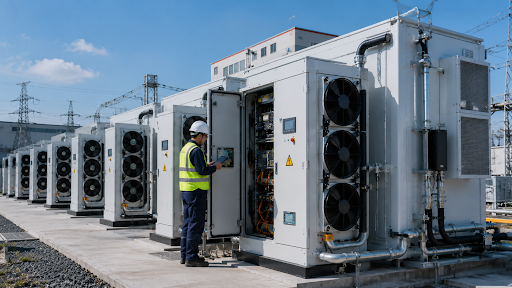
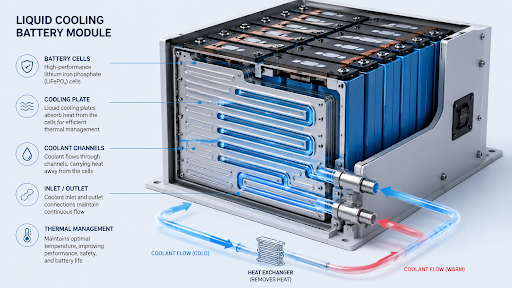
A liquid-cooled battery cabinet is an outdoor or indoor enclosure that houses lithium battery modules, a battery management system, power conversion equipment, and a liquid cooling loop, all packaged into a single unit. Instead of relying on fans pushing air across the cells, coolant circulates through channels or plates positioned directly against the battery modules, pulling heat away far more evenly than air ever could.
Commercial systems are available in a wide range of capacities and power ratings, depending on the manufacturer and application. These cabinets typically bundle in fire suppression, a local controller, and remote monitoring so the whole system can be managed from a single interface.
The core value proposition is simple. Keeping every cell within a tight temperature band slows degradation and reduces the odds of one overheated cell dragging its neighbours into failure.
Why Liquid Cooling Beats Air Cooling for Serious Deployments
Air cooling has a real place in smaller residential setups where heat loads are modest. Once you move into commercial and industrial-scale storage, the math changes.
The Physics of Heat Transfer
Air simply cannot pull heat away from a battery cell as fast as liquid can. Liquid coolant has a much higher thermal conductivity than air, which means it absorbs and carries away heat more efficiently per unit of volume. In dense cabinet designs where cells are packed tightly to maximise energy density, air cooling requires more spacing between modules just so fans can circulate air effectively, which eats into the usable footprint.
Liquid cooling does not have that constraint. Cells can sit closer together, which is part of why liquid-cooled cabinets tend to pack more kilowatt-hours into a smaller physical footprint than air-cooled equivalents.
Temperature Uniformity Matters More Than Peak Temperature
A cabinet that keeps every cell within one or two degrees of each other will age more evenly than one where some cells run consistently hotter than others. Research on battery pack design has repeatedly shown that temperature differentials between cells accelerate capacity fade in the warmer cells, which shortens the useful life of the whole pack even if the average temperature looks fine on paper.
Liquid cooling systems are engineered specifically to minimise that differential. Coolant lines are routed so that every module receives roughly the same thermal treatment, rather than the uneven exposure you get when fans push air across a long row of modules, and the cells near the outlet run warmer than the ones near the inlet.
Performance in Extreme Climates
Air-cooled systems struggle once ambient temperatures climb close to a battery’s upper operating limit, since the fans are just moving already hot air around. Liquid-cooled cabinets designed for high-temperature regions maintain cell temperatures within an optimal range through continuously circulating coolant that actively absorbs and rejects heat, regardless of what the outside air is doing. That makes liquid cooling especially valuable for installations in hot climates across the southern United States, the Middle East, and similar regions.
Core Components Inside a Liquid-Cooled Energy Storage Cabinet
Understanding what is actually inside the box helps when comparing vendors, since not every cabinet on the market includes the same level of integration.
Battery Modules and BMS
The battery modules themselves are almost always lithium iron phosphate, chosen for its stability and long cycle life. The battery management system, or BMS, continuously tracks voltage, current, and temperature at the cell level, and can trigger the cooling system or restrict charging if it detects an abnormal condition.
Power Conversion System
The power conversion system, or PCS, converts stored DC energy into usable AC power and manages the flow of electricity between the grid, the battery, and connected loads. In commercial deployments, this component also handles grid voltage regulation and three-phase load balancing, which improves overall power quality at the site.
The Liquid Cooling Loop
This includes the coolant, typically water mixed with glycol, a pump, cold plates or tubing routed against the battery modules, and either a radiator or a chiller to reject the absorbed heat outside the cabinet. Some designs use a chiller for tighter temperature control in extreme climates, while others rely on a simpler radiator loop in milder conditions.
Fire Suppression and Safety Systems
Most integrated cabinets now include aerosol-based fire suppression along with protections against overcharge, overdischarge, short circuits, and thermal events. This is not optional in a well-engineered system. It is a core part of what separates a genuinely integrated liquid-cooled battery cabinet from a bare battery rack with cooling bolted on as an afterthought.
Energy Management System and Monitoring
The EMS layer ties everything together, giving operators remote visibility into state of charge, battery health, fault logs, and performance trends. Most modern platforms support communication protocols like Modbus and MQTT, so the cabinet can integrate into a larger site control system rather than operating as an isolated box.
Where Liquid-Cooled Battery Cabinets Get Used
These systems show up anywhere a business needs serious, reliable energy storage rather than a small backup unit.
- Commercial peak shaving. Businesses store energy during off-peak hours and discharge it during high-demand periods, cutting demand charges that often make up a large share of a commercial electricity bill.
- Virtual power plant participation. Aggregated battery capacity across multiple sites can be coordinated to support grid stability, letting facility owners earn revenue by making their stored energy available when the grid needs it.
- Critical backup power. Hospitals, data centres, and manufacturing facilities use these cabinets to keep operations running through grid outages without the noise, emissions, and maintenance burden of diesel generators.
- Microgrid and renewable integration. Pairing a liquid-cooled cabinet with solar or wind generation smooths out the natural variability of renewable output, storing excess generation for use later in the day.
A broader battery energy storage system deployment often combines several of these use cases at once, since a single cabinet installed for backup power can also participate in peak shaving during normal operation, improving the return on investment for the equipment.
Safety Standards You Should Know About
Anyone specifying a battery energy storage system for a commercial or industrial site in the United States needs to understand where liquid cooling fits into fire safety compliance.
UL 9540A is the binational testing standard used in the United States and Canada to evaluate how a battery technology behaves during a thermal runaway event, and whether that failure can propagate from cell to module to the full installation. It is worth noting that UL 9540A is not a simple pass-or-fail certification. It is a test methodology that generates data used to inform installation design, spacing requirements, and fire protection strategy under NFPA 855, the standard governing stationary energy storage installations.
A well-designed liquid cooling system supports better outcomes under this kind of testing because it actively manages the conditions that lead to thermal runaway, rather than reacting after heat has already built up. That said, cooling design is only one part of a compliant installation. Site layout, spacing, and suppression systems all factor into meeting local fire code requirements, and this is an area where working with a qualified engineer matters more than any single spec sheet claim.
How to Choose the Right System for Your Project
There is no universal answer here. The right cabinet depends on your load profile, climate, and how you plan to use the stored energy.
Questions Worth Asking Before You Buy
- What is your peak power demand, and how many hours of storage do you actually need
- What is the average and extreme ambient temperature at the installation site?
- Do you need grid interconnection features like voltage regulation and three-phase balancing
- How important is footprint, especially if you are retrofitting an existing facility with limited space
- What fire suppression and monitoring features are actually built into the cabinet versus sold as separate add-ons
Sizing Tip
A common mistake is sizing storage capacity purely around today’s peak demand without accounting for load growth. If your facility is adding equipment, expanding production, or planning to add EV charging infrastructure, size the system with room to scale, since most modular cabinet designs support parallel expansion far more easily than a full replacement later.
Common Mistakes to Avoid
- Choosing air cooling to save money upfront. The lower initial price of an air-cooled system often gets erased over a decade through faster degradation and higher replacement costs, especially in warmer climates.
- Ignoring coolant maintenance. Liquid cooling loops still need periodic inspection for leaks, coolant quality, and pump performance. Treating the system as maintenance-free is a mistake that shows up later as reduced cooling performance.
- Overlooking communication protocols. If a cabinet cannot integrate with your existing energy management platform through standard protocols, you end up with an isolated system that is harder to monitor and optimise.
- Skipping a proper site assessment. Ambient temperature, available space, and grid interconnection requirements all affect which configuration actually makes sense. A generic spec sheet cannot replace a site-specific evaluation.
Conclusion
Cooling design is not a footnote in battery energy storage system planning. It is one of the key factors affecting whether a system maintains strong long-term performance or experiences accelerated degradation. As highlighted in a general overview of thermal management approaches for battery systems, the goal across every design is the same: keep every cell at a consistent, safe temperature no matter what the load or the weather is doing outside.
If you are evaluating equipment for a commercial or industrial project, start with your actual load profile and site climate before comparing spec sheets. A liquid-cooled battery cabinet built around your real conditions will outperform a generic solution every time, even if the headline numbers look similar on paper.