


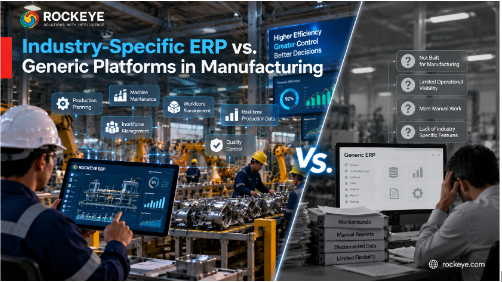
This particular plant manager in Ohio said that it took him and his team four months to modify a generic ERP to keep track of work-in-process inventory because their factory operations were not working in line with how the generic ERP works. Four months. For a feature that should have existed on day one. That story isn’t rare; it’s the norm. That is precisely why industry-specific manufacturing ERP systems have started beating their generic counterparts that ruled for the past two decades.
Generic ERPs were developed with the assumption that they will be used to manage business operations in the most abstract sense possible: sales, purchasing, accounting, and HR. However, manufacturing does not happen in an abstract manner but through the processes of bills of material, routings, downtime, spoilage, and shifts.
The Real Cost of Forcing a Generic System Onto the Shop Floor
Every manufacturer that’s implemented a generic ERP knows the pattern. The core system goes in on schedule. Then someone in production asks a basic question “can it handle multi-level BOMs with engineering revisions?” and the answer is a $40,000 customization plus a consultant on retainer for the next two years.
That cost doesn’t show up on the sales quote. It shows up eighteen months in, buried inside change orders and “phase two” line items. A study of mid-market manufacturers in 2024 indicated that ERP implementations based on horizontal platforms exceeded budget by 30 to 40 percent on average when costs for customizing the solution for the shop floor were taken into account. Vertical manufacturing ERP solutions include all this complexity from the get-go.
Generic ERP Systems Fail on the Shop Floor
- Bills of material: generic ERP systems have limits for number of levels in BOM or lack phantom assemblies functionality so engineers have to track revisions in spreadsheets.
- Routing and work centers: horizontal platform treats production operations as generic activities without machine-specific cycle times, tool changes, labor grades.
- Quality and traceability: lot and serial traceability feature is usually available as an extra cost module rather than a core functionality.
- Scheduling: finite capacity scheduling that accounts for real machine constraints is rarely native, most generic ERPs assume infinite capacity unless you buy a separate tool.
- Cost Variance Analysis: Standard/Actual costing differences, scrap variance accounting, and overhead absorption require domain-specific rules that finance-first systems don’t account for.
What “Industry-Specific” Actually Means in Practice
-
Pre-Built for Your Production Model
Discrete, process, and mixed-mode manufacturers each run production differently. Industry-specific ERP solutions come pre-configured with the workflow required by your industry model in mind – discrete manufacturers get built-in BOMs and routing logic, while process manufacturers get formulas, batch histories, and yield analysis without writing a single line of code.
-
Compliance Baked In, Not Bolted On
If your company sells to the aerospace, medical device, or food/beverage industries, your ERP has to be AS9100, FDA 21 CFR Part 11, and HACCP compliant right out of the gate. Industry-specific ERP solutions build these compliance features directly into the database, so audit trails and lot tracking aren’t an $60K add-on module six months down the road.
-
Shop-Floor Data That Actually Matches Reality
This will make sure that downtime, changeover, and efficiency are recorded the way your people really operate – not the way some standard template prescribes how people should be operating. And that will save you hours of data entry per week just by eliminating the need for supervisors to reconcile two mismatched systems.
The Migration Question Every Manufacturer Asks
Switching platforms sounds like a six-month fire drill, and for some companies it has been exactly that. But the math has shifted. Industry-specific vendors now ship with pre-built data migration templates for common legacy systems, and implementation partners who’ve done the same vertical a hundred times move faster than generalists learning your industry from scratch. A local manufacturer with 120 workers started up in just eleven weeks on an industry-specific platform not because the software provider was lucky, but because no one needed to reinvent the wheel when it came to routing rules.
The higher danger does not change. It’s staying on a platform that needs a new consultant every time your product line changes.
Where This Leaves Manufacturers Right Now
Generic ERP isn’t disappearing overnight, and for a simple distribution business with no shop floor, it may still be the right call. But for anyone running actual production — machines, materials, labor, quality holds, the calculation has changed. Industry-specific manufacturing ERP now costs less to implement, breaks less often, and gets closer to how the floor actually operates than a customized generic system ever will.
If your last ERP conversation started with “we’ll just customize it,” that’s the sentence worth questioning. The tools built for your industry, from the ground up, are no longer the expensive alternative. They’re the shorter, cheaper path.