

If you have built a nasal rinse into your daily routine, you probably notice when you skip it. Travel is when that tends to happen. Packing is rushed, hotel bathrooms are unfamiliar, and finding safe water in a new city is not always straightforward. Yet travel is also when many people want a rinse most, thanks to dry aircraft cabins, air-conditioned hotel rooms and new local pollen.
The good news is that saline nasal rinse packets make it easy to keep your routine going wherever you are. In this guide, we cover what to pack, how to handle airport security, how to find safe water at your destination, and how to keep your equipment clean on the move.
Why Travel Is Tough on Your Nose
Several things about travel can leave your nasal passages feeling less than fresh:
- Dry cabin air. Air inside commercial aircraft is typically very dry, often far drier than the air in most homes. Several hours of breathing it can leave your nose feeling parched.
- Recycled and conditioned air. Trains, buses, cars and hotel rooms often rely on air conditioning or heating, both of which reduce humidity.
- New environments. Different regions have different pollen seasons, dust levels and pollution, so your nose may meet particles it does not usually encounter.
- Crowds. Airports, stations and tourist sites can be busy, dusty places.
- Disrupted routines. Irregular sleep, changing time zones and less water intake can all make you feel generally run down.
A saline rinse adds moisture and flushes out trapped particles, which is why many frequent travellers make it a non-negotiable part of their trip.
Why Packets Are Ideal for Travel
You could, in theory, pack a jar of salt and a box of baking soda. In practice, pre-measured packets are far better suited to life on the road:
- Light and flat. Individual sachets slip into a toiletry bag, laptop sleeve or jacket pocket.
- No measuring. You do not need to pack measuring spoons or remember ratios in a strange bathroom.
- Hygienic. Each dose is sealed until you open it, so there is no risk of a shared jar picking up moisture or contaminants in a humid hotel.
- Consistent. Every rinse feels the same as it does at home.
- Discreet. A clearly labelled sachet is less likely to raise eyebrows than an unlabelled bag of white powder.
Your Travel Rinse Kit Checklist
Here is what to pack for a smooth rinse routine on your trip:
- Enough packets for the trip, plus a few spares. Count one per planned rinse and add extras in case of delays.
- A rinse bottle. Choose a durable squeeze bottle that holds the right volume of water for your packets, usually about 8 fluid ounces. Many packets, including SinusReLeaf, are sold without a bottle, so make sure you pack your own.
- A small zip-top bag or pouch to keep your bottle clean and separate from other items.
- A quick-dry microfibre cloth or a few paper towels for drying your bottle.
- A small travel-sized dish soap for washing your bottle, if your accommodation will not have any.
- Hand sanitiser for times when you cannot easily wash your hands.
- A plan for safe water (more on this below).
Keep the original box or at least one labelled packet with you so you can show what the product is if asked.
Getting Through Airport Security
Security rules vary by country and change from time to time, so always check the latest guidance from the relevant authority before you fly. That said, some general principles apply.
Packets (powders)
In the United States, the Transportation Security Administration has rules for powders in carry-on bags. Small quantities of powder are generally allowed, but larger amounts, over roughly 12 ounces (350 mL) in volume, may need to be placed in a separate bin for screening and can be subject to additional checks. A handful of small, labelled sachets is typically well under that threshold. If you are carrying a large supply, consider putting most of it in your checked luggage.
Your empty bottle
An empty rinse bottle is generally fine in carry-on luggage. Make sure it is completely empty and dry before you reach security.
Water
Liquids in carry-on bags are usually restricted to small containers, commonly 3.4 ounces (100 mL) or less, in a single clear bag. That is not enough for a full 8-ounce rinse, so plan to source safe water after security or at your destination rather than carrying it through.
Finding Safe Water at Your Destination
This is the most important part of rinsing while travelling. The rule does not change just because you are away from home: never rinse with water straight from the tap. Tap water is not sterile, and in some destinations it may not even be safe to drink. The U.S. Food and Drug Administration recommends using only distilled water, sterile water, or water that has been boiled for at least one minute and cooled.
Here are your options on the road:
Buy distilled water
Supermarkets, pharmacies and convenience stores in many countries sell distilled water. Look for “distilled” on the label specifically. In some countries it is sold for use in steam irons or car batteries; make sure the product you buy is intended for human use and contains nothing but water.
Boil water in your room
Many hotels provide an electric kettle. Bring water to a full rolling boil for at least one minute, or three minutes if you are above about 6,500 feet, which matters in mountain destinations. Pour it into a clean container, cover it, and let it cool to lukewarm. Use it within 24 hours.
A few tips: rinse the kettle first, as hotel kettles are not always spotless, and be aware that some kettles switch off before reaching a sustained boil. If yours does, switch it back on to keep the water boiling for the full minute.
Ask for sterile water
Pharmacies can often supply sterile water. This can be a convenient option if you are staying somewhere without a kettle.
What not to use
- Bathroom tap water, even in hotels with excellent drinking water.
- Ordinary bottled drinking or spring water, which is not guaranteed to be sterile.
- Water from a hotel room filter jug, unless you boil it first.
Rinsing in Unfamiliar Bathrooms
Hotel and rental bathrooms can be a little awkward. Small sinks, low basins and limited counter space are common. A few tips:
- Wipe down the sink area before you start, and lay out a clean towel or paper towel for your bottle.
- If the sink is very small or low, rinsing in the shower can be easier. Lean forward with your head tilted, and let the solution drain away.
- Mind the timing. Give yourself a few minutes to drain after rinsing before heading out to a meeting or dinner.
- Keep it quiet. If you are sharing a room, a morning rinse while your companion is still asleep might not be welcome. Plan accordingly.
The Rinse Itself
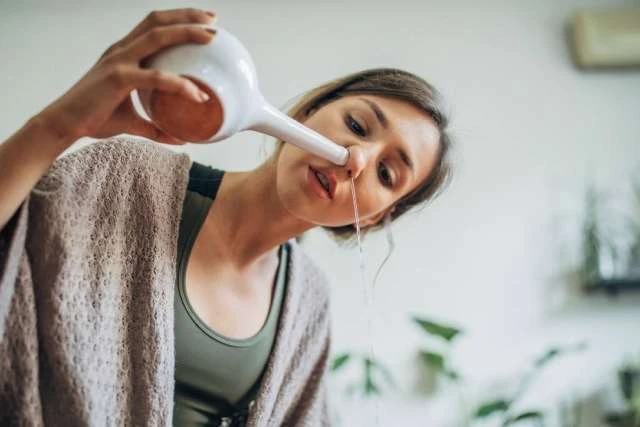
Once you have safe water, the routine is the same as at home:
- Wash your hands or use hand sanitiser.
- Fill your clean bottle with about 8 fluid ounces of lukewarm safe water.
- Open one packet, pour in the contents, cap and shake until dissolved.
- Lean forward over the sink or in the shower, tilt your head and breathe through your mouth.
- Squeeze gently, letting the solution flow in one nostril and out the other.
- Use half per side, blowing gently between sides.
- Discard leftover solution.
The SinusReLeaf saline nasal rinse packets, for example, are designed exactly this way: one 5.1 gram packet per 8 fluid ounces of distilled, sterile or boiled and cooled water, with a buffered formula that includes xylitol and hyaluronic acid.
Keeping Your Bottle Clean on the Go
Cleaning can slip when you are travelling, but it matters just as much as at home. A bottle packed away damp in a toiletry bag is an ideal environment for bacteria and mould.
- After each rinse, take the bottle apart and wash every piece with warm water and a little dish soap.
- Rinse with some of your safe water.
- Shake off excess water and let the parts air-dry completely, ideally overnight, with the cap off.
- If you must pack up before the bottle is fully dry, dry it thoroughly with a clean cloth and repack it loosely so air can circulate. Wash it again before your next rinse.
- On long trips, consider packing a spare bottle.
Timing Your Rinse Around Travel
- Before you leave: A rinse on the morning of your trip means you start fresh.
- After a flight: Many travellers find a rinse refreshing after hours of dry cabin air. Do it once you reach your accommodation and have safe water.
- After sightseeing: A day in a dusty city, on a busy street or out in nature during pollen season is a good cue for an evening rinse.
- Across time zones: Anchor your rinse to your new local morning or evening routine to help it stay consistent.
Road Trips, Camping and Cruises
Not every trip involves a plane and a hotel, and each style of travel needs a slightly different plan.
Road trips
A car gives you more room, so you can carry a full jug of distilled water from home. Keep it out of direct sunlight, and store your packets somewhere cool rather than on the dashboard or in a hot boot.
Camping
Stream, lake and campsite tap water are never suitable for rinsing. Bring sealed distilled water, or boil water on your camp stove for at least one minute and let it cool in a clean, covered container. Pack your bottle in a sealed bag to keep dust and insects out, and make sure it can dry fully between uses.
Cruises
Cabin bathrooms are compact and ship tap water is not intended for nasal rinsing. Ask guest services whether distilled or sterile water is available, or bring sealed distilled water if your cruise line allows it. Check your cruise line’s rules on kettles before packing one.
Whatever kind of trip you take, saline nasal rinse packets stay the same: light, sealed and ready to mix as soon as you have safe water.
A Quick Safety Reminder
Check your product label for age guidance and cautions before you travel, just as you would at home. SinusReLeaf is intended for adults 21 and over and recommends that people who are pregnant or breastfeeding speak with a health care professional before use. If you develop pain, ear discomfort, fever or worsening symptoms while travelling, stop rinsing and seek local medical advice. Remember that rinsing is a hygiene practice, not a treatment.
If you are travelling with pets, keep packets well out of reach. Some formulas, including SinusReLeaf, contain xylitol, which is highly toxic to dogs.
Frequently Asked Questions
Can I take saline nasal rinse packets in my carry-on?
Small quantities of powder are generally permitted in carry-on luggage, though rules vary by country. Check current guidance from your airport’s security authority before you fly.
Can I rinse on the plane?
It is not practical. Aircraft bathrooms are cramped, and you would need sterile water. Wait until you land.
What if I cannot find distilled water?
Boil water for at least one minute and let it cool, or ask a pharmacy for sterile water. Never substitute tap water.
How many packets should I pack?
One per planned rinse, plus a few extras in case of delays or a change of plans.
Travel Fresh
Travel does not have to mean abandoning your routine. With a small kit, a plan for safe water and a few smart habits, you can rinse just as easily in a hotel room as you do at home. Saline nasal rinse packets make the whole process light, simple and consistent.
Before your next trip, stock up on saline nasal rinse packets from the SinusReLeaf shop, so your routine travels with you.
This article is for general information only and is not medical advice. Nasal rinse products are intended for routine nasal hygiene. If you have ongoing symptoms or health concerns, please speak with a qualified health care professional.