

Introduction
A rat inside a property is easy to notice. The reason it got there is often much harder to discover.
You may hear movement at night, find droppings in a cupboard, notice gnaw marks or spot a rat crossing the garden. What you cannot immediately see is the route the animal has taken to reach the building.
For some properties, that route can begin underground.
Drainage systems connect different parts of a property to an extensive network of pipes, chambers and junctions. When sections of this system become damaged or poorly connected, they can potentially provide rodents with opportunities to move from underground areas towards buildings.
This is why recurring rat activity sometimes requires more than conventional treatment. CCTV Drainage Surveys for Rats can help investigate the hidden side of the problem, while professional Pest control can address active rodent activity and help protect the property from further infestation.
1. Don’t Just Ask Where the Rat Is — Ask How It Got There
When someone discovers a rat, the natural reaction is to search for an obvious opening.
People check doors, windows, roof spaces, garages and gaps around the outside of the building. These are all sensible places to consider, but they are not the only possibilities.
A rat does not necessarily need to enter from above ground.
If underground drainage has a defect, rodents may potentially use that network as a concealed route. The actual weakness could be several metres away from where the rat is eventually discovered.
That creates a frustrating situation for property owners. They may seal one visible gap and still experience activity because the real access route remains untouched.
Finding the route is therefore just as important as finding the rodent.
2. Why Rats Are So Well Suited to Drainage Networks
Rats are extremely adaptable animals. They can navigate confined spaces, climb, swim and exploit small openings when searching for food and shelter.
Underground drainage can provide several of the conditions rodents need.
Pipes offer protection and darkness, while drainage networks may carry food residue and other materials that can attract opportunistic animals.
If the system contains structural damage, the drainage network may also provide opportunities for rats to move beyond the pipes and into surrounding areas.
The presence of rats near a drainage system does not automatically mean the drains are responsible. However, where an infestation is persistent or unexplained, investigating the drainage network can help determine whether it is contributing to the problem.
3. The Hidden Defects That Could Create an Entry Route
A drainage problem does not always involve a dramatic collapse or major break.
Sometimes the issue is much smaller.
A displaced joint, damaged connection or crack may create a vulnerable section within an otherwise functioning drainage network.
Potential problems can include:
Cracked Pipework
A fracture can create an opening between the pipe and surrounding ground. Its significance will depend on its location and condition.
Failed Joints
Where sections of pipe no longer meet correctly, gaps may develop within the drainage system.
Defective Junctions
Connections between different drainage runs can become vulnerable over time and may require inspection.
Open Redundant Pipes
Old or unused pipework that has not been properly sealed can create unnecessary access points.
Damaged Chambers
Inspection chambers and access points can become vulnerable if covers, connections or surrounding structures deteriorate.
These defects are difficult to assess accurately from the surface. This is where internal CCTV inspection can provide valuable evidence.
4. What Happens During a CCTV Drainage Investigation?
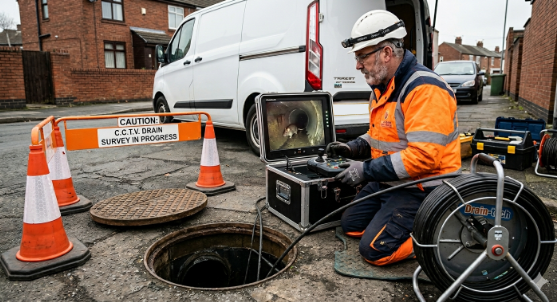
A drainage CCTV inspection is essentially an investigation into what is happening inside the hidden network beneath the property.
Specialist camera equipment is introduced into suitable sections of the drainage system, allowing the pipework to be examined internally.
Rather than relying on assumptions, the inspection can provide visual information about the condition of the pipes.
Depending on the findings, the survey may identify:
- Structural damage
- Cracks or fractures
- Separated joints
- Open connections
- Signs associated with rodent access
- Problems within branch lines
- Issues around junctions
- Other drainage abnormalities
The findings can then help determine whether further drainage work or pest management is appropriate.
This makes CCTV Drainage Surveys for Rats particularly useful when the source of an infestation is uncertain.
5. When Repeated Pest Treatment Is Telling You Something
Imagine treating a rat problem successfully, only to discover signs of rodents again weeks or months later.
It is tempting to assume that the new rats have simply appeared from somewhere else.
But recurring activity can also be a reason to look at the property differently.
If rodents repeatedly return to the same building, there may be an unresolved environmental factor giving them access.
This does not mean every recurring infestation is caused by drainage. Other possibilities include food sources, neighbouring properties, structural gaps, waste storage or changes in the surrounding environment.
A professional assessment can help narrow down the possibilities.
Where drainage is suspected, CCTV inspection provides a way to investigate the theory rather than repeatedly guessing.
6. How Professional Pest Control Fits Into the Bigger Picture
Effective rat management is not simply about removing a rodent from a building.
A professional Pest control service can assess the signs of infestation, determine the nature of the problem and recommend an appropriate treatment strategy.
However, treatment may only address the immediate issue.
If an accessible route remains, future rodents may eventually exploit the same weakness.
This is why pest management and property maintenance can work together.
A practical strategy may involve:
Assess the infestation → investigate possible access routes → inspect drainage where appropriate → treat active rodent activity → repair vulnerabilities → monitor the property.
The aim is to create a solution that considers both the present infestation and the conditions that could contribute to another one.
7. Why CCTV Inspection Can Save Unnecessary Disruption
Underground drainage is not easy to investigate manually.
Opening up large sections of ground before knowing where a problem exists can result in unnecessary disruption to gardens, driveways, floors or commercial areas.
A CCTV inspection can provide an initial view of the pipework from inside.
If a defect is discovered, its approximate location and nature can help inform decisions about subsequent work.
That does not mean every drainage defect can be resolved without excavation. Some repairs will still require physical access.
The advantage is that property owners can potentially make those decisions with better information.
8. A Rat Problem Can Become a Property Maintenance Warning
Rodent activity can sometimes reveal weaknesses that have gone unnoticed for years.
A property owner may never think about underground drainage until rats start appearing.
But once a problem is identified, the investigation can provide an opportunity to consider the wider condition of the drainage system.
This is particularly relevant for:
- Older residential properties
- Rental properties
- Commercial premises
- Restaurants and food businesses
- Warehouses
- Buildings with extensive underground drainage
- Properties with a history of rodent activity
In these situations, understanding the infrastructure can be an important part of maintaining the property.
9. What Can You Do to Reduce Future Rat Risks?
Professional treatment and drainage investigations are only part of prevention.
Everyday property management also matters.
Keep rubbish securely contained and avoid leaving food waste accessible. Check external areas for signs of rodent activity and deal with obvious structural gaps where appropriate.
If drainage defects have previously been identified, recommended repair work should be addressed rather than allowing the problem to remain unresolved.
It is also worth paying attention to recurring patterns.
If rats consistently appear near the same drain, wall or external area, that information can be useful to a pest professional when assessing the property.
Small clues can sometimes point towards a much larger underlying issue.
10. When Should You Investigate Your Drains?
A drainage survey may be worth considering when there is a clear reason to suspect that underground pipework is connected to the infestation.
Examples include:
- Rat activity repeatedly returns after treatment
- Rodents are frequently seen around drainage points
- A property has known drainage damage
- There is no obvious above-ground entry route
- Rats appear close to toilets or plumbing areas
- A building has old or poorly maintained drainage
- You want to understand the source before arranging further work
A professional assessment can determine whether CCTV drainage investigation is appropriate for the circumstances.
Conclusion: Find the Route, Not Just the Rat
A rat infestation is often treated as a problem that begins when the animal becomes visible.
In reality, the story may have started much earlier.
A hidden drainage defect could potentially provide rodents with an opportunity to move towards a property without anyone noticing. By the time a rat appears indoors, the access route may already have been established.
That is why investigating the source can be so important.
CCTV Drainage Surveys for Rats can provide a detailed look inside underground drainage and help identify defects or potential access points. Combined with professional Pest control, appropriate drainage repairs and sensible prevention, this can create a more complete strategy for protecting a property.
The most effective response to recurring rat activity is not always another round of treatment. Sometimes the better question is:
“What is allowing them to come back?”
Finding the answer could be the first step towards making the property far less welcoming to rats.