

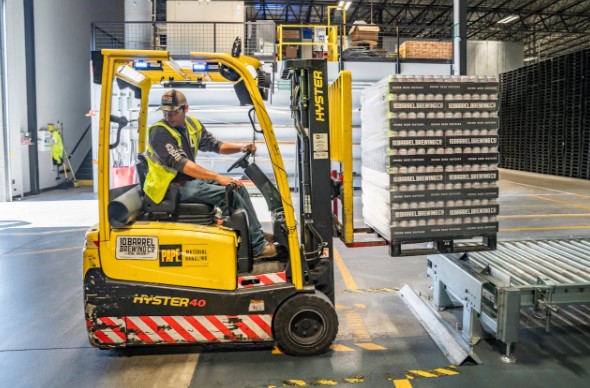
Industrial material handling has historically relied on administrative controls, training certifications, and painted walkways to separate high-tonnage equipment from floor personnel. During busy dock operations, these measures still leave safety dependent on how alert workers and operators remain throughout the shift.Heavy equipment and busy warehouse traffic make it harder to manage every hazard through operator response alone.
Audible warnings and convex mirrors can help workers and drivers stay aware of nearby activity, but they have limited information about the actual distance between a forklift and a person in a busy staging area. Noise from machinery and other equipment can also make repeated warning sounds less noticeable as the shift continues. Transitioning toward engineered Forklift Safety demands a departure from these passive systems in favor of active, automated intervention protocols.
The Failure of Unintegrated Sensor Silos
A forklift sensor only sees activity within its detection range. It does not track what is happening throughout the warehouse or show how people and vehicles move across the wider site. Information about repeated near-misses or frequently used pedestrian crossings remains outside its view. Operations directors are left managing isolated data sets that offer zero predictive value for layout optimization or incident prevention.
Real operational risk reduction requires deterministic physical separation mapped against the physical layout of the manufacturing facility. Without centralized telemetry linking vehicle movement to pedestrian locations, safety managers remain strictly reactive, investigating incidents only after capital damage or labor loss has occurred. Facilities need spatial positioning that ties directly into the equipment controller to enforce mechanical compliance.
Overcoming the Limitations of Basic Proximity with RTLS
Relying on basic Bluetooth RSSI tags for proximity warnings often yields broad three to five meter variances, which is sufficient for zone presence but wholly inadequate for precise collision avoidance. High-traffic choke points demand exact positional truth to prevent false positives from shutting down production pipelines unnecessarily. By upgrading the tracking stack to true RTLS spatial intelligence, safety directors eliminate the guesswork associated with fluctuating signal strengths.
Active Vehicle Governance via Edge Logic
Modern tracking architectures utilize Ultra-Wideband and advanced ranging hardware to establish sub-decimeter positional accuracy across dynamic indoor environments. By executing zero-latency edge logic directly on local hardware nodes, the tracking system computes intersection trajectories without relying on delayed cloud processing round trips. This architectural design ensures that safety interventions occur instantly, removing the human latency inherent in standard braking procedures.
Replacing Reaction Time with CANbus Integration
True industrial security materializes when this spatial intelligence integrates directly with the internal controller area network of the material handling equipment. Instead of triggering a flashing strobe, the tracking hardware issues direct CANbus commands to govern travel speed, restrict acceleration, or initiate a complete stop when a pedestrian breaches a defined safety perimeter. This closed-loop control mechanism actively prevents collisions by taking mechanical control before an operator even realizes a hazard exists.
Enforcing B1 Pedestrian Separation Standards
Meeting strict B1 pedestrian separation standards requires more than painted walkways and administrative reprimands for speeding violations. With a reverse RTLS setup, wearable locators and vehicle hardware exchange location information as they move through the facility. As the vehicle moves, its location is used to determine the area that needs protection. No manual zone adjustment is required from the supervisor.
Bridging the Gap with Digital Twin Visualization
Weekly reports often leave plant engineers working with older heatmap data when they need to understand problems happening on the floor right away. When safety directors mirror real-time positioning telemetry into a continuous three-dimensional digital twin, they unlock total situational visibility over hidden congestion patterns. These spatial models continuously expose unrecorded near-misses and unauthorized driver shortcuts long before a severe impact takes place.
Targeting Ghost Assets and Equipment Utilization
Failing to maintain strict visibility over material handling fleets inevitably leads to ghost assets and phantom inventory scattered across vast square footage. When drivers spend fifteen minutes per shift searching for a specific class of forklift, the resulting labor loss compounds into massive capital inefficiency by the end of the fiscal quarter. Tying precise telemetry to operational logic ensures that equipment utilization metrics reflect reality rather than optimistic assumptions.
Connecting these spatial coordinates to higher-level enterprise systems exposes exactly how physical layout constraints force drivers into risky maneuvering behaviors. Comparing vehicle movement records with production schedules can reveal issues such as too many assets kept in one area or staging lanes positioned in ways that restrict aisle space. Reviewing the floor layout and making suitable changes can reduce the conditions that lead to repeated safety concerns.
Tracking data from forklifts can give operations teams a better understanding of how vehicles move through the facility and where problems may occur. With continuous, two-way Forklift Tracking , teams can monitor vehicle locations more consistently and use that information to improve visibility across the plant floor.
Eliminating the Operational Drag of Preventable Incidents
LocaXion is the world’s first pure-play RTLS & Digital Twin systems integrator. We engineer systems for your business outcomes-not just “tracking.”
That means less risk, less integration of guesswork, and faster time-to-value. And because we’re not locked to one technology stack, you get the freedom to scale with the right technology – not the technology we happen to sell.
RTLS tracks your assets. LocaXion transforms how your operation runs.
That’s the difference. And it’s not a small one.
Stop relying on unintegrated sensor silos and passive alarm protocols and engineer your outcomes today at https://locaxion.com/