

Setting the context: two different questions
In practical machine learning, most problems can be framed as one of two questions.
- “Given this input, what is the correct label?”
- “Given this input (or even no input), can we create something new that looks realistic and useful?”
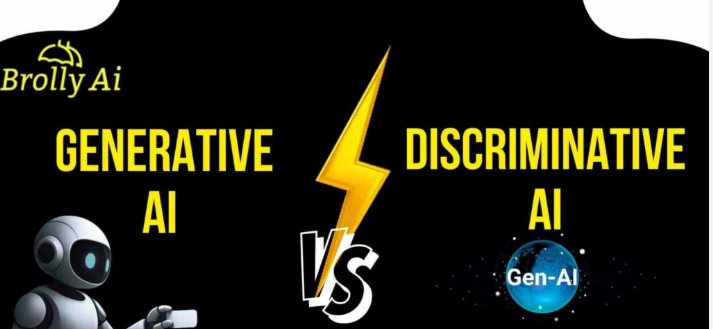
The first question is the core of discriminative AI. The second question is the core of generative AI. Both are valuable, but they are built for different outcomes and are trained and evaluated in different ways. If you are learning through a gen AI course, this difference is one of the most important foundations to get right early.
Discriminative AI: predicting labels by drawing boundaries
Discriminative models learn the relationship between inputs and target labels. Their job is to separate classes or predict a specific output variable as accurately as possible.
What discriminative models learn
A discriminative model focuses on learning a rule like: “Given X, predict Y.”
- X could be an email, an image, or a customer profile.
- Y could be spam/not spam, cat/dog, or churn probability.
In a classification setting, you can think of the model as learning a decision boundary. For example, with a simple spam filter, the model finds patterns in words, sender behaviour, and formatting that best separate spam emails from legitimate ones.
Typical examples
- Logistic regression, support vector machines, decision trees, random forests
- Most supervised deep learning classifiers
- Many “predictive analytics” systems (fraud detection, credit scoring, medical diagnosis support)
How success is measured
Discriminative models are usually evaluated using metrics tied to correctness of prediction:
- Accuracy, precision, recall, F1-score
- ROC-AUC for ranking/classification
- Mean squared error or mean absolute error for regression
The output is not “new data.” It is a label, a probability, or a numeric prediction.
Generative AI: modelling data to create new samples
Generative models aim to learn how data is distributed so they can produce new examples that resemble what they learned from. Instead of only predicting a label, they learn to generate data: text, images, audio, code, or structured outputs.
What generative models learn
A generative model tries to capture the underlying structure of the data itself. Informally, it learns: “What does realistic data from this domain look like?” That is why it can create a new paragraph, a new image, or a new synthetic record that follows learned patterns.
Modern generative AI is often built with large neural networks trained on massive datasets. In text generation, the model learns to predict the next token repeatedly, which produces coherent sequences over time.
Typical examples
- Large language models that generate text and code
- Image generators that produce new visuals from prompts
- Models used for data augmentation and synthetic data creation
If you are taking a gen AI course, you will often see that generative models can still be used for classification tasks, but their defining capability is producing new, plausible content.
How success is measured
Evaluation is more nuanced because “correctness” can be subjective depending on the use-case. Common approaches include:
- Human evaluation for usefulness and factuality (especially in text)
- Similarity and quality metrics for images (with caution)
- Task-based evaluation: does the generated output help a downstream goal?
- Safety checks: does it avoid harmful, private, or biased outputs?
A simple comparison through one example dataset
Imagine you have thousands of product reviews.
- A discriminative approach might answer: “Is this review positive or negative?”
Output: a sentiment label (positive/negative) and maybe a confidence score. - A generative approach might answer: “Write a helpful summary of the review” or “Draft a response to the customer.”
Output: new text that did not exist in the dataset, shaped by patterns the model learned.
So, discriminative AI is about deciding. Generative AI is about creating.
When to use which in real projects
Many teams make better decisions when they start with the outcome they need.
Use discriminative AI when:
- You need reliable classification or prediction
- The success metric is clear and measurable
- Mistakes have high cost, and you want stable, testable performance
Examples: fraud detection, defect classification in manufacturing, lead scoring.
Use generative AI when:
- You need content generation, summarisation, or transformation
- The output is open-ended (text drafts, code suggestions, creative variations)
- You benefit from rapid ideation or personalised responses
Examples: customer support drafting, document summarisation, synthetic training data generation.
In many real systems, the best design is hybrid: a generative model produces candidates, while a discriminative model ranks, filters, or validates them. This is a common pattern taught in a gen AI course, because it balances creativity with control.
Conclusion
Discriminative AI is built to predict labels or values by learning boundaries between outcomes. Generative AI is built to learn the structure of data so it can create new samples that resemble what it learned. Understanding this difference helps you choose the right approach, evaluate results properly, and design systems that are both useful and dependable. If you keep this foundation clear while studying a gen AI course, you will find it much easier to connect model capabilities to real business and product needs.