


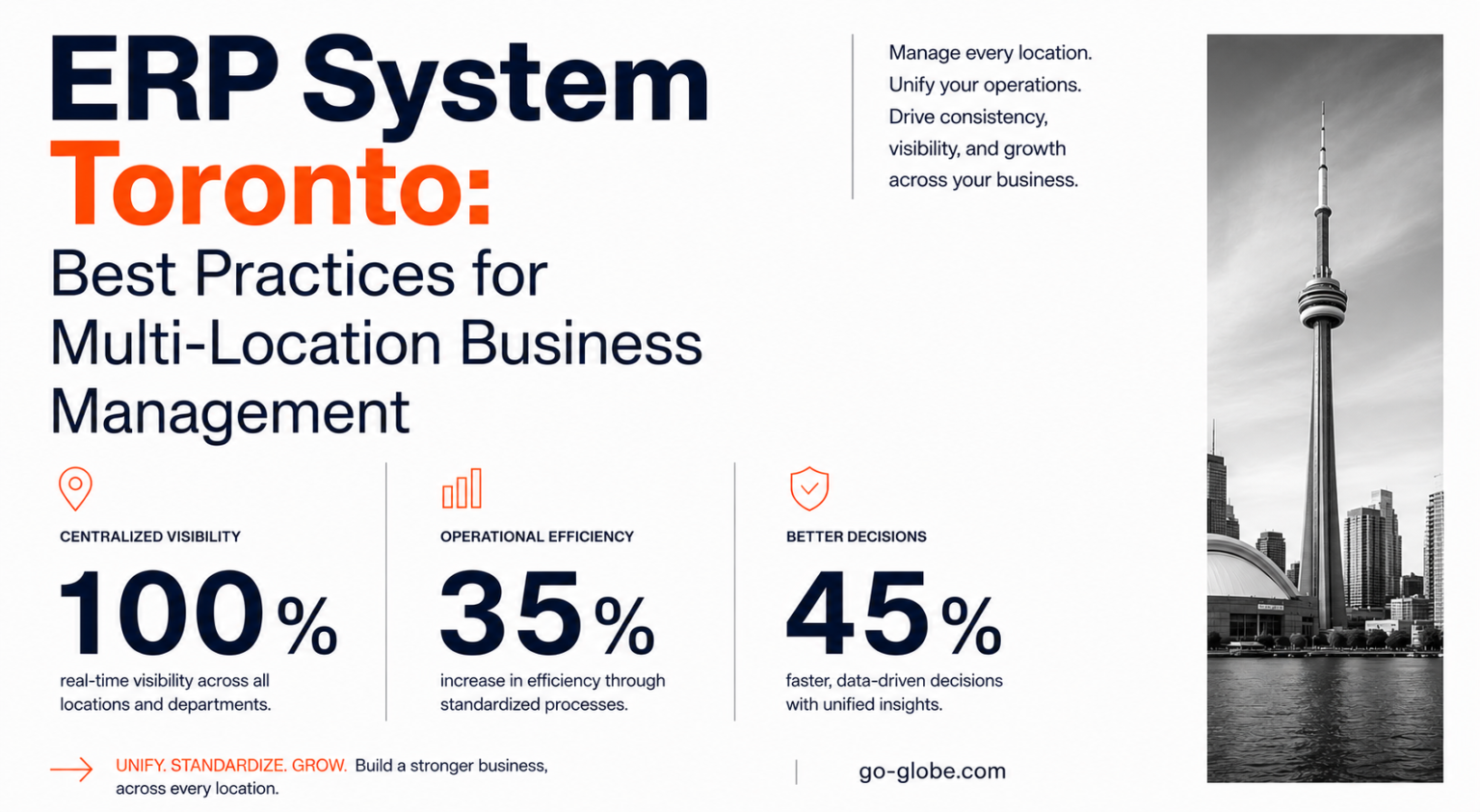
Running two locations of a single business is challenging enough. It is even more difficult to run more than one location at a time. They don’t have many in one store. Another has other sales numbers. Staff schedules clash. Reports arrive late. If you don’t have the proper tools, growth becomes chaos. This is why more Ontario businesses are getting an ERP system Toronto companies can use to run all of their operations from a single hub.
Today, in this blog post, we will explore why ERP is important for multi-location companies and discuss some best practices for making it work for you.
What is an ERP System Toronto Businesses Actually Need
ERP is an acronym for Enterprise Resource Planning. It is software designed to integrate various parts of a business such as finance, inventory, sales, and human resources into one system—all in one place, rather than having to use five different tools that don’t communicate.
This is even more crucial for a company with several branches. With a good ERP system Toronto companies utilize, the proprietors and managers will have a single view of the whole operation. No more guessing. No waiting for someone to send a spreadsheet via email. Simple real-time data.
Basic tools are enough for small businesses with just one business site. After a second or third location, however, things begin to get complicated quickly. Stock must be transferred from one location to another. Staff should have regular timetables. Financial staff must bring together figures from branches. An ERP system addresses all of these issues by combining them all into a single system.
Why Multi-Location Businesses Struggle Without ERP
Let’s be honest. There are a lot of businesses that expand without having a system. They start with spreadsheets. They add some applications. They employ more people to fill in the holes. It is effective, but only temporarily.
Then trouble begins.
There is a discrepancy in the number of items that are in the store and the warehouse. Sales reports can take days to put together. When hours are not being recorded in the same way across each of the branches, payroll can get a lot messy. Customer data exists in a variety of systems, and a given customer appears in five different forms.
Slow growth is experienced due to these problems. They also come with a price tag. Under-stocking or stock-outs are caused by poor inventory control. Hours are lost every week in manual reporting. Errors are caused by disconnected systems and cause frustration for staff and customers alike.
An ERP system resolves these problems by ensuring that each location has the same tools, the same data, and the same rules.
Best Practices for Managing Multiple Locations with an ERP System Toronto Teams Trust
Buying ERP software is only the first step. Using it well is what makes the difference. Here are the best practices that matter most.
1. Centralize Your Data From Day One
The biggest advantage of ERP is having one source of truth. Every location should feed data into the same system. Sales, inventory, payroll, and customer records should not live in separate tools.
When data is centralized, managers can compare performance across locations easily. They can spot which branch is doing well and which one needs help. This visibility is hard to get without a proper ERP system Toronto businesses can rely on.
2. Standardize Processes Across Locations
Every branch should follow the same basic processes. This includes how sales are recorded, how inventory is counted, and how returns are handled. If each location does things differently, your data becomes messy and hard to trust.
Standardization does not mean removing flexibility. Local managers can still adjust for local needs. But the core process, and the way data is entered into the ERP, should stay consistent.
3. Set Up Role-Based Access
Not every employee needs access to everything. A cashier does not need to see payroll data. A branch manager may not need access to company-wide financial reports. Setting clear roles and permissions keeps your system secure and reduces confusion.
Most modern ERP systems allow you to set custom access levels for each user. Take the time to set this up properly when you first implement your system.
4. Automate Routine Tasks
One of the biggest benefits of ERP is automation. Reordering stock, generating invoices, and creating reports can all happen automatically. This saves time and reduces human error.
For multi-location businesses, automation becomes even more valuable. Instead of manually checking stock levels at five different branches, the system can alert you when any location runs low. This keeps operations smooth without constant manual checking.
5. Train Your Staff Properly
Even the best ERP system will fail if staff do not know how to use it. Training should happen at every location, not just head office. Make sure every team member understands how to enter data correctly, since bad data in one location affects reports for the whole business.
Ongoing training also helps. As you add new features or update your system, staff need refreshers to keep using it effectively.
6. Choose the Right ERP Consultants Toronto Businesses Recommend
Setting up an ERP system is not simple. It involves choosing the right software, customizing it for your business, and training your team. This is why many companies work with experienced ERP consultants Toronto businesses recommend.
Good consultants understand your industry and your specific challenges. They help you avoid common mistakes, like choosing software that does not fit your business size, or setting up processes that do not match how your teams actually work.
Working with the right consultants can save months of trial and error, and help you get real value from your system much faster.
7. Plan Your ERP Implementation Toronto Companies Follow Step by Step
A successful ERP implementation Toronto companies rely on does not happen overnight. It takes planning. Here is a simple breakdown of the process:
- Assessment: Understand your current processes and where they break down.
- Software Selection: Choose an ERP system that fits your business size, industry, and budget.
- Customization: Adjust the system to match your specific workflows.
- Data Migration: Move existing data into the new system carefully, avoiding errors.
- Testing: Run the system in a test environment before going live.
- Training: Teach staff at every location how to use the new tools.
- Go-Live: Launch the system across all locations, with support ready for any issues.
- Review: Check performance after a few weeks and make adjustments as needed.
Rushing through any of these steps often leads to problems later. A careful, planned rollout gives your team the best chance of success.
8. Monitor Performance Regularly
Once your ERP system is running, do not just leave it alone. Check reports regularly. Look for patterns across locations. Are some branches consistently running low on stock? Are certain locations processing orders slower than others?
Regular monitoring helps you catch problems early, before they turn into bigger issues. It also helps you find opportunities, like which products sell best in which locations, so you can adjust marketing and inventory accordingly.
9. Keep Your System Updated
Software changes over time. New features get added. Security improves. Make sure your ERP system stays updated so you can take advantage of these improvements. An outdated system can slow down your operations and create security risks.
10. Gather Feedback from Every Location
Your head office is not the only place with useful insights. Branch managers and staff see daily challenges that head office may not notice. Create a simple way for staff to share feedback about the ERP system. This helps you improve processes and fix small issues before they grow.
Benefits of a Strong ERP System Toronto Businesses Can Expect
When done right, a strong ERP system Toronto businesses use brings real, measurable benefits:
- Better Visibility: See performance across all locations in real time.
- Improved Efficiency: Automate repetitive tasks and reduce manual work.
- Accurate Reporting: Get reliable numbers you can trust for decision-making.
- Stronger Inventory Control: Avoid stockouts and overstocking across branches.
- Consistent Customer Experience: Serve customers the same way, no matter which location they visit.
- Easier Scaling: Add new locations without rebuilding your systems from scratch.
These benefits add up over time, helping multi-location businesses grow with fewer headaches.
Common Mistakes to Avoid
Even with good intentions, businesses sometimes make mistakes when adopting ERP systems. Watch out for these common issues:
- Choosing software that is too complex for your business size. Bigger is not always better. Choose a system that matches your actual needs.
- Skipping proper training. Staff who do not understand the system will avoid using it correctly, leading to bad data.
- Rushing the implementation process. Trying to launch everything at once, without proper testing, often leads to costly errors.
- Ignoring feedback from branch staff. They see daily problems that the head office may miss.
- Failing to update the system regularly. Outdated software can create security risks and slow performance.
Avoiding these mistakes gives your business a much smoother path to success.
Why Professional Support Matters
Running an ERP system in multiple locations is a huge responsibility! It affects all aspects of your business: finance, stocking, staffing, etc. Whether it’s trusted ERP consultants Toronto or a committed implementation partner, expert guidance can mean the difference between a seamless implementation and a frustrating one.
The Professional Support doesn’t end after launch. All this maintenance, updates, and troubleshooting are important in the long run. Having a trusted partner is key to helping you fine-tune your system as your business evolves and expands.
Final Thoughts
Having many business locations doesn’t need to be daunting. The right ERP system Toronto firms can rely on gives them one image of what’s occurring. You save time. You reduce errors. You make quicker and better decisions.
The real secret is to select the appropriate system, plan it well, and then train your staff properly. Small steps properly taken make large strides over time.
When it comes time for your business to take the plunge into multi-location management, it can be a much easier process when you work with a team that is experienced in handling multiple locations. Businesses in Toronto have successfully planned, implemented, and managed ERP solutions through GO-Globe that provide them with the structure and efficiency needed for their complex multi-location operations.