


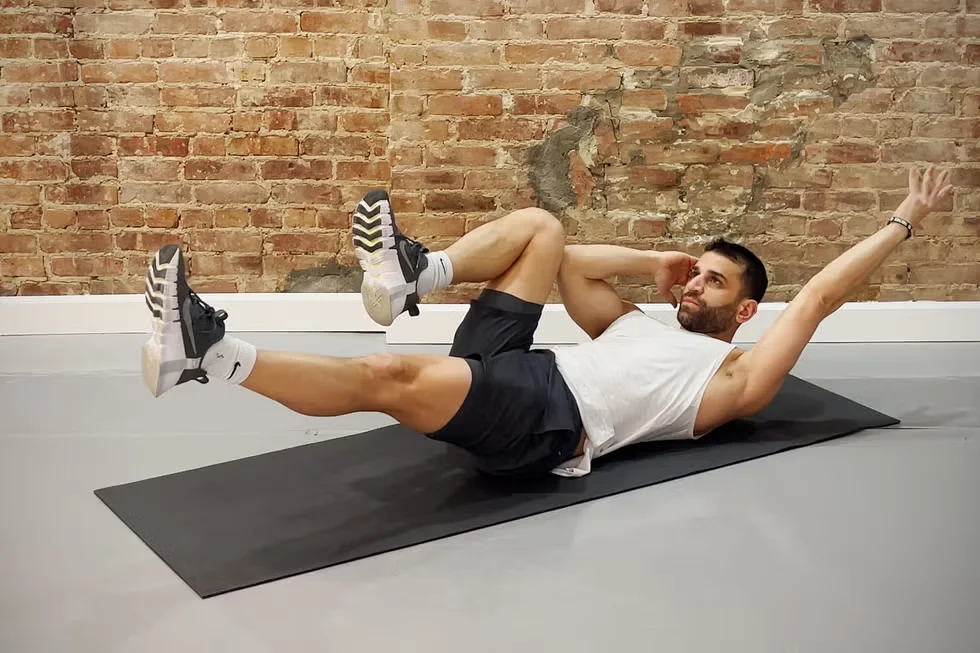
Stand near the finish of any half marathon and you can spot it. Runners who looked tall at mile two are folding at the hips by mile twelve, shoulders rolled forward, feet slapping the road. Their legs are tired, of course. A lot of that collapse starts in the trunk, though.
Most runners know they should “do core.” Fewer know what that work is meant to accomplish, which is why so much of it turns into a few rushed sets of crunches after a long run.
What Your Abs Do While You Run
Running is a long string of single-leg landings. Each time a foot hits the ground, your pelvis wants to drop on the opposite side and your torso wants to rotate with the swinging arm. Your abs, obliques and the deep transverse abdominis spend the whole run resisting those movements, so force from the ground travels up through a stable trunk instead of leaking out sideways.
So the job is mostly stability. The muscles hold position against forces trying to bend or twist you. Training that only curls the spine forward, rep after rep, misses most of what running asks for.
Three Patterns Worth Training
Anti-extension
This is the ability to keep your lower back from arching. It matters on downhills and in the late miles when your hips start to sag. Planks count, but only if you brace properly: ribs down, a slight tuck of the pelvis, a slow exhale before you hold. Once a 45-second plank feels easy, move to body saws or ab wheel rollouts instead of holding longer.
Anti-rotation
Your arms swing, your legs alternate, and your trunk has to stay square. The Pallof press trains this directly. Stand side-on to a cable or resistance band anchored at chest height, hold the handle at your sternum, press it straight out and resist the pull back toward the anchor. Two-second holds at full extension do more than fast reps.
Lateral stability
Side planks and suitcase carries train the obliques and hip muscles that stop your pelvis from dropping on each stride. A suitcase carry is simple. Hold one heavy dumbbell or kettlebell at your side and walk about 40 steps without leaning toward it, then switch hands. If you lean, the weight is too heavy.
A 15-Minute Routine for Easy Days
Core work fits best after easy runs. Avoid it right before speed sessions or long runs, when you want your trunk fresh. Two or three sessions a week is plenty for most runners.
- Dead bugs: 3 sets of 8 slow reps per side
- Pallof press: 3 sets of 10 per side, with a two-second hold
- Side plank: 3 holds of 20 to 30 seconds per side
- Suitcase carry: 3 walks per hand
The dead bug deserves a note. It teaches you to keep your lower back still while your arms and legs move, which is close to what a running stride demands.
Progress It Like You Progress Mileage
Runners understand gradual overload better than most athletes. Nobody jumps from 20 miles a week to 50. Core training works the same way, and it stalls for the same reason running does: repeating the identical session for months.
Change one variable at a time. Add load to the carry. Slow the tempo on dead bugs. Lengthen the lever on a plank by walking your elbows further forward. Then keep that new version for a few weeks before touching anything else. Piling on reps rarely fixes a plateau, because high reps mostly build endurance in a movement you already own.
Gym or Living Room?
Bodyweight work gets you started. Dead bugs, planks and side planks need nothing but floor space. The catch is that progression gets harder without equipment. A cable station makes anti-rotation work easy to load, and a rack of dumbbells means your carries can keep getting heavier as you get stronger.
For a wider menu of gym and home options, the core training breakdown from TruFit Athletic Clubs (https://trufitathleticclubs.com/blog/ab-workouts-that-actually-work/) sorts exercises by movement pattern and includes beginner progressions. That layout makes it easy to pick one or two moves per pattern and stay with them.
Mistakes That Waste the Effort
Speed is the most common one. Fast reps feel productive but let momentum do the work. Swinging through hanging leg raises, yanking your head forward on crunches and holding a plank with your hips sagging toward the floor all fall into the same trap.
Timing is the second. A hard core session right before intervals leaves your trunk tired at the exact moment you need it.
The third is expecting visible abs from this work. Definition depends far more on nutrition and body composition than on ab exercises. What core training gives a runner is a torso that keeps its shape when the legs start to fade.
How to Tell It Is Working
Don’t expect much in the first two weeks. Around the four to six week mark, start checking a few things. Does your posture hold in the last third of a long run? Do steep downhills feel steadier? Does the hip drop on your tired side look less obvious in race photos or a quick phone video?
Those are the changes worth tracking. They tend to show up well before anything changes in the mirror, and they are the ones that make mile twelve feel more like mile two.