

Key Takeaways
- Comfortable jeans should work when you stand, sit, walk, and bend.
- Rise, leg shape, stretch, waistband fit, and inseam all influence how denim feels.
- Body measurements and brand size charts are more useful than relying on one size label.
- Current denim offers room for straight, relaxed, wide-leg, bootcut, and slim silhouettes.
- The best pair supports your routine and personal style, not just a passing trend.
Table Of Contents
- Why Jeans Fit Matters More Than Trends
- Take Four Useful Measurements
- Choose A Rise That Feels Natural
- Compare Common Leg Shapes
- Check Stretch And Fabric Feel
- Find The Right Length For Your Shoes
- Spot Common Fit Problems
- Build A Practical Denim Wardrobe
- Care For Jeans So They Keep Their Shape
- Use A Simple Final-Fit Checklist
- Conclusion
The right jeans should feel dependable from the first coffee run through the end of the day. A flattering wash or current silhouette can be appealing, but the pair you reach for repeatedly is usually the one that stays comfortable while you move through real life.
Torrid is a women’s apparel brand with a curve-focused denim collection that lets shoppers compare rises, fits, stretch levels, and inseam options. Its online jeans selection serves customers across the United States, and shoppers seeking curvy jeans in sizes 10–30 can use those filters to narrow choices based on the fit details that matter most.
1. Why Jeans Fit Matters More Than Trends
Jeans can carry an outfit, but they should not require constant adjusting. The same tagged size may fit differently between brands because patterns, fabric blends, rises, and intended silhouettes vary. Start with how the jeans feel at the waist, seat, and thighs, then decide whether the look suits your wardrobe.
Many 2026 denim trends make space for classic straight legs, streamlined slim cuts, bootcut shapes, and relaxed proportions. That range is useful because a travel day may call for a flexible relaxed fit, while a darker straight-leg pair may better suit an office or dinner plan.
2. Take Four Useful Measurements
Measure before shopping when possible. Take your waist measurement where you prefer the waistband to sit, measure the fullest part of your hips, and measure the inseam from the crotch seam to the preferred hem point. For rise, measure from the crotch seam up to the top of the front waistband on a pair you already like.
Compare those numbers with each brand’s size chart rather than assuming your usual size will translate exactly. Hemming length is generally simpler than correcting a waistband, seat, or thigh fit, so prioritize a comfortable fit through those areas first.
3. Choose A Rise That Feels Natural
Rise describes where the waistband sits on the body. High-rise jeans sit closer to the natural waist and offer more midsection coverage. Mid-rise styles usually sit between the hips and waist, making them an easy everyday option. Low-rise jeans sit lower on the hips and can work well with longer tops or relaxed outfits.
There is no universally correct rise. The best one stays in place while sitting and walking, without pinching, rolling, or creating pressure at the waistband.
4. Compare Common Leg Shapes
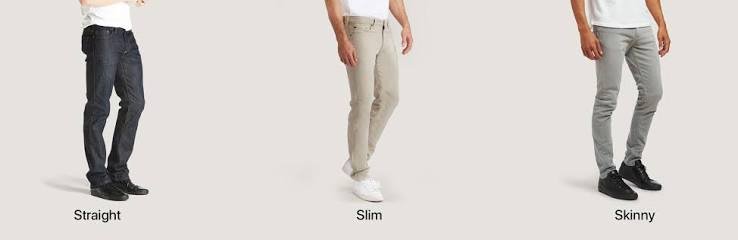
- Straight-leg: A balanced, versatile shape for sneakers, loafers, and boots.
- Skinny: A close fit that works well with oversized knits, tall boots, and long layers.
- Bootcut: A subtle opening below the knee that accommodates boots and heeled shoes.
- Flare: A stronger leg opening that often pairs nicely with fitted tops and platforms.
- Wide-leg: A roomy silhouette with movement, often styled with tucked shirts or shorter jackets.
- Boyfriend or relaxed: Casual cuts with more ease through the hip and thigh.
- Barrel-leg: A curved, fashion-forward option for those who want something beyond a standard straight cut.
5. Check Stretch And Fabric Feel
Rigid denim has little or no stretch and may soften as it is worn. Comfort-stretch denim has some give for easier movement, while high-stretch denim feels more flexible from the start. Check the fabric label, then test the jeans by sitting, bending, climbing a step, and walking around.
Jeans should feel secure without painful pressure. If stretch denim feels loose in the fitting room, it may not become more supportive with wear. If rigid denim feels sharply restrictive, sizing up or choosing a roomier cut may be the better choice.
6. Find The Right Length For Your Shoes
Cropped and ankle lengths show more of the shoe. Regular, tall, and extra-long lengths create different proportions and work with different footwear. Try jeans with the shoes you expect to wear most often. A small break at the hem can look classic, while a clean ankle hem can feel more polished. Extra-long hems can create a current look, but they should not drag underfoot.
7. Spot Common Fit Problems
- Waist gap: Try a cut that better matches your waist-to-hip proportion.
- Pulling across the hips: Look for a larger size, more thigh room, or added stretch.
- Extra fabric at the knees: Consider a shorter inseam or a different leg shape.
- Waistband rolling: The rise may be too short, tight, or poorly positioned for you.
- Loose seat: A different cut or smaller size may offer better support.
- Restricted movement: Choose more ease through the thighs or a more flexible fabric.
8. Build A Practical Denim Wardrobe
A small, useful denim rotation is often better than several random pairs. Begin with one comfortable everyday jean, add a dark wash for more polished outfits, and consider a relaxed or wide-leg pair for casual days. Add a trend-led shape only if it works with the tops and shoes you already wear.
If your wardrobe includes flats, boots, and heels, different inseams may make more sense than trying to force one pair to do every job.
9. Care For Jeans So They Keep Their Shape
Follow the care label, especially for jeans with stretch fibers. High heat can be hard on elastic materials, so air drying or using lower heat can help preserve the original feel. When jeans are not visibly dirty, washing less often may help protect color and reduce wear. Turn denim inside out before washing to limit surface abrasion, then reassess the fit after several wears because some fabrics relax over time.
10. Use A Simple Final-Fit Checklist
- Does the waistband stay comfortable without sliding or digging in?
- Can you sit, bend, and walk normally?
- Does the seat lie smoothly without sagging or strong pulling?
- Do the thighs have enough room for daily movement?
- Does the leg shape work with your intended shoes?
- Does the hem create the crop or break you want?
- Would you still want to wear these after several hours?
Conclusion
The best jeans are not defined by one trend, size label, or body type. A strong choice combines a comfortable rise, a useful leg shape, suitable stretch, and a length that works with your actual outfits. Treat fit as a personal tool, then use seasonal denim inspiration as a starting point rather than a rule.