

The terminology confusion between chest of drawers and dresser in the Australian children’s furniture market has persisted into 2026, and it continues to produce purchasing decisions that do not match what the Australian family actually needs. Understanding exactly what each term means in the Australian market context — and how the two products differ in function, size, and suitability for different Australian children’s bedroom stages — gives Australian families the clearest framework for the chest of drawers Australia decision. This September guide provides the complete 2026 Australian clarification.
The Australian Terminology Problem
Why is the chest of drawers vs dresser terminology confusing in the Australian market?
The Australian furniture market uses chest of drawers and dresser inconsistently across retailers, with the same product described by both terms depending on the retailer’s preference, country of origin, and marketing context. The British influence on Australian furniture terminology uses chest of drawers as the primary term for all drawer-based storage units regardless of height or configuration. The American influence uses dresser specifically for the wider, lower unit often featuring a mirror or hutch above the drawer section. The result in the Australian children’s furniture market is that a parent searching for a ‘dresser’ may find anything from a mirror-topped wide unit to a standard narrow chest, and a parent searching for a ‘chest of drawers’ may encounter the same range under a different name. The practical solution for Australian families is to assess each product by its specific dimensions, drawer count, and feature set rather than by the label the retailer has applied.
Functional Definitions for Australian Families
How should Australian families define chest of drawers and dresser by function rather than name?
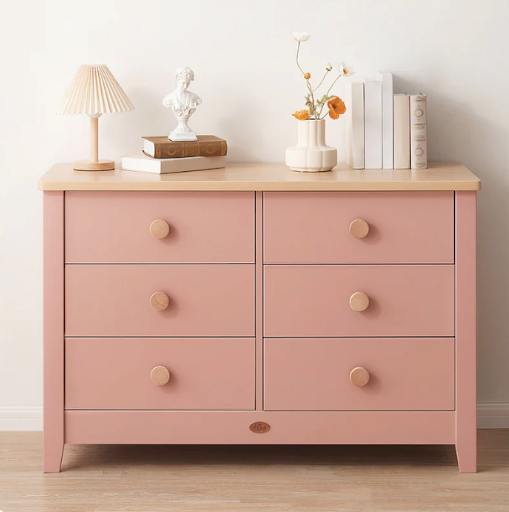
For Australian children’s bedroom purchasing purposes, the most useful functional definitions are: a chest of drawers is a vertical stack of drawers without a mirror or hutch attachment, in a width of 60 to 100 cm and a height of 80 to 120 cm, serving purely as closed clothing and item storage; a dresser is a wider, lower unit at 100 to 130 cm width and 80 to 100 cm height, often with a mirror or open shelving display above the drawer section, providing both storage and a dressing or display surface. The chest of drawers is the more practical choice for most Australian nurseries and children’s bedrooms where maximum storage per floor space is the priority. The dresser is the more practical choice for older Australian children’s bedrooms where a dressing mirror and display surface add function beyond the chest’s pure storage role.
| Feature | Chest of Drawers (AU) | Dresser (AU typical) | Best Choice for Australian Context |
| Typical width | 60-100 cm | 100-130 cm | Chest: compact AU bedrooms; dresser: larger AU rooms |
| Typical height | 80-120 cm | 80-100 cm + mirror/hutch | Chest: higher storage per sqm; dresser: display function |
| Mirror or hutch | No | Often yes | Dresser: adds dressing function for older AU children |
| AU nursery change top | Yes — most at correct height | Sometimes — confirm height | Chest: better for AU nursery change function |
| Storage capacity per AU sqm | Higher — narrower footprint | Lower — wider footprint | Chest: better AU storage efficiency |
| Aesthetic coherence (suite) | Matches most AU bedroom suites | Creates focal feature | Context-dependent for AU families |
| Post-nursery utility | Full clothing storage indefinitely | Full clothing storage + display | Both serve full AU primary school years |
The Australian Terminology Across States
Does the chest of drawers vs dresser terminology differ across Australian states?
The terminology variation in Australian children’s furniture is not strongly state-based — it reflects the specific retailer’s conventions and the brand’s country of origin marketing language rather than regional Australian usage differences. However, Australian families who grew up with British-influenced furniture terminology (more common in Victoria and South Australia) tend to default to chest of drawers for all drawer storage units, while Australian families with stronger American cultural influences (more common in Queensland and Western Australia through American media) may use dresser as the default term regardless of the specific product’s mirror or hutch configuration. When communicating with Australian retailers, describing the specific piece by dimensions and features rather than name produces the most accurate product matching.
What Australian Nurseries Need: The Case for the Chest
Why is a chest of drawers typically the better Australian nursery choice over a dresser?
The Australian nursery context favours the chest of drawers over the dresser for three specific reasons. First, the change top function: a quality Australian chest of drawers at 80 to 90 cm height provides the correct ergonomic change surface height for the waterproof change mat that converts it to a changing dresser — a function the wider, lower dresser configuration may not provide at the correct ergonomic height for Australian parents. Second, the mirror safety concern: a dresser with a mirror attached is positioned at a height and proximity where an Australian toddler in the active climbing stage at 12 to 24 months can reach and potentially dislodge the mirror, creating a breakage and injury risk that the mirror-free chest of drawers does not present. Third, floor space efficiency: the chest of drawers’ narrower footprint provides more clothing storage per square metre of Australian nursery floor space than the wider dresser, which is the more practically relevant metric in compact Australian nurseries.
What Australian Primary School Bedrooms Need: The Case for the Dresser
When does the dresser become more appropriate than a chest of drawers for an Australian child?
The dresser becomes more appropriate than a chest of drawers for Australian children at approximately age eight to ten, when three changes in the Australian child’s bedroom needs coincide. First, the nappy changing function that made the chest’s flat top the primary specification is long past. Second, the Australian child’s growing interest in personal grooming and self-presentation makes a dressing mirror a genuinely used functional addition rather than an unused decorative feature. Third, the Australian child’s bedroom aesthetic ambitions have grown to a point where the dresser’s more substantial visual presence creates the furnished, complete bedroom aesthetic that older Australian primary school children often want. For Australian families who have used a chest of drawers through the nursery and early primary years, upgrading to a dresser at the upper primary stage is a common and appropriate transition.
Frequently Asked Questions
Is a tallboy the same as a chest of drawers in Australia?
A tallboy in the Australian furniture market refers specifically to a narrower, taller drawer unit of five to seven drawers at a height of 110 to 140 cm and a width of 45 to 60 cm — narrower and taller than a standard Australian chest of drawers. The tallboy provides more drawer storage per unit of floor width than a standard chest, making it the preferred choice for small Australian children’s bedrooms where wall width is limited but ceiling height provides adequate vertical storage space. Both the tallboy and the standard chest serve the same fundamental clothing storage function; they differ in footprint profile rather than function.
Can an Australian chest of drawers double as a room divider in a shared children’s bedroom?
A low Australian chest of drawers of 60 to 80 cm height can function as a practical soft room divider in a shared Australian children’s bedroom, creating a physical boundary between the two children’s personal zones without the visual weight of a full-height partition. The chest provides the front-facing storage function on one side and a physical barrier on the other, delineating the two Australian children’s individual spaces. Confirm the specific chest’s structural stability in a freestanding non-wall-adjacent position before using it as a room divider, and wall-anchor it even in this central position if the Australian children are under seven years of age.
What is the best drawer organisation system for an Australian children’s chest?
The most effective drawer organisation system for an Australian children’s chest of drawers assigns one clothing category to each drawer with a clear visual label — a picture label for pre-reading Australian children, a text label from approximately Year 1 — showing exactly what belongs in each drawer. The vertical file-fold method for storing clothing — folding items so they stand vertically rather than stacking horizontally — allows every item to be visible when the drawer is opened, eliminates the ‘buried item’ problem of horizontal stacking, and makes the end-of-laundry put-away process straightforward enough for Australian primary school children to manage independently from approximately age seven.
Does an Australian children’s chest of drawers need to be a specific distance from the cot?
There is no specific required distance between an Australian children’s chest of drawers and a cot under Australian safety standards. The practical positioning consideration is that the chest — particularly when used as a changing dresser — should be positioned with the nappy storage and wipes within arm’s reach of the change surface on the chest top, typically meaning all changing supplies are stored in the top drawer or on an open shelf immediately below the change surface. The chest should not be positioned such that reaching for supplies during a nappy change requires the Australian parent to move away from the baby on the change surface at any point during the change.
Final Thoughts
The Australian chest of drawers versus dresser decision in 2026 is most clearly resolved by function rather than name: Australian nurseries and young children’s bedrooms favour the chest for its change top compatibility, floor space efficiency, and mirror-free safety; older Australian children’s bedrooms favour the dresser for its mirror, display surface, and more furnished aesthetic. Australian families can compare current options at boori.com.au/collections/dresser