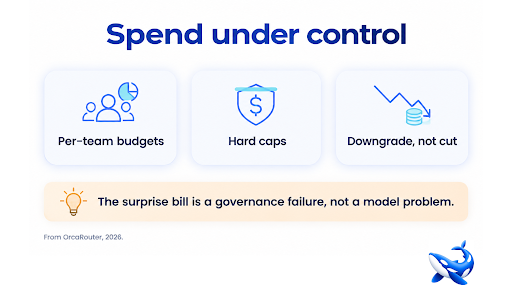
The surprise LLM bill is the most common cost failure in production AI. It is rarely one big mistake — it is a runaway process, an uncapped batch job, or a team that switched to a more expensive model without telling anyone. An AI router turns cost control into governance: per-team budgets, hard caps, and behaviour that degrades gracefully instead of cutting service. OrcaRouter is one platform built around this pattern.
Budgets, not just rates
Rate cards tell you what a token costs; they do not tell you what your team spends. Budgets are where the real control happens. A router can carry per-team budgets and per-project limits, so the question “how much did this feature cost” has an answer that is a report, not a mystery.
When a team’s spend approaches its ceiling, the router has a decision to make. The graceful option: downgrade to a cheaper model for that team’s tolerant traffic, keeping the service alive while slowing the burn. The firm option: hard cap, block, and log. Both are better than the alternative — discovering the overage on the invoice.
Why this is a router problem
Cost control in code does not scale. Every team re-implements its own accounting, its own limits, its own idea of “cheap enough”. The router centralises it: one set of budgets, one set of caps, one view of spend across every model and every service. When a model’s price rises, the router can re-balance traffic away from it globally, not per-team.
That is the governance story: the router is where spend policy lives, and policy changes are configuration rather than code.
The budget line that matters
The most useful budget decision is not which model is cheapest but which traffic is tolerant. If every call goes to the frontier model because nobody configured a rule, the router saves nothing. The teams that report real savings are the ones that decided, explicitly, which of their workloads can run on a cheap model — and then let the router enforce it. That is the difference between a discount and a policy: a router with no rules is just a proxy; a router with cheap-first rules and per-team budgets is a cost-control system. Set the rules before you need them, and the surprise bill stops being a recurring event and becomes a resolved one.
From surprise to budget
The difference between a surprise bill and a budget is whether anyone decided, in advance, what the spend should be. A router makes that decision explicit: per-team budgets, per-project caps, and a graceful path when the limit is hit. The first month on a router is usually the first month a team can answer “what did we spend on models, and where did it go” without a spreadsheet. That is the governance win, and it compounds — because the teams that can see their spend are the ones that control it, and the ones that control it rarely get the surprise bill again.
A concrete budget example
A simple example makes it concrete. A team sets a monthly model budget of $2,000 across three projects. The router carries per-project caps: $800 for the customer-facing project, $700 for the batch pipeline, $500 for experiments. When the batch pipeline spikes and hits its cap, the router downgrades its tolerant calls to a cheaper model rather than cutting it off, and the spike does not eat the customer-facing project’s share. Without the caps, the spike would have arrived as one merged bill and one argument about who caused it. Budgets are not bookkeeping; they are how a team keeps spend predictable.
The difference between a rate and a budget
A rate card tells you what a token costs. A budget tells you what your product is allowed to cost. The confusion between the two is why so many teams discover their model spend on the invoice rather than in the planning: they negotiated the rate and never set the budget. A router is where the budget lives — per-team, per-project, with a cap that has real behaviour attached to it. When a cap is reached, the router does not just stop the service and surface an error; it degrades gracefully, routing the tolerant traffic to a cheaper model so the service stays up while the spend slows. That is the difference between a spending ceiling and a wall. A wall is a failure; a ceiling with a downgrade path is control.
The other half of the budget story is visibility. A team cannot control what it cannot see, and most teams cannot see their model spend in any useful form until the bill arrives. The router records every call — model, tokens, cost — so the question “what did this feature cost this month” has an answer that is a report, not a guess. Per-team breakdowns turn monthly reconciliation into a five-minute task instead of an afternoon of cross-referencing vendor dashboards. And when a team’s spend trends up, the router’s data shows it before it becomes a problem, so the budget can be adjusted deliberately rather than reactively.
Budgets also change behaviour. A team that knows it has $500 for experiments behaves differently from a team that thinks it has “as much as it needs.” The router’s per-team caps make that constraint visible and enforceable, and the downgrade path makes the constraint survivable. That is governance that works because it is in the infrastructure, not in a policy document nobody re-reads.
The takeaway
Cost control is governance, and an AI router is where it lives: per-team budgets, hard caps, and graceful downgrade instead of service cuts. The surprise bill is a governance failure, not a model problem — and it is preventable the moment spend policy exists in one place. For teams running LLMs at any real scale, that is worth more than a cheaper rate card.
Sourcing note: this article describes the AI-router category and OrcaRouter’s implementation. Per-team budgets, hard caps and downgrade-on-limit behaviour are OrcaRouter’s own published descriptions, checked August 2026.