


When people talk about growing a SaaS business, the conversation usually revolves around getting more customers. More traffic, more signups, more revenue. While those things are important, they only tell part of the story.
Real growth isn’t just about bringing people in. It’s about making sure your business can continue delivering a great experience as it gets bigger. If your support team is overwhelmed, your marketing budget is being wasted, or your employees are buried in repetitive work, adding more customers can actually create more problems than opportunities.
The SaaS companies that grow steadily over time often have one thing in common: they build systems before they desperately need them. Instead of constantly putting out fires, they create processes that make the business easier to run every month.
Here are a few practical ways to make that happen.
Stop Reinventing the Wheel
Every growing company reaches a stage where the same questions come up again and again.
How should support respond to a common issue?
Who approves new feature requests?
What’s the process for launching a new update?
If every employee answers those questions differently, work slows down and mistakes become more common.
Documenting your workflows doesn’t have to be complicated. A shared knowledge base or a few simple guides can save hours every week. It also makes onboarding new team members much smoother because they don’t have to rely on someone else’s memory to learn how things work.
Small improvements like these often make a bigger difference than adding another software subscription.
Let Automation Handle the Boring Stuff
Your team’s time is valuable, so don’t spend it on tasks that software can complete in seconds.
Sending welcome emails, updating customer records, assigning support tickets, creating recurring reports, and organizing internal documentation are all tasks that can often be automated.
Many SaaS businesses are now adopting enterprise AI solutions to take this even further. These tools can summarize customer conversations, organize internal knowledge, draft documentation, and route requests to the right people automatically.
The goal isn’t to replace employees. It’s to remove repetitive work so they can focus on solving problems, helping customers, and building better products.
Pay Attention to the Numbers That Matter
One of the easiest mistakes SaaS companies make is measuring everything.
Modern analytics platforms can generate hundreds of reports, but looking at more dashboards doesn’t automatically lead to better decisions.
Instead, ask a simple question:
“Which numbers actually tell us if we’re getting healthier as a business?”
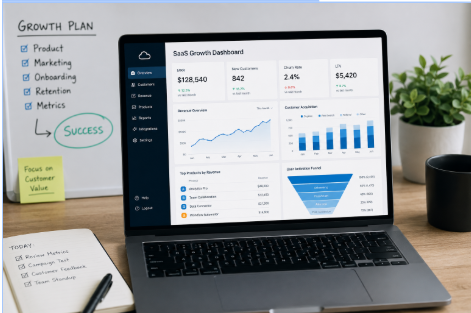
For many SaaS companies, that means keeping a close eye on metrics like:
- Monthly recurring revenue (MRR)
- Customer churn
- Customer lifetime value
- Trial-to-paid conversion rate
- Customer acquisition cost
When everyone understands which metrics matter most, it’s much easier to prioritize the right projects.
Don’t Assume Every Campaign Worked
Marketing reports can sometimes be misleading.
A campaign may appear successful because conversions increased, but would those customers have signed up anyway?
That’s why more SaaS marketing teams are using incrementality testing. Instead of assuming every conversion came from an ad, controlled experiments help measure whether a campaign actually influenced customer behavior.
That extra layer of insight helps companies spend their budgets more wisely instead of simply rewarding whichever campaign receives the last click.
Make Your Product Easy to Learn
Even the best software loses customers if people struggle during their first week.
A smooth onboarding experience can have a bigger impact on retention than adding another feature.
Simple improvements include:
- Interactive product walkthroughs
- Short tutorial videos
- Helpful tooltips
- Searchable help centers
- Quick-start checklists
When customers experience value early, they’re much more likely to stay.
Help Your Teams Share What They Know
As companies grow, departments naturally become more specialized.
Sales hears customer objections.
Support understands recurring issues.
Marketing sees changing trends.
Product teams know what’s being built next.
If those insights stay inside individual teams, everyone misses opportunities.
Regular conversations between departments—even a short meeting each week—can uncover ideas that improve customer experience, reduce duplicated work, and help everyone make better decisions.
Give Your Team More Time to Think
One of the biggest advantages of modern software isn’t simply speed—it’s creating space for better thinking.
Instead of spending hours preparing reports or manually organizing information, employees can focus on strategy, customer relationships, and product improvements.
That’s where AI productivity becomes valuable. It isn’t about working longer hours or trying to replace people with technology. It’s about helping talented employees spend less time on repetitive administrative work and more time on the creative, high-impact tasks that actually move the business forward.
Over time, those small time savings add up to a much more agile company.
Growth Is Built One Improvement at a Time
It’s easy to believe that scaling requires a major breakthrough or a dramatic change in strategy.
In reality, sustainable growth usually comes from dozens of small improvements.
A smoother onboarding flow.
A better support process.
Smarter reporting.
More thoughtful marketing decisions.
Clearer communication between teams.
Each change may seem minor on its own, but together they create a business that’s easier to manage, easier to scale, and far more enjoyable for both employees and customers.
Conclusion
Growing a SaaS company doesn’t have to mean adding more complexity. The strongest businesses focus on improving the way they work before they focus on working harder. By building reliable systems, making informed decisions, and continually refining everyday processes, SaaS companies can create steady, sustainable growth that lasts well beyond their next milestone.