

You pick up a jar of cream in the store, turn it over, and find a long string of Latin words in tiny print. You put it back on the shelf, a little puzzled, with no clear idea of what you were about to put on your face. That list isn’t a secret code, though.
It’s called the INCI list, an international naming system that labels every ingredient the same way worldwide. Once you know its rules, it becomes one of the most useful tools you have for choosing a face moisturizer with confidence. Here’s how to read it step by step, and what a Quebec-made formula can add to your decision.
What Your Face Moisturizer Label Is Telling You
A Shared Naming System
INCI stands for International Nomenclature of Cosmetic Ingredients. In Canada, cosmetic regulations require the ingredients to appear on the packaging using these standardized names. That means you can see a product’s full composition, no matter the brand.
Latin and English Names
Plant-derived ingredients appear under their Latin botanical name, including the plant’s genus and species. Most other ingredients are listed in English. Water, for example, usually shows up as “Aqua” or “Water.”
How to Read an INCI List in Four Steps
1. Start With the First Ingredients
Ingredients are listed in descending order of concentration. The first five or six make up most of the formula, so they give you a good sense of its texture.
In a moisturizer, you’ll often see water or a floral water near the top, followed by plant oils and butters. A rose floral water, for example, may appear as “Rosa Damascena Flower Water.”
2. Decode the Botanical Names
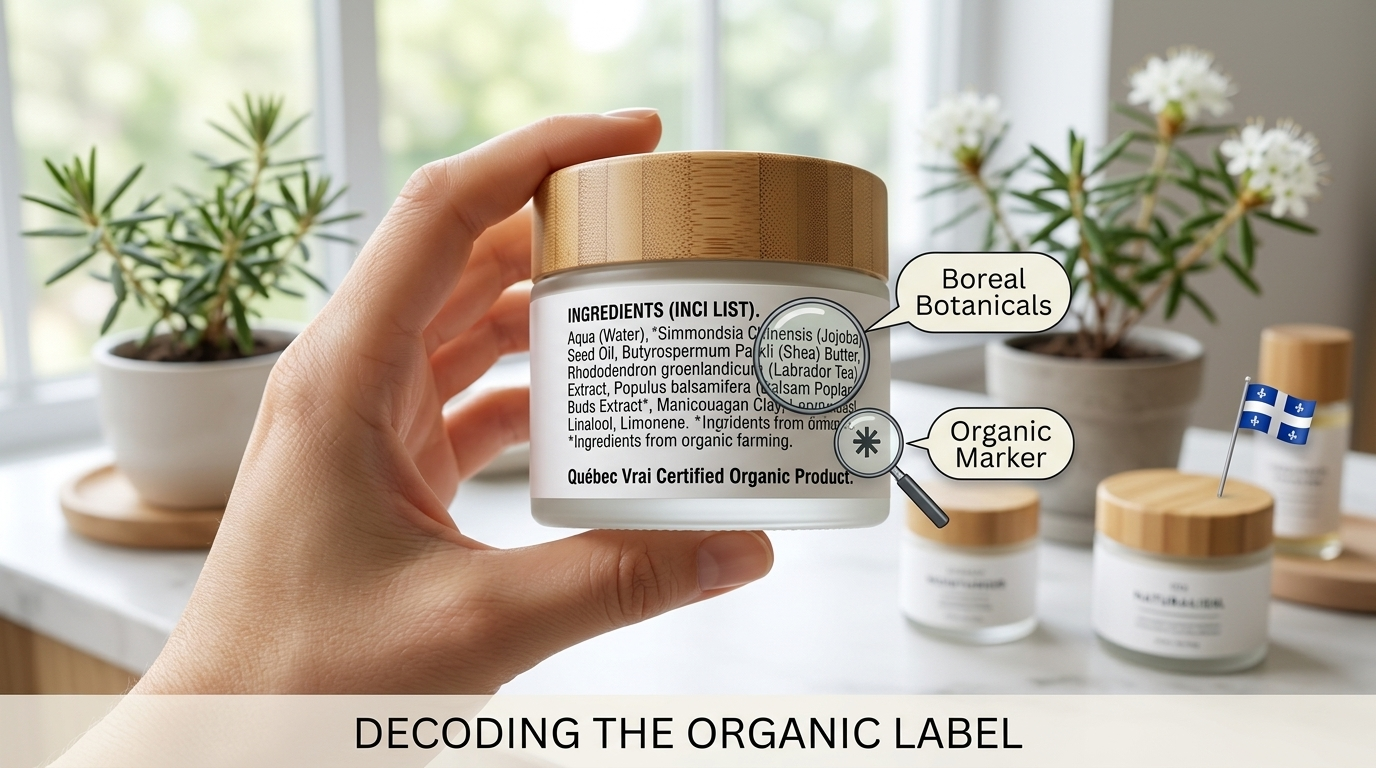
The Latin name tells you exactly which plant was used. “Butyrospermum Parkii Butter” is shea butter, while “Simmondsia Chinensis Seed Oil” is jojoba oil.
It also specifies the plant part, whether it’s the seed, flower, leaf, or root. This detail helps you understand where each natural skincare ingredient in the formula comes from.
3. Look for Organic Markers
On an organic face moisturizer, you’ll often see an asterisk next to certain ingredients. A note at the bottom of the list then explains which ones come from organic farming, and sometimes what share of the total formula is natural or organic.
Keep in mind that organic certification is granted product by product. In Quebec, for example, Québec Vrai certification applies to a specific product rather than to an entire line, so it’s worth checking each label.
4. Read the End of the List
Ingredients present at 1% or less can be listed in any order after the others. That’s often where you’ll find essential oils, plant extracts, and preservatives.
You might also spot names like “Linalool” or “Limonene” in this section. These aromatic compounds occur naturally in many essential oils, and their presence tells you what gives the formula its scent.
Why a Quebec-Made Cream Is Worth a Look
Ingredients From the Land
A natural face cream made in Quebec may include boreal botanicals harvested from nearby ecosystems. Labrador tea (Rhododendron groenlandicum), balsam poplar (Populus balsamifera), and Manicouagan clay are good examples.
Some local makers build whole lines around a single native plant, like the Labrador tea skincare offered by Idoine Bio. Seeing that plant’s Latin name on the label lets you connect the INCI list to a specific place of origin.
A Climate That Shapes the Formula
Dry air, indoor heating, and sharp temperature swings put skin to the test for several months of the year. A formula developed here accounts for those conditions, which can guide your choice of texture during winter.
Traceability Close to Home
A local manufacturer often lets you ask questions directly about where an ingredient comes from or how the product is made. That kind of access supports a transparency that pairs well with reading the label.
Three Questions to Ask at the Shelf
- What are the first ingredients?They make up most of your face moisturizer. Check that they match the texture and comfort level you’re looking for.
- Which ingredients are organic?Find the asterisk and the note that goes with it at the bottom of the list. It tells you what share of the formula comes from organic farming.
- Where do the ingredients come from?The Latin name tells you the plant, but not its origin. The maker’s website or customer service can fill in the rest.
To practice, browse a few natural face creams made in Quebec and read their ingredient lists with these three questions in mind. You’ll quickly notice which ingredients show up from one formula to the next.
Reading the Label Is Part of Your Routine
Reading an INCI list takes a little practice, but the rules stay simple: ingredient order, Latin names, organic markers, and the end of the list. With those reference points, every organic moisturizer becomes easier to evaluate.
Choosing a Quebec-made formula adds one more layer, since you know where some ingredients come from and where your cream was made. It’s a concrete way to make informed choices for your skin.
What’s one ingredient you discovered for the first time by reading the label on your moisturizer?