A weekend at a drive-in campsite, a canoe trip with several portages, and a week travelling between campgrounds place very different demands on a power setup. The most useful starting point is the longest stretch you will spend away from a dependable charging source—and what must keep working during that time.
For trips built around phones, headlamps and navigation devices, compact USB power banks may cover the job. Add refrigeration, several camera batteries or equipment that needs an AC outlet, and a larger battery becomes more useful. Solar panels and vehicle charging can extend that supply, but only when they fit how you actually travel.
Match the Power Setup to the Way You Camp
Before comparing batteries, consider where the equipment will spend the trip. A unit that stays beside a vehicle can be considerably larger than something you carry over a rocky trail or between lakes.
| Type of trip | Practical starting setup | What determines whether it is enough |
| Day hikes and overnight backpacking | USB power bank, suitable cables and spare device batteries where applicable | The number of recharges needed before returning |
| Canoe trips with portages | Compact charging equipment protected during transport | Carrying weight, water exposure and days between charging opportunities |
| Car camping without electrical hookups | Rechargeable lights, a power bank for outings and a battery station for larger camp loads | Daily energy use and time spent at the same site |
| Road trips between campgrounds | A battery station with compatible vehicle charging, plus mains charging where available | Actual driving hours and charging input |
A separate power bank remains useful even when you have a larger battery at camp. It lets you recharge a phone or navigation device during a day out without moving the main supply or disconnecting the fridge.
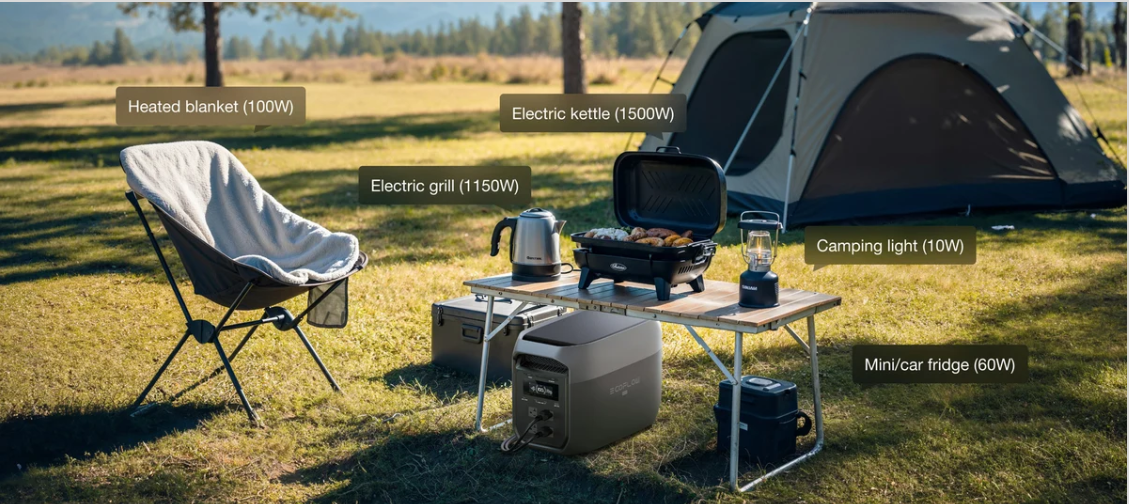
For vehicle-based camping, a portable power station becomes worthwhile when it supports equipment that smaller charging accessories cannot conveniently handle. The reason to carry one should be clear: keeping a compatible fridge running, charging several devices each evening, or supplying an appliance that requires AC power.
Identify Which Equipment Changes Your Energy Needs
The biggest item on your packing list is not necessarily the biggest energy user. A pump may draw substantial power but operate for only a few minutes. A smaller device running throughout the day can consume more energy overall.
Refrigeration deserves particular attention because it creates an ongoing demand. A compressor fridge cycles on and off, so multiplying its running wattage by 24 hours will not give a reliable daily estimate. Look for manufacturer energy-use data with stated test conditions, or measure consumption over a representative day. Ambient temperature, the temperature setting and frequent opening can all change the result.
Decide whether you need powered refrigeration before sizing the battery. For a short trip where a suitable ice cooler meets your food-storage needs, removing that continuous electrical load may let you carry a much smaller setup.
Electric cooking and heating introduce a different trade-off. They can require high output and consume a substantial share of stored energy. As a calculation example, an appliance drawing 1,500 W for ten minutes uses 250 Wh before accounting for power-system losses. Whether that is worthwhile depends on how much energy must remain for the rest of camp.
Plan meals and sleeping equipment alongside the electrical setup. An electric kettle or heater should be a deliberate addition, with its energy cost understood.
Size the Battery for the Gap Between Recharges
A seven-day road trip with dependable charging every evening can need less battery capacity than three nights at one unserviced campsite.
Work out how much energy your equipment uses during the period between reliable recharges. For steady loads, multiply watts by operating hours to obtain watt-hours. For cycling appliances, use measured consumption or suitable manufacturer data.
Consider a hypothetical camp setup using 300 Wh per day. Three full days without charging would require 900 Wh delivered to the equipment. A battery labelled 900 Wh would leave no allowance for conversion losses, the power station’s own consumption, reserve settings or unexpectedly higher demand. The nominal capacity therefore needs to exceed the planned delivered energy.
Output requires a separate check. The battery must support the combined running power of devices used together, along with any relevant startup demand. A larger watt-hour rating does not automatically mean an appliance will start successfully.
This separates two decisions: enough output to operate the equipment, and enough usable energy to sustain it until the next recharge.
Choose a Recharging Method That Fits Your Itinerary
Vehicle Charging for Trips That Keep Moving
Vehicle charging is most useful when driving is already part of the itinerary. Check the charging rate available through your particular vehicle connection and the power station’s input limit. A standard accessory socket and a dedicated alternator charger are different arrangements; their performance should not be treated as interchangeable.
Driving time matters as much as charging speed. If a setup receives an average of 80 W for two hours, it takes in about 160 Wh before storage losses. That would replace only part of the 300 Wh daily consumption in the earlier example.
Use the vehicle and charger as instructed, and avoid drawing down the starter battery while parked. A plan that requires an extra drive every day solely to recharge may be poorly suited to a stationary camping trip.
Solar for Camps With Usable Sunlight
Portable solar panels make more sense when you stay in one place and have somewhere suitable to deploy them. A shaded campsite may be comfortable, but it can offer little useful charging unless a permitted, unobstructed location is within cable reach.
Panel wattage is a rated output under test conditions, not a promise of continuous delivery. Tree shade, cloud, panel orientation and the power station’s input limits affect what reaches the battery. Long summer daylight hours do not all provide equally productive charging.
For a short trip, carrying enough stored energy can be simpler than adding panels. For a longer stay, solar becomes more valuable—but the plan should still work through a period of poor charging weather, whether by reducing optional loads or reaching another charging source.
Campsite Electricity for Predictable Recharging
Where available, an electrical campsite can simplify a trip involving substantial appliance use. Confirm that the specific site you reserve includes electricity and that your connection equipment is suitable.
Also consider charging time. A brief stop with access to an outlet is useful only if it restores enough energy before you leave. Keep the mains charging cable accessible rather than buried beneath the rest of your gear.
Account for Canadian Campsite Conditions
Campground rules can determine which power options are practical. In Banff National Park, for example, published generator hours are 9 a.m. to 10:30 a.m. and 5 p.m. to 7 p.m. A fuel generator therefore cannot be assumed to provide overnight electricity. Check the current rules for your destination; schedules and restrictions differ between parks.
Early- and late-season trips also require attention to battery temperature limits. Check charging and discharging limits separately: a battery may still supply electricity at a temperature where it cannot accept a charge. A cold morning can therefore delay the replenishment you expected from solar or the vehicle.
Plan a dry, ventilated operating position for the power equipment. Protection for transport does not necessarily provide a suitable enclosure during use. Keep vents clear, protect connections from rain and spray, and avoid placing the unit where water can collect.
Conclusion
For a typical weekend of car camping, a useful starting arrangement is a small power bank for day outings and a main battery sized for the camp equipment you will actually use. Add solar when your stay, sunlight access and energy demand justify it; use vehicle charging when regular driving provides a meaningful recharge.
The decisive test is whether the setup can cover the longest gap between dependable charging opportunities. Build around that gap, and each item you carry will have a clear purpose.