

Your toddler has outgrown the infant seat and you are staring at a wall of options with no clear roadmap. Convertible, all-in-one, forward-facing only: the terminology alone sends most parents into a research spiral. If you are shopping for the best car seats for toddlers in Canada, this guide covers what Transport Canada actually requires, what safety features matter most, and how to match the right seat type to where your child is today.
What Canadian Regulations Actually Require
Car seat safety in Canada works on two levels. Transport Canada sets the federal standards all seats sold here must meet, including the Canadian Motor Vehicle Safety Standards (CMVSS). Every seat legally sold in Canada carries the National Safety Mark on its label, confirming it has passed these requirements. Provincial and territorial governments then set the rules for when children must transition between stages.
The Transport Canada framework follows four stages: rear-facing, forward-facing with a five-point harness, booster, and seat belt. For toddlers, best practice means staying rear-facing as long as the seat allows, then moving to a forward-facing harnessed seat, and remaining harnessed until the child reaches that seat’s maximum weight or height. Every stage should last as long as possible, not be rushed.
Why Rear-Facing Longer Is Always Safer
Most Canadian parents know rear-facing is safest for infants, but many underestimate how long toddlers can stay in that position. Transport Canada recommends keeping children rear-facing for as long as the seat allows, even well into the toddler years. In a frontal crash, a rear-facing seat cradles the child and distributes force across the back, shoulders, and head. A forward-facing child is thrown forward into the harness, concentrating impact on fewer contact points.
Many convertible seats sold in Canada support rear-facing up to 40 lbs. The Clek Foonf and Clek Fllo both have a rear-facing limit of 40 lbs in Canada. The Nuna RAVA supports rear-facing from 5 to 40 lbs in the Canadian version. Parents researching on US retailer sites should be cautious: some of these same models list higher rear-facing limits in the US, but those figures do not apply to the Canadian-certified versions of the same product.
Understanding Your Seat Type Options
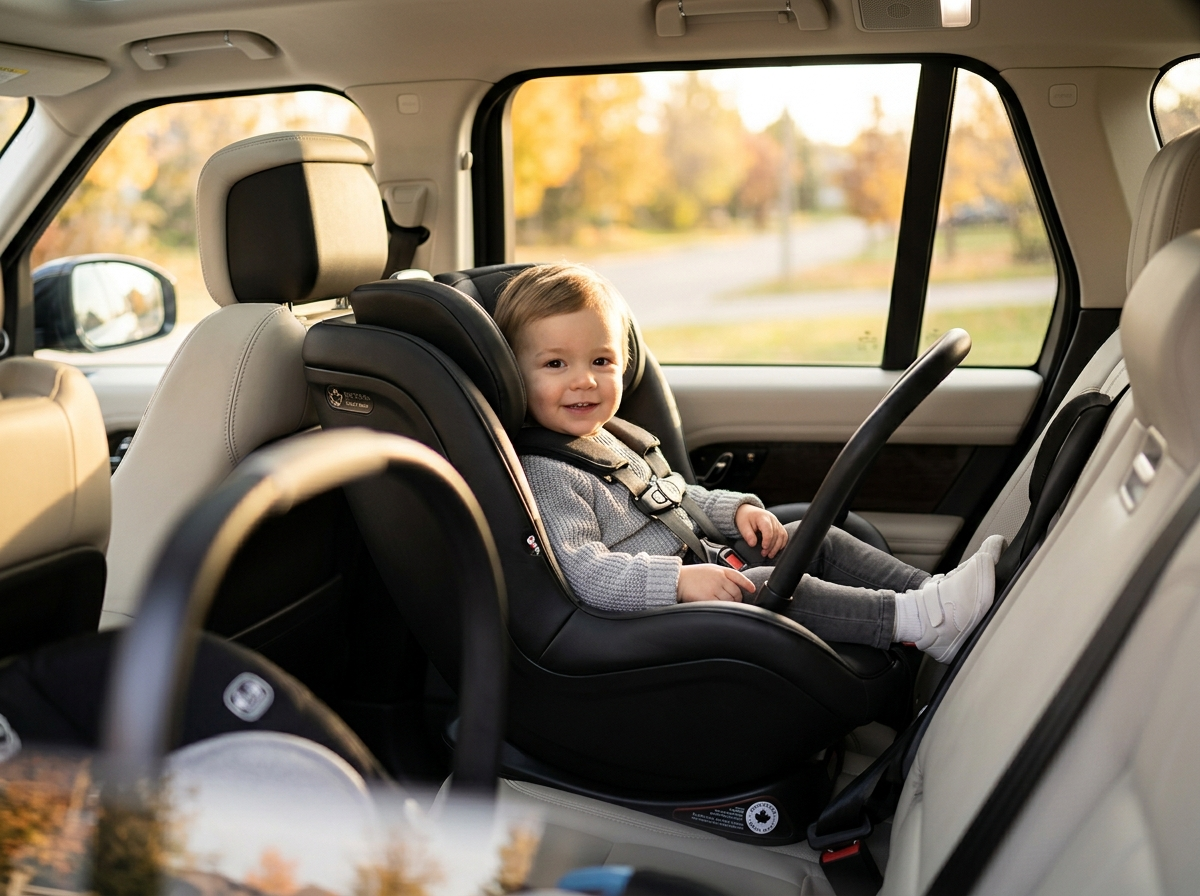
Convertible car seats are the most common starting point for toddlers transitioning out of an infant seat. They install rear-facing for younger children and convert to forward-facing as the child grows, typically offering several years of use from a single frame. All-in-one seats extend that range further by adding a booster mode. For families comparing specific models, a curated selection of convertible car seats in Canada is a more reliable starting point than a US-focused roundup, since it only includes seats that are certified for Canadian sale and carry the National Safety Mark.
Forward-facing harness seats are a third option for children who have already outgrown rear-facing use. They typically offer higher forward-facing weight limits than convertibles, making them a practical choice for larger toddlers. The trade-off is that they cannot be used rear-facing, so they are not appropriate as a first seat for a toddler still within their rear-facing limits.
Key Safety Features That Matter Most
Installation method is one of the most consequential choices. Canada uses UAS, the Universal Anchorage System, to connect car seats to vehicle anchor points. UAS lower anchors handle the main seat connection, and a top tether strap is required for all forward-facing installations in Canada. This tether requirement is a meaningful differentiator from some other markets. Always confirm the Canadian model’s UAS weight limits, which can differ from US specifications for what appears to be the same product.
Rebound bars are worth understanding for rear-facing installations. The Nuna RAVA, for example, requires a rebound bar when installed rear-facing in Canada. The bar prevents the seat from rotating forward in a crash and is a required part of a correct installation. Always follow the Canadian installation manual specifically, as US instructions for the same seat model may differ in ways that affect safety.
Side-impact protection varies significantly between entry-level and premium models. Extended side wings, energy-absorbing foam layers, and deep side walls differ in ways that a spec sheet does not always capture. Narrow profiles matter for families fitting multiple seats across a back row. The Clek Fllo and Clek Foonf are designed and manufactured in Canada with three-across installation scenarios specifically in mind.
Matching the Right Seat to Your Child’s Stage
For toddlers still within their rear-facing limit, the priority is a convertible seat with the highest available Canadian rear-facing limit so they stay in that position as long as possible. For toddlers transitioning forward-facing, a high forward-facing harness limit keeps harnessing going well past the minimum. For families wanting long-term value from one seat, comparing the full range of convertible and all-in-one car seats helps identify which configuration fits both the child’s current stage and the vehicle. These are the best car seats for toddlers in Canada when the goal is maximum years of use from a single investment.
Vehicle fit matters as much as the seat’s specifications. A seat that installs correctly in one car may fit differently in another due to seat angle, belt routing, or anchor placement. Handling the seat in your actual vehicle before purchasing is the most reliable confirmation, especially for rear-facing installation where angle adjusters and anti-rebound bar clearance vary by vehicle.
Canadian-Specific Factors Worth Knowing
Winter clothing is the most common installation error Canadian parents make. Thick snowsuits compress in a crash, creating slack in a harness that felt snug in normal use. The correct approach is to dress the child in regular clothing or thin fleece under the harness, buckle snugly, then place a blanket over the harness afterward. Installing a child in a puffy snowsuit under the harness straps is a safety issue regardless of how tight the harness feels at the time.
Always confirm the seat you are buying carries the National Safety Mark and is the Canadian-market version of the product. Seats available from US online retailers may not be certified for Canadian use, and their specifications, including weight limits and installation requirements, may differ from Canadian versions in ways that affect safety. Purchasing from a Canadian retailer removes that uncertainty.
The Bottom Line
Choosing the right toddler car seat in Canada means understanding the Transport Canada framework, applying Canadian-specific weight limits, and matching the seat type to where your child is right now. The best seat is not the most expensive option: it is the one that fits your child, installs correctly in your vehicle, and keeps them in the appropriate stage for as long as the seat allows.
Which stage of the car seat journey are you currently navigating? Are you still keeping your toddler rear-facing, or have you recently made the switch to a forward-facing harness? Share your experience in the comments below.