


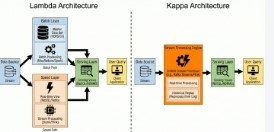
Modern data systems increasingly need to react to events as they happen: a payment is authorised, a sensor crosses a threshold, a user clicks “buy”, or a shipment changes status. In many teams, this has historically produced two parallel pipelines—one for real-time decisions and another for nightly or hourly batch reconciliation. Kappa Architecture proposes a simpler alternative: treat the event stream as the system of record, build one streaming pipeline, and reprocess by replaying history when you need new outputs. For practitioners learning modern data engineering patterns in a data science course in Hyderabad, Kappa is a useful mental model because it forces clarity about what “truth” means in an event-driven world.
What Problem Kappa Architecture Solves
Kappa Architecture is often discussed as a response to the operational complexity of “two-path” systems. When teams maintain both a streaming path (for low-latency outputs) and a batch path (for completeness and backfills), they face recurring issues:
- Duplicate business logic implemented twice, which drifts over time
- Conflicting results between batch and stream outputs, creating trust gaps
- Extra infrastructure and scheduling overhead for batch jobs
- Slower experimentation because every change must be validated in two places
Kappa’s core claim is straightforward: if you can model your domain as an ordered log of immutable events, you can generate the same results that batch would produce—without a separate batch layer.
Core Principles of Kappa Architecture
Kappa Architecture is built on a few practical principles:
1) An immutable event log is the source of truth
All meaningful changes are captured as events and appended to a log. You do not “update rows” in the log; you add new facts. This makes history explicit and auditable.
2) Stream processing is the primary compute model
Instead of running periodic batch jobs, you continuously process events as they arrive. Stateful operators (windows, joins, aggregations) maintain the current derived state.
3) Reprocessing happens by replay, not by batch
When you need to rebuild a derived dataset—because of a bug fix, a new feature, or a changed metric definition—you replay the event stream from the beginning (or from a checkpoint) through an updated processing job.
4) A serving layer exposes derived views
Kappa doesn’t eliminate materialised outputs; it changes how they are produced. The serving layer might store aggregates, feature tables, or queryable projections optimised for downstream use.
This way of thinking aligns with how many modern platforms are built: events in, continuous transformations, fast queries out.
How Reprocessing Works in Practice
Reprocessing is where Kappa either shines or struggles—depending on your data volumes and retention strategy.
- Version your processing logic. Treat transformations as deployable artefacts with explicit versions.
- Support idempotency. Outputs should remain correct even if the same event is processed more than once (common in distributed streaming).
- Use durable checkpoints and state snapshots. Many streaming frameworks allow you to persist state so recovery is reliable after failures.
- Plan for event retention. If your event log only keeps a few days of data, “replay everything” may not be possible. Some teams tier storage: recent events in a fast log, older events in cheaper object storage, both replayable.
A helpful way to explain this to learners in a data science course in Hyderabad is: Kappa treats “batch” as a special case of streaming—streaming over a very large time window.
Typical Use Cases Where Kappa Fits Well
Kappa is particularly effective when the business value depends on timeliness and when event history is naturally available.
- Fraud detection and risk signals: continuous scoring with quick model or rule updates via replay
- Operational monitoring: near real-time dashboards and alerts, with consistent backfills after logic changes
- Personalisation and recommendations: streaming features (recent clicks, session behaviour) feeding low-latency decisioning
- IoT and telemetry analytics: large volumes of time-ordered events, windowed aggregates, anomaly detection
- Order and inventory tracking: event-sourced state that can be rebuilt for audits or debugging
In these cases, a unified pipeline reduces drift and keeps “live” and “historical” outputs aligned.
When Kappa May Not Be the Best Choice
Kappa Architecture is not a universal replacement for batch processing. It can be a poor fit when:
- Full reprocessing is prohibitively expensive due to extreme data volumes and long histories
- You need heavy offline transformations (complex joins across many static datasets) that are simpler in batch engines
- Event quality is inconsistent, with late, missing, or poorly defined events that make replay unreliable
- Governance requires strict snapshots at fixed times, where batch reporting workflows are mandated
In reality, many organisations adopt a “Kappa-first” approach for operational and product analytics while still using batch tools for certain compliance reporting or deep historical modelling.
Conclusion
Kappa Architecture simplifies data systems by removing the traditional batch layer and placing the event stream at the centre: one processing paradigm, one set of transformations, and reprocessing via replay. The trade-off is that you must design carefully for event retention, state management, and correctness under replays. If you are building modern analytics or machine learning pipelines—and especially if you are exploring these concepts through a data science course in Hyderabad—Kappa is worth understanding as a practical blueprint for reducing pipeline duplication while keeping derived data consistent, timely, and easier to evolve.