


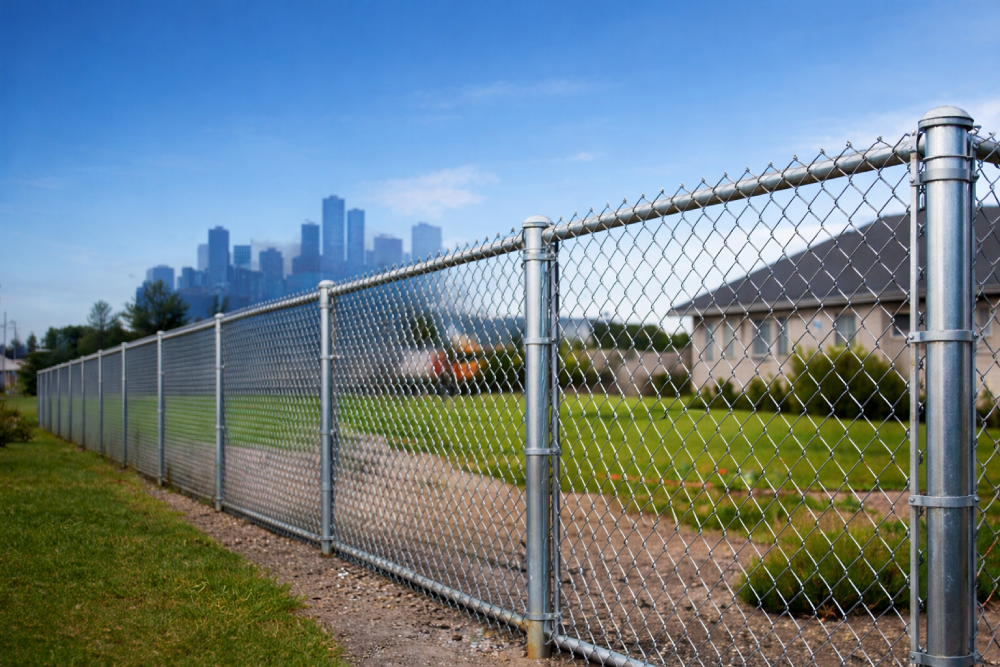
Drive through Campbell Heights, Port Kells or South Westminster, and you’ll see the same thing around almost every yard: chain link. Construction sites, truck yards, warehouses and storage lots all use it. There’s a reason it’s the default, and it isn’t only price.
For a business, a fence does a few jobs at once. It keeps people out after hours, keeps equipment and inventory in, controls where trucks come and go, and shows insurers and the City that the site is managed. Chain link does all of that over long distances for a fraction of the cost of solid fencing. Because it’s see-through, security cameras, patrols and passing police can actually see what’s happening inside.
Commercial chain link isn’t just a taller version of a backyard fence, though. The posts are heavier, the wire is thicker, the gates are built for trucks, and construction sites come with Building Code rules of their own. This guide covers what Surrey businesses and site managers should know before they get quotes.
Construction Sites: Keeping the Public Out and Your Equipment In
What the Building Code expects
Site fencing on a construction project isn’t optional. Under Part 8 of the BC Building Code, when construction or demolition could be a hazard to the public, the site needs a strongly built fence, boarding or barricade at least 1.8 m high (about 6 feet) between the work and the street or any open side. The access gates have to be closed and locked whenever the site is unattended, and the fencing has to stay up until the work is finished.
The Code also covers shutdowns. If work stops and the site will sit empty during normal working hours, for example, while you wait on a permit or a financing draw, the hazardous parts still need to be protected. A proper perimeter fence is the simplest way to do that.
When the building sits right up against a public sidewalk, the rules get stricter. You may need a covered walkway or solid hoarding instead of open fencing. Your building permit conditions and the inspector will tell you what’s needed for your site.
Temporary panels or a permanent fence?
Most Surrey construction sites use one of two setups.
Temporary panel fencing is the familiar system of chain-link panels, usually 6 feet high and 10 to 12 feet long, standing in weighted bases and clamped together. It goes up in hours, can be moved as the project moves through phases, and is usually rented by the month. The trade-off is security. Panels can be lifted out of their bases or pushed over, so they need good clamps, sandbags or bracing, and regular checks.
Permanent post-in-ground chain link costs more up front, but it’s much harder to defeat. It makes sense on longer projects, on sites with expensive equipment parked overnight, and on land that will become a yard or laydown area once construction wraps up. In that last case, you only pay for the fence once.
Little things that make a big difference
- Plan the gates around the trucks. Concrete trucks, flatbeds and excavator floats need a wide, clear opening. Put a separate walk gate beside it so crews aren’t swinging the big gate open all day.
- Add a windscreen. Mesh screening cuts dust and blowing debris, blocks sightlines into the site and gives you space for signage and branding. It also catches wind like a sail, so panels with screens need extra bracing.
- Post clear signage. “Construction site, authorized personnel only” signs at every gate tell visitors where they stand and help on the liability side.
- Walk the line every week. Fences get bumped by machines and nudged by people looking for a shortcut. A five-minute walk on Monday morning catches gaps before someone else finds them.
Warehouses and Industrial Lots: Building a Fence That Stays a Deterrent
A warehouse or truck yard fence has to work every night for 20 years, not just for the length of a project. That changes how you build it.
Height and what goes on top
Six feet is the baseline for most commercial chain link. Yards storing vehicles, equipment, scrap metal or high-value inventory often go to 7 or 8 feet. Taller fences need heavier posts and usually a middle rail to keep the fabric rigid.
What goes on top is where Surrey’s rules come in. Razor wire is banned in every zone in the city, so the coils you see on some older sites elsewhere aren’t an option here. Strands of barbed wire on angled arms are a common deterrent on industrial land, but check what your zone allows before you order it. The next section has more on that.
Stopping people from going under or through
Most break-ins don’t go over the top. People cut the fabric, lift it at the bottom or squeeze through a gap at a gate. A few upgrades make that much harder:
- Heavier 9-gauge fabric, which takes real effort to cut
- Smaller mesh in high-risk areas. Tighter diamonds give no toeholds for climbing and are harder to cut through.
- A bottom rail or tension wire, or fabric buried a few inches into the ground, so the bottom can’t be peeled up.
- Tight gate gaps. A gap of several inches under a gate is an open invitation.
Gates built for trucks.
Gates take more abuse than any other part of a commercial fence. For wide truck entrances, cantilever sliding gates are the go-to. They roll sideways on rollers mounted to the posts, with no track on the ground to fill with gravel or get crushed by a loader. Swing gates are cheaper but need clear space to open, which is something many tight Surrey yards don’t have.
Plan for automation even if you don’t install it on day one. Keypads, card readers and gate operators are much easier to add later if the gate and posts were sized for them. Steel bollards in front of the gate posts are cheap insurance against the truck driver who cuts the corner.
Screening without regrets
If you’d rather not show off your inventory to the street, privacy slats or windscreen will hide it. Just know that screening turns an open fence into a wall that catches wind. A fence designed for open mesh can lean or fail once it’s covered. If screening is part of the plan, tell your contractor up front so they can size the posts and spacing for it.
Commercial-Grade vs. Residential: What Actually Changes
If you get two quotes for the same length of fence and one is far cheaper, check whether it’s really a residential fence with a commercial price tag. These are the parts that should be different:
- Wire. Backyard fences usually use 11 or 11.5-gauge fabric. Commercial jobs typically use 9-gauge, which is thicker, stiffer and much harder to cut.
- Posts. Commercial fences use heavy-wall steel pipe, often called Schedule 40. Line posts are commonly around 2 3/8 inches in diameter. Corner, end and gate posts go up to 2 7/8 or 4 inches, compared with the lighter, thinner posts on most homes.
- Rails. A top rail is standard on both. Taller commercial fences add a middle rail and a bottom rail or tension wire to keep the fabric from bowing or being pushed out.
- Footings. Bigger posts need bigger, deeper concrete footings, especially at gates and corners, which carry the most load.
- Gates. Residential gates are sized for people and lawn mowers. Commercial gates are sized for trucks and built to be opened dozens of times a day.
None of these upgrades are glamorous, and you won’t notice most of them on day one. You’ll notice them in year five, when the fence is still straight, and the gate still closes.
Surrey Rules That Affect Commercial Fences
Most of Surrey’s fence height rules are written for residential lots, but a few apply to everyone.
Razor wire is banned everywhere. Surrey’s Zoning Bylaw prohibits barbed tape and razor wire as fencing material in all zones, including commercial and industrial. If your security plan includes it, change the plan.
Barbed wire and electric fencing are limited. On residential land, they aren’t allowed except in agricultural zones and on acreage lots of 2 hectares or more. On commercial and industrial land, confirm with the City what’s permitted for your zone before you order barbed wire arms.
Stay off City land and easements. Fences can’t be built on City property, road rights-of-way or easements. Industrial lots often have utility rights-of-way, drainage easements or covenants registered on title, so pull a title search before you finalize the fence line.
Check your development permit. Many commercial and industrial properties were approved with a development permit, and some include conditions on fencing, landscaping and screening along the street. Read yours, or ask the City, before you change the frontage.
Permits for the extras. A standard residential fence in Surrey doesn’t need a building permit, but commercial projects are less clear-cut. Fencing can be tied to development permit conditions, and wiring a gate operator needs an electrical permit. When in doubt, call the City first.
Request a BC 1 Call locate before anyone digs. Industrial sites tend to have more buried services than a backyard, including power feeds, gas, fibre, storm drains and sometimes old lines nobody remembers. Locates are free, and hitting a line is not.
What to Ask a Commercial Fence Contractor
Commercial work is a different job from backyard fencing, and not every fence company does it well. Before you sign, ask:
- Can you show me commercial jobs you’ve done in Surrey or nearby? Ask for addresses you can drive past, ideally yards that are a few years old.
- What exactly are you quoting? Get the fabric gauge, post sizes and wall thickness, rail layout, footing depth and gate specs in writing. That’s the only way to compare quotes fairly.
- Are you registered with WorkSafeBC, and what liability coverage do you carry? On a commercial site, the general contractor or property manager will ask for this anyway. Have it ready.
- How do you handle temporary fencing? On construction projects, ask whether they supply, install, move and remove panels as the job changes, and what that costs per month.
- Can the gates be automated later? Even if you’re starting with a padlock, posts and gates sized for an operator save money down the road.
- How fast can you repair damage? Trucks hit fences. A contractor who can patch a damaged section within a day or two is worth more than a slightly lower quote.
- What does your warranty cover? Get the workmanship warranty in writing, separate from the manufacturer’s warranty on materials.
Chain Link Fence Contractors Surrey
A good commercial fence is one of the cheapest security investments a Surrey business can make. It keeps trespassers and thieves out, keeps your site in line with the Building Code during construction, and gives cameras and patrols a clear view of what’s inside. Spec it properly, with heavier posts and wire, truck-ready gates and nothing on top that Surrey doesn’t allow, and it will do that job for decades.
If you’re comparing commercial chain link fence contractors in Surrey, Poker Link Fence is a Surrey-based company that installs permanent and temporary chain link for construction sites, warehouses and industrial properties across the Lower Mainland. They can walk your site, flag access and security issues, and give you a detailed written quote.