


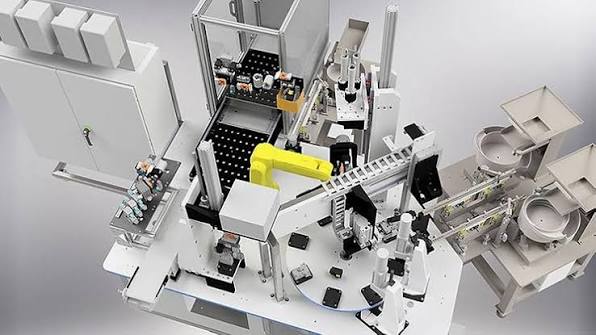
Modern manufacturing rarely depends on one machine operating by itself. Automated systems connect robots, PLCs, machine vision, conveyors, sensors, tooling, safety devices, and production equipment so individual processes work together as one coordinated operation.
The value comes from integration. A robot can move parts quickly, but the larger system must also know when a machine is ready, whether the part passed inspection, where the component should go next, and how to respond when a fault occurs.
What Are Automated Systems?
Automated systems are connected combinations of hardware and software designed to perform and coordinate manufacturing tasks with limited manual intervention.
A complete system may include:
- Industrial robots
- PLC controls
- HMI interfaces
- Machine vision
- Conveyors
- Sensors
- Servo systems
- Custom tooling
- Safety equipment
- Production data systems
GLOBAL Automation Technologies designs these systems around actual manufacturing constraints such as parts, cycle time, quality requirements, floor space, existing machinery, and production targets.
How Do Automated Systems Work?
Automated production depends on communication between individual machines and devices.
A typical sequence might involve:
- A sensor detects an incoming component.
- A PLC confirms the next machine is available.
- A robot picks and positions the part.
- The machine completes its process.
- Vision equipment verifies the result.
- The controls system determines where the part goes next.
- Production information is recorded for operators or supervisors.
Each device performs a specific job, but the controls architecture keeps everything synchronized.
Why Integration Matters in Automated Systems
A production line can contain several automated machines and still operate inefficiently if they are not properly connected.
Common integration challenges include:
- Machines waiting on one another
- Incorrect robot handshakes
- Conveyor backups
- Inconsistent safety logic
- Disconnected inspection results
- Separate operator interfaces
- Poor fault recovery
Integrated controls allow robots, machines, conveyors, safety equipment, and production data to operate as one system rather than isolated equipment islands. GLOBAL specifically designs PLC, HMI, robot, vision, and safety interfaces around the existing plant environment.
Robotic Automated Systems
Industrial robots are frequently at the center of automated production.
Depending on the application, robots can perform:
- Machine tending
- Material handling
- Assembly
- Palletizing
- Inspection
- Packaging
- Finishing
- Part transfer
The robot itself is only one component. Tooling, fixtures, controls, sensors, safety systems, and machine interfaces determine whether the cell can operate reliably.
GLOBAL develops robotic systems from process study and simulation through build, installation, commissioning, training, and ongoing support.
Automated Systems for Machine Tending
Machine tending is a common example of integrated automation.
A robot may:
- Pick a raw component.
- Load it into a CNC machine.
- Signal that loading is complete.
- Wait for the machining cycle.
- Remove the finished part.
- Move it to inspection or another process.
PLC communication coordinates the robot and machine so each step occurs in the correct sequence.
Adding vision, automated part presentation, or downstream inspection can turn a simple machine-tending cell into a more complete production system.
Automated Systems for Material Handling
Material handling systems move components between operations.
These systems may use:
- Robots
- Conveyors
- Pallet systems
- Racks
- Sensors
- Vision guidance
Applications include pick-and-place, palletizing, depalletizing, bin picking, and inter-station transfer.
GLOBAL integrates these handling processes with PLC controls so material flow stays synchronized with production rather than becoming a separate bottleneck.
Machine Vision in Automated Systems
Vision gives automated systems the ability to collect information about a component before making the next decision.
Machine vision can identify:
- Part presence
- Location
- Orientation
- Assembly status
- Quality conditions
- Surface features
For example, a camera can identify where a randomly positioned component is located and send coordinates to a robot.
Vision results can also be passed directly into line controls so failed components are automatically removed or routed for further inspection.
How PLC and HMI Controls Coordinate Automation
The PLC acts as the logic controller for many manufacturing systems.
It receives signals from sensors and equipment, then determines what should happen next.
PLCs may coordinate:
- Robot cycles
- Machine commands
- Conveyors
- Pneumatic systems
- Vision results
- Safety devices
- Production recipes
The HMI provides operators with a visual interface for monitoring the process, acknowledging faults, changing approved settings, and viewing equipment status.
GLOBAL integrates PLCs, HMIs, robots, vision, and safety logic as part of one controls architecture.
Automated Systems and Production Data
Modern automation can also collect information about how the line is operating.
Useful data may include:
- Cycle time
- Machine status
- Production counts
- Faults
- Inspection results
- Downtime
- Rejects
This information can be shown through HMI or supervisory systems to support troubleshooting and process improvement.
The goal is not simply to collect data. Operators need information that helps them understand what is happening and where production is being lost.
Can Existing Machines Become Part of Automated Systems?
Yes.
Manufacturers often have equipment that performs its primary process well but lacks modern automation or connectivity.
Existing lines can potentially be upgraded through:
- Robot integration
- PLC upgrades
- New HMIs
- Machine vision
- Conveyor additions
- New sensors
- Safety upgrades
- Networking and data collection
GLOBAL performs line upgrades and manual-to-automated conversions designed to connect new technology with equipment manufacturers already use.
How Simulation Improves Automated System Design
Integration problems are easier to correct before equipment reaches the production floor.
Simulation can evaluate:
- Robot reach
- Motion paths
- Interference
- Cycle time
- Equipment layout
- Sequencing
GLOBAL uses AI-assisted simulation to identify programming and integration issues earlier in the project, helping reduce surprises during installation and startup.
What Are the Benefits of Automated Systems?
Higher Throughput
Coordinated automation can reduce delays between operations and maintain more consistent cycle times.
Improved Repeatability
Robots and programmed controls perform tasks according to defined sequences and process settings.
Better Quality Control
Automated inspection can identify problems during production instead of waiting until the final stage.
Improved Safety
Automation can reduce direct operator exposure to repetitive, heavy, or hazardous tasks.
Better Scalability
Integrated systems can be expanded with additional robots, stations, or product variants when the original architecture is designed for future growth.
What Should an Automated Systems Integrator Provide?
A complete automation project typically requires several engineering disciplines.
Look for a partner capable of handling:
- Feasibility analysis
- Process engineering
- Simulation
- Mechanical design
- Robot integration
- PLC/HMI programming
- Machine vision
- Safety engineering
- Build and testing
- Installation
- Commissioning
- Training
- Production support
GLOBAL combines system integration with technical staffing so manufacturers can use one partner for both the automated equipment and the engineering resources needed to launch and sustain it.
Build Automated Systems Around the Whole Production Process
Reliable automation depends on more than individual machines. Robots, controls, sensors, vision, tooling, safety equipment, and existing production assets need to function as one coordinated system.
GLOBAL Automation Technologies designs automated systems around your process, equipment, cycle time, quality requirements, and production goals. Their team can take a project from feasibility and simulation through engineering, build, commissioning, training, and ongoing plant-floor support.