

Most people compare generators by the day rate and stop there. That is where the bill starts. Denver planning ranges for a 76 to 100 kW towable diesel run $3,250 to $5,850 per four-week period, and a common 100 kW rental unit burns about 7.3 gallons an hour at full load. The national average diesel price reached $6.285 a gallon on September 14, 2026. That works out to about $46 an hour. Run the unit 16 hours a day for 24 days, and the fuel alone lands near $17,600, several times the rental charge.
Two caveats apply. The national figure is an on-highway retail average, so delivered off-road fuel can cost less. Full-load burn also overstates typical use. The pattern still holds, because on busy sites the fuel line can pass the equipment line.
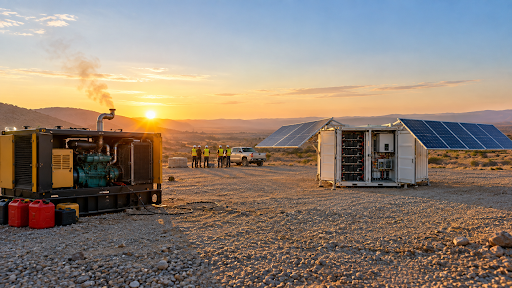
That is why a solar container deserves a fair test against the generator you already know. This guide runs the numbers, then covers noise, storms, winter, container homes, and the small loads people forget. To see a production lineup while you read, browse the Solar Container range from Highjoule.
What a Solar Container Actually Replaces on a Real Site
A solar container puts panels, lithium batteries, a power conversion system (PCS), and an energy management system (EMS) inside one transportable steel unit. It does not replace every kilowatt-hour a generator makes. It replaces the daytime hours and, with enough battery, part of the night.
Think of three roles.
- Replace. On sunny, daytime-heavy loads, the container can run the whole site.
- Reduce. Paired with a small generator, it cuts engine hours. Atlas Copco says diesel hybrids with batteries can reduce engine runtime by up to 90 percent, according to a Texas rental supplier.
- Backstop. Keep a small generator as insurance and let it start only when the battery runs low.
The solar container market is built around this mobility. The MarketsandMarkets report values it at $0.29 billion in 2025, and $0.83 billion by 2030, and portable units held 61.5 percent of 2024 value. In plain terms, this is mostly a market for power that moves from job to job.
What a Diesel Generator Really Costs Once the Meter Runs
Add up every line before you compare.
- Rental. Denver rental ranges for 20 to 25 kW towables run $1,550 to $2,450 per four weeks, and 76 to 100 kW units run $3,250 to $5,850.
- Fuel. A diesel burns roughly 0.07 gallons per kWh at full load. Typical use is closer to 0.1 gallons per kWh. At $6.285, that is about $0.44 to $0.63 per kWh in fuel alone.
- Refueling. Vendor fueling visits add $95 to $175 per stop plus a per-gallon uplift.
- Service. Diesel oil changes come every 100 to 150 hours, and annual service on 60 to 150 kW diesels typically runs $1,000 to $2,500. Run one around the clock, and that is an oil change every four to six days.
- Lifespan. Quality industrial diesels last 15,000 to 30,000 hours before a major overhaul, and a unit running 12 hours a day reaches 20,000 hours in about five years. At 24 hours a day, you get there in roughly 2.3 years.
Fuel and service are the lines that keep repeating. They are also the lines a solar container mostly removes.
A Five-Year Cost Model You Can Copy
Take a remote job that uses 60 kWh a day, six days a week. That is 18,720 kWh a year. Here are the assumptions, all labeled so you can swap in your own.
- A 25 kW towable diesel rents for $2,000 per four weeks, a midpoint of the Denver range, across 13 periods a year.
- Fuel burns at 0.1 gallons per kWh and costs $6.285 a gallon, held flat.
- Delivery, cables, and refueling visits are left out to stay conservative.
| Cost line | Assumption | Per year |
| Rental, 25 kW towable | $2,000 per four weeks, 13 periods | $26,000 |
| Fuel | 1,872 gallons at $6.285 | $11,765 |
| Rental plus fuel | Both lines together | $37,765 |
| Five-year total | Fuel price held flat | $188,825 |
Fuel price risk is easy to measure. Every $1 change in the diesel price moves the yearly fuel bill by $1,872. Diesel is up $2.546 a gallon from a year ago.
Now compare a solar container against that yearly bill. The installed costs below are placeholders, not quotes. Replace them with a written quote.
| Solar container installed cost (placeholder) | Simple payback against diesel rental |
| $60,000 | 1.6 years |
| $90,000 | 2.4 years |
| $120,000 | 3.2 years |
This assumes the solar container replaces both the rental and the fuel. If you keep a small backup generator, subtract its cost. The math also ignores financing, maintenance, and resale value. It does show one clear rule. Short jobs favor the rental, and jobs longer than about two years favor owning the power source, especially if you can redeploy it.
Solar container price and container price in context
Public listings help you sanity-check quotes. RPS Solar Pumps lists a bare-bones 20-foot unit with 3,000 watts of solar at $18,990 and a fully built 40-foot unit with 12,000 watts at $67,990. The steel shell is the smallest line. If you search for a container for sale, a one-trip 20-footer runs about $2,500 to $3,500. Highjoule publishes specifications for its units but asks buyers to request quotes.
Tax and tariff notes
This is general information, not tax advice. The homeowner credit under Section 25D ended on December 31, 2025. Business owners can still claim Section 48E, but solar projects that had not begun construction by July 4, 2026 generally must be placed in service by December 31, 2027, while storage keeps its credit longer. On imports, a mid-2026 company filing lists Section 301 tariffs of 25 percent on Chinese non-EV lithium-ion batteries and 50 percent on Chinese solar cells and modules. Get a CPA and a customs broker involved before you sign.
Noise, Fumes and Fuel Runs
Noise is a cost that never shows up on an invoice until a neighbor complains. Diesel generators usually measure 70 to 85 decibels from 23 feet away. A 50 kW diesel produces around 85 dB(A) untreated. OSHA requires a hearing conservation program when exposure reaches an 8-hour average of 85 dBA. The agency’s noise page explains the rule.
Local limits are often tighter. Residential zones commonly enforce nighttime limits of 50 to 55 dB(A) at the nearest dwelling, and a set that reads 78 dB(A) at 7 meters can still produce 68 dB(A) at 30 meters. One supplier describes a night crew that drew two noise complaints in a week under a 55 dB property-line limit until it swapped to a canopy unit.
A solar container has no engine, so the main sounds come from the inverter and cooling fans. Ask for dBA at 10 meters at full load instead of assuming silence.
Fumes matter too. RMI notes that solar-plus-storage systems carry none of the air quality health risks that generators do. Lighting shows the same pattern. Solar-powered lighting avoids the noise and fumes of diesel light towers.
Storm Season and the Fuel Bottleneck
Storms expose the weakest link in generator plans, which is fuel delivery. In its analysis of generator-centric disaster response, RMI describes many Houston critical facilities lacking backup power after Hurricane Beryl. The same source reports that after Hurricane Fiona in Puerto Rico, solar-plus-storage microgrids kept dialysis running in Adjuntas and a fire station dispatching in Guánica. Another RMI piece says more than two million people lost power during Hurricane Ian while microgrids kept critical services running.
Fuel access is the choke point. A published account describes a San Juan hotel paying $12,000 for fuel for every five days of running a 1 MW generator after Fiona, and being grateful just to receive the delivery.
Governments are responding. North Carolina’s State Energy Office announced $5 million for permanent and mobile solar and battery systems after Hurricane Helene. The Coastal Review report has the details. Mobile units also serve people directly. Containerized microgrids can charge portable batteries that residents carry home to run oxygen concentrators or CPAP machines overnight.
The practical plan is a solar container for the daily load and a small generator as a multi-day cloud backstop.
Where Each Option Wins
| Situation | Better fit | Why |
| Two-week repair job | Rental generator | No time to repay capital |
| Daytime-heavy site running a year or more | Solar container | Rental and fuel bills repeat every month |
| Night-heavy load with little sun | Hybrid or generator | Battery cost climbs fast |
| Site under a strict noise limit | Solar container or silent hybrid | Property-line limits |
| Remote ranch with pumps and cold storage | Solar container | Loads follow the sun and refueling trips cost time |
| Storm-recovery hub | Solar container plus small generator | Fuel deliveries jam after storms |
| Deep winter with heavy electric heat | Hybrid or fuel | Short days and huge loads |
Winter is the honest weak spot
Cold hits batteries harder than panels. Charging lithium iron phosphate cells below 32°F causes lithium plating, which permanently reduces capacity. Discharge still works in the cold, but a battery delivers about 80 to 90 percent of its capacity at 32°F, 60 to 70 percent at 14°F, and 40 to 50 percent at minus 4°F. See GridWright’s cold charging guide for the full chart.
Better systems manage this. A low-temperature cutoff simply stops charging, while self-heating batteries send incoming charge to internal heaters first. Ask any seller whether the thermal system heats as well as cools. Then size the array for winter sun, not summer sun.
Matching HJ-FBESS Models to Job Profiles
The HJ-FBESS Solar Container works well for this exercise because Highjoule publishes real configurations. The table below matches three job profiles to models. Yields use my planning assumptions of 5 summer sun hours, 3 winter sun hours, and a 0.8 system factor. Confirm them with the NREL PVWatts calculator.
| Job profile | Daily use | Model | Summer yield | Winter yield | Storage |
| Job trailer and tools | 60 kWh | HJ-10G-P024E040 (10 ft, 24 kWp) | About 96 kWh | About 58 kWh | 40 kWh |
| Packing shed with cold room | 150 kWh | HJ-20G-P057E241 (20 ft, 57 kWp) | About 228 kWh | About 137 kWh | 241 kWh |
| Remote camp or pumping station | 400 kWh | HJ-40H-P136E482 (40 ft high cube, 136 kWp) | About 544 kWh | About 326 kWh | 482 kWh |
The model data comes from Highjoule’s published table, and the PCS supports black start and off-grid microgrid formation. That is the feature to ask about when a generator will share the site. The same page lists a DC-coupled design with 88 to 95 percent round-trip efficiency, which is a vendor claim to verify. A June 2026 Highjoule press release says a foldable unit was being prepared for shipment to a U.S. customer. For any U.S. install, request the UL 9540 listing and UL 9540A report for your exact model.
Powering a Container Home or Container House
A solar container home has a different job from a worksite unit. It runs every day, so efficiency matters more than raw size. Here is a planning budget for an efficient 20-foot container house. The wattages are typical assumptions, so replace them with your own appliances.
| Load | Assumption | Daily energy |
| LED lighting | 12 fixtures at 10 W for 5 hours | 0.6 kWh |
| Refrigerator | Efficient model | 1.2 kWh |
| Mini-split, 12,000 BTU | 700 W average for 8 hours | 5.6 kWh |
| Laptop, router, chargers | 100 W for 10 hours | 1.0 kWh |
| Water pump and fan | Light use | 0.4 kWh |
| Induction cooktop and kettle | About 45 minutes | 1.0 kWh |
| Total | 9.8 kWh |
At 4 kWh per installed kW per day, that needs about 2.5 kW of panels in summer and roughly 4 kW in winter. A battery of 8 to 10 kWh covers most of the evening. RPS lists a 20-foot, 6,000-watt build with two lithium batteries totaling 10.24 kWh for $43,990 fully built out. On paper, that fits.
The mini-split dominates the budget, so insulation is your cheapest battery. Before buying any container house, check zoning and the building code your county has adopted.
The Small Loads Around the Box
Solar Container Cold Room
Refrigeration is where solar and storage pay off fastest, because the load is steady and daytime-friendly. ColdHubs has expanded to more than 40 locations serving more than 2,100 farmers and vendors. The design keeps improving. Its second-generation rooms add thermal storage, so a room can hold temperature for three days during outages without starting the backup generator if no warm goods are loaded. A U.S. supplier takes a hybrid approach, and its solar cold box runs on solar by day and on battery for up to 15 hours before a generator is needed. Insulation and door discipline shrink a solar container cold room load more cheaply than extra batteries do.
Solar Container Vent and Fan
Airflow is a tiny load with big consequences for condensation and heat. A solar container vent with its own panel needs no wiring. A solar container fan of that type runs only in sunlight, so check the specs. One kit pairs a 25 W panel with an 8,800 mAh battery to run two exhaust fans for up to 12 hours after a full charge. Airflow claims vary wildly. One rated roof fan moves 35.2 cfm from a 4.5 W panel, while another listing advertises 530 cfm from a 10 W kit. Ask for tested airflow before you buy. Keep the battery and inverter compartments of a listed system on the manufacturer’s ventilation design.
Solar Container Lights
Lighting is the easiest load to cover. Twelve 10 W LED fixtures draw only 120 watts. Put lights on their own breaker and add motion sensors for storage areas and yards. Solar-powered site lighting can also replace a diesel light tower, which removes another engine from the site.
Delivery Day to First Power
Plan the landing in four steps.
- Lead time. RPS quotes about 30 days of production for its made-to-order units. Ask every seller for a written ship date.
- Site prep. You need a level pad, truck access, and a crane rated for the loaded weight, not the empty box. A bare 20-foot container weighs about 5,000 pounds and a 40-footer about 8,000. Foldable units weigh far more. One maker lists 10.64 tons for a complete 20-foot high cube unit and 30.48 tons for the 40-foot version.
- Delivery. Once a solar container ship date or truck slot is confirmed, verify the CSC plate and lifting points before offloading. SolarCont lists its 20-foot high cube unit at under 20 tons with about five hours of assembly.
- Setup and first week. Highjoule’s FAQ puts deployment of a 100 kW, 20-foot unit at about 120 minutes with six workers. Then watch the first week closely. Check string voltages, confirm remote alerts reach a real person, and test the generator auto-start if you run a hybrid.
Questions to Ask a Container Company Before You Sign
Any container company can sell you a shell. Fewer can support a power system through a winter. Ask these seven questions.
- Can the system start and stop a generator automatically, and what triggers it?
- What is the sound level in dBA at 10 meters at full inverter load?
- Does the thermal system heat as well as cool the batteries?
- What does the battery warranty cover, in years and in cycles?
- Who is the importer of record, and are the delivery terms in writing?
- Which documents ship with the unit, including UL 9540, UL 9540A, and the CSC plate?
- How do I add panels or batteries later?
Solar Container Questions Buyers Ask
Is a solar container cheaper than a diesel generator?
It costs more up front and much less to run. With the placeholder prices in the model above, payback against a diesel rental lands between 1.6 and 3.2 years on a job that uses 60 kWh a day.
Can a solar container run at night?
Yes, to the extent of its battery. Size storage for the share of your load that happens after dark, and keep a small generator for long cloudy stretches.
Can it replace a generator completely?
For sunny, daytime-heavy loads, often yes. For night-heavy loads, deep winter, or life-safety uses, plan a hybrid.
How loud is a solar container compared with a generator?
A diesel typically measures 70 to 85 dB at 23 feet. A solar container has no engine, but inverters and cooling fans still make some noise, so get a dBA figure in writing.
Does a solar container work in winter?
Yes, with the right design. Panels keep producing, but batteries need heating before they can charge below freezing, and short days cut yield. Size the array for winter.
Your Next Step
Write down your daily kilowatt-hours, your job length in months, and what you pay for fuel and rental today. That is enough to run the model above with your own numbers. If the payback lands inside your job length, request written quotes and start with the seven questions. If it does not, rent the generator and revisit when the next long job appears.