

Furniture repair shops see the same failures over and over, and convertible sofas produce a particularly predictable set of them. Technicians who spend their days replacing hinges and restuffing cushions tend to develop strong opinions about which construction choices hold up. Those opinions rarely match what shoppers prioritize in the showroom.
The Failure Points Nobody Inspects
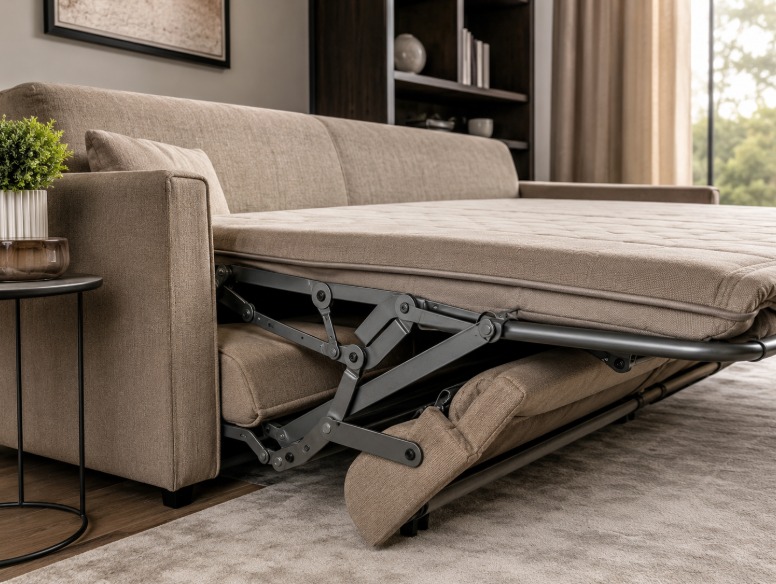
Most convertible sofas do not fail at the fabric. They fail at the joint where the mechanism meets the frame. Every conversion cycle transfers load through that connection, and a frame made of engineered board will eventually crush around the fasteners. Solid wood and heavy gauge steel absorb the same stress without deforming, which is why the cheapest frames rarely survive past a few hundred cycles.
Hinges tell a similar story. Untreated hardware develops play, then binds, then stops seating properly. Treated steel hinges cost more upfront and are one of the few components that almost never come back for service.
The third recurring issue is foam. Compressive fatigue in low density foam shows up within a year, and it shows up first along the fold line, where the material is bent rather than compressed. High density foam and individually wrapped pocket springs handle repeated folding far better, though they add weight and cost.
What the Sleep Surface Actually Requires
The old pull out design put a thin pad over a folding metal grid, which is why an entire generation associates convertibles with a bar across the lower back. Contemporary designs approach the problem differently, either by suspending the sleep surface on a continuous deck or by eliminating the fold entirely through a click clack or trundle style conversion.
Shoppers comparing a Queen Size Sofa Bed against a standard mattress often find the gap smaller than expected, provided the mattress depth reaches four inches or more and the support deck runs continuously beneath it.
Daytime Duty Is the Longer Shift
A convertible sits as a sofa for roughly 350 days a year and functions as a bed for maybe fifteen. Design that optimizes only for the fifteen produces a piece that nobody enjoys. Seat depth, back angle, and cushion resilience carry most of the daily experience, and mechanisms that force a shallow seat or a bolt upright back tend to get replaced early regardless of how well they sleep.
Sectional versions extend the useful range further. Corner and chaise configurations add seating and often storage without expanding the footprint, which matters in rooms where the sofa is also defining the traffic path.
Longevity as a Design Decision
A few practical markers correlate with a long service life:
- Frames of solid wood or heavy duty metal rather than particleboard
- High density foam or pocket spring cushioning
- Performance rated upholstery suited to heavy use
Restraint in styling matters too. Multifunctional pieces get kept longer than single purpose ones, so clean lines and neutral upholstery age better than anything tied to a specific season. The furniture that lasts tends to look unremarkable, and that is usually deliberate.