


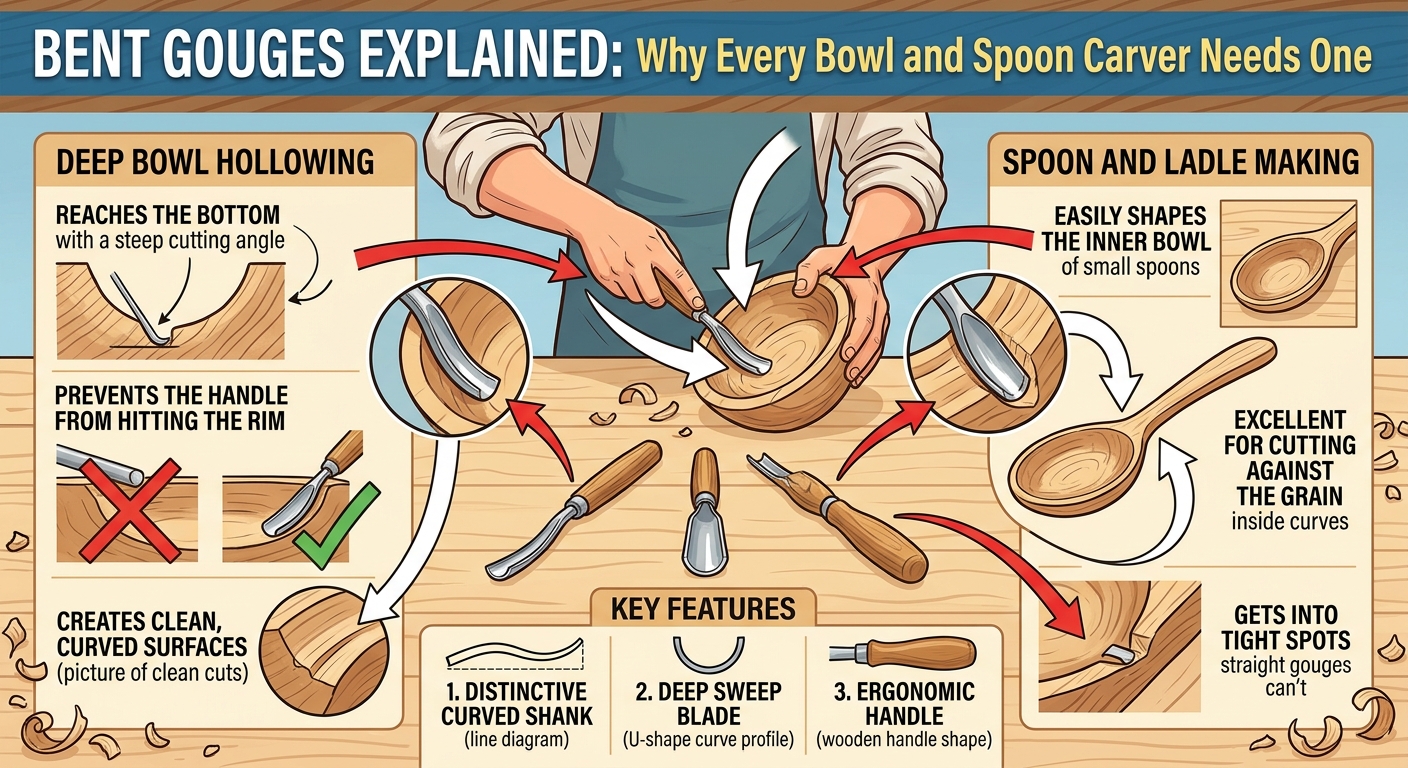
Straight tools handle straight problems. The moment a project curves inward, whether it is the bowl of a spoon, the inside of a kuksa, or the base of a carved dish, a straight gouge runs out of clearance and starts scraping rather than cutting. That is the exact problem a bent gouge was designed to solve, and it explains why the tool shows up in nearly every serious spoon and bowl carver’s roll.
What Makes a Gouge “Bent”
A bent gouge is simply a gouge whose shaft curves upward from the handle before reaching the cutting edge. That curve lifts the handle clear of the workpiece, letting the blade reach deep into a hollow form without the carver’s hand banging into the rim. Depth is the whole point: a flat gouge can hollow the first centimeter of a bowl just fine, but past that point the handle collides with the wood before the edge reaches the bottom. Bent gouges are built specifically to keep cutting long after a straight tool would stall out.
Sweep: The Curve That Matters Most
Sweep, the curvature of the cutting edge itself, is the second variable that matters as much as the bend in the shaft.
- Low-sweep (labeled #3 or #5): long, shallow, controlled passes for smoothing and refining an already roughed-out hollow
- High-sweep (higher numbers): digs deeper and faster, the tool of choice for initial hollowing of a kuksa or deep bowl
Most carvers who work spoons and bowls regularly end up owning at least two sweeps: one aggressive tool for roughing and one gentler tool for finishing cuts.
Matching Size to the Project
Size follows the same logic as any other carving tool: match the gouge width to the scale of the hollow.
- 10-15mm: teaspoons and small serving spoons
- 20-30mm: kuksas, ladles, and larger bowls where speed matters more than fine control
Buying a single mid-size bent gouge is a reasonable way to start, since it handles a wide range of projects reasonably well before specialization becomes worthwhile.
Technique and Bracing
Technique with a bent gouge differs slightly from straight-tool carving. Because the curve changes how force translates from hand to edge, most carvers use a controlled push or a rocking, scooping motion rather than a straight shearing cut. Bracing the workpiece firmly, either in a carving vise or against the body with a carving glove, matters more here than with straight tools because the cutting angle constantly changes as the gouge follows the curve of the hollow.
Steel, Handles, and Long-Term Comfort
Steel quality has an outsized effect on how a bent gouge performs over time. High-carbon steel tempered to a hardness in the 60-62 HRC range holds an edge through the abrasive, repetitive cuts that hollowing demands, while softer steel dulls quickly and turns hollowing into a frustrating, effort-heavy task. A dull bent gouge is also considerably more dangerous than a sharp one, since it requires extra force exactly in the position, hands wrapped around a curved hollow, where slips are hardest to control.
Handle shape and length also affect how a bent gouge performs during long hollowing sessions. A handle that is too short forces the hand close to the wood and limits leverage on deeper cuts, while one that is well balanced for its blade length lets the carver apply steady pressure without gripping harder than necessary. Hardwood handles finished smooth, without sharp edges or seams, reduce fatigue and blistering across a full afternoon of hollowing, which matters more than it sounds once a kuksa or a large serving bowl is underway.
Buying a Set Instead of a Single Tool
For carvers building out a kit rather than buying a single tool, curated bent gouge sets that pair a couple of sweeps and sizes together tend to be more useful than buying gouges individually and guessing at compatibility. STRYI’s bent gouge lineup, at https://woodcarving-tools.com/collections/bent-tools, is organized around exactly this kind of practical pairing, covering everything from delicate spoon bowls to deep kuksa hollows.
Once a bent gouge earns a permanent spot in the tool roll, most carvers notice it gets reached for more often than almost any other single tool, precisely because so much of spoon, bowl, and kuksa carving comes down to one task: reaching into a curve that a straight blade simply cannot follow.