


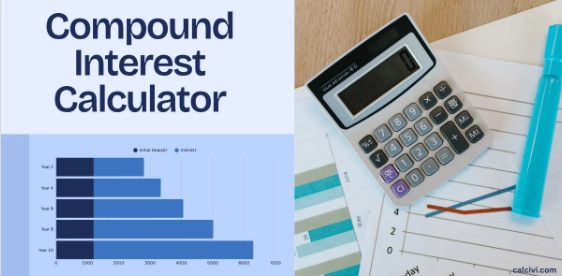
A compound interest calculator in the UAE can help you estimate how your savings or investments may grow over time. Unlike simple interest, compound interest allows previously earned interest to become part of the balance and generate additional returns.
This makes compounding especially useful when planning long-term savings, investments, retirement funds, or other financial goals.
What Is a Compound Interest Calculator?
A compound interest calculator is a financial planning tool that estimates the future value of money based on factors such as:
- Initial investment
- Interest or expected return rate
- Investment period
- Compounding frequency
- Regular contributions
Several financial institutions in the UAE provide calculators or planning tools that allow users to estimate future savings. For example, Emirates NBD’s calculator includes an initial investment, monthly contribution, duration, and estimated annual return.
What Is Compound Interest?
Compound interest means earning returns on both the original amount and the returns accumulated previously.
For example, suppose you deposit AED 10,000 and earn a return. After the first period, the interest is added to your balance. During the next period, the return is calculated on the larger balance.
genui{“learning_viz”:{“type_id”:”COMPOUND_INTEREST”,”content”:”FV=PV(1+r)^n”,”locale_override”:”en-AE”}}
This creates a compounding effect that can become increasingly significant over longer periods. HSBC UAE also explains that compound growth can apply to savings and investments when returns are reinvested.
How a Compound Interest Calculator UAE Works
Using a compound interest calculator tool is generally straightforward.
You normally enter:
- Initial investment
- Monthly or regular contribution
- Expected annual return
- Investment period
- Compounding frequency
The calculator then estimates the future value and may show how much comes from your contributions versus accumulated interest or investment growth.
For example, Emirates NBD’s calculator asks users for their initial investment, monthly contribution, duration, and estimated annual rate of return.
Example of Compound Growth
Suppose you start with:
- Initial amount: AED 50,000
- Annual return: 5%
- Investment period: 10 years
- No additional contributions
If the return compounds monthly, the estimated future value would be approximately AED 82,350.
The calculation is only an illustration. Actual savings or investment returns depend on the product, rate, fees, market performance, and other conditions.
Why Compounding Frequency Matters
Interest can be compounded at different intervals, including:
- Daily
- Monthly
- Quarterly
- Annually
Generally, more frequent compounding can produce a slightly higher result when the nominal rate and other assumptions remain the same.
HSBC UAE explains that its example calculations can use monthly or daily compounding, with the number of compounding periods affecting the calculation.
However, you should always use the actual compounding method specified by your bank or investment product rather than assuming that every account compounds at the same frequency.
Monthly Contributions and Compound Growth
Regular contributions can make a major difference to long-term savings.
For example, someone who starts with AED 20,000 and contributes AED 1,000 every month can potentially build a much larger balance than someone who only makes the initial deposit.
A calculator can help compare different monthly contribution amounts and investment periods.
This is useful for goals such as:
- Retirement planning
- Education savings
- Home purchases
- Emergency funds
- Long-term wealth building
- Children’s future expenses
Compound Interest for Savings Accounts
A savings account may allow your balance to earn interest or profit while remaining relatively accessible.
However, the actual calculation method depends on the account.
Some savings products calculate interest using the daily balance and credit it monthly. HSBC UAE’s E-Saver, for example, calculates interest using the daily closing balance and pays interest monthly.
When using a calculator, make sure the rate and compounding frequency match the actual account terms.
Compound Interest for Investments
Compounding can also occur with investments when income is reinvested.
For example, if an investment generates dividends and those dividends are reinvested to purchase additional units or shares, those additional holdings can potentially generate future returns.
However, investment returns are not guaranteed.
Unlike a fixed interest assumption in a calculator, market investments can rise or fall. Therefore, an investment calculator should be treated as a projection rather than a promise of future performance.
Compound Interest vs. Simple Interest
The main difference is how returns are calculated.
Simple interest is generally calculated only on the original principal.
Compound interest takes previously accumulated returns into consideration.
Over short periods, the difference may be relatively small. Over longer periods, however, compounding can have a much greater effect.
This is one reason starting early can be important when building long-term savings.
How to Use a Compound Interest Calculator in the UAE
Follow these steps:
Step 1: Enter Your Starting Amount
Enter the amount you already have available for saving or investing.
For example:
AED 25,000
Step 2: Add Monthly Contributions
If you plan to add money every month, enter your expected contribution.
For example:
AED 1,000 per month
Step 3: Enter the Expected Rate
Enter the annual interest rate or expected investment return.
For example:
5%
For investments, remember that this is an assumption and actual returns may vary.
Step 4: Select the Time Period
Choose how long you plan to keep the money invested.
For example:
10 years
Step 5: Select the Compounding Frequency
Choose daily, monthly, quarterly, or annual compounding if the calculator provides these options.
Step 6: Review the Results
The calculator may show:
- Final balance
- Total contributions
- Total interest or growth
- Year-by-year growth
This can help you understand how different assumptions affect your financial goal.
Using a Calculator for Fixed Deposits
A compound interest calculator UAE can also be useful when comparing fixed deposits, but you need to use the correct assumptions.
A fixed deposit may have a fixed rate for a specific tenure, but the way returns are paid or reinvested can differ between products.
Therefore, compare the calculator’s estimated result with the bank’s actual maturity calculation.
Using a Calculator for Retirement Planning
Long-term retirement planning is another useful application.
You can enter:
- Current savings
- Monthly investment
- Expected annual return
- Number of years until retirement
Then you can test different scenarios.
For example, you might compare saving AED 1,000, AED 2,000, and AED 3,000 per month to see how your projected balance changes.
This can demonstrate how increasing contributions or starting earlier may affect long-term growth.
Benefits of Using a Compound Interest Calculator
A calculator can help you:
- Set realistic savings targets
- Compare different investment scenarios
- Understand the effect of time
- Estimate future balances
- See the impact of regular contributions
- Compare different assumed rates
- Plan for long-term financial goals
It can also make complex calculations easier for people who are not comfortable with financial formulas.
Limitations of Compound Interest Calculators
A calculator does not guarantee a specific future result.
The actual outcome can be affected by:
- Changing interest rates
- Investment market performance
- Fees
- Missed contributions
- Inflation
- Taxes where applicable
- Changes in product terms
For example, a calculator using a constant 7% return assumes that rate remains constant for the projection. Real investment returns may fluctuate considerably.
Therefore, it is useful to test multiple scenarios rather than relying on one optimistic assumption.
Tips for Using a Compound Interest Calculator UAE
For more realistic planning:
- Use the actual interest or profit rate when calculating savings products.
- Use conservative assumptions for investment returns.
- Include regular contributions if you plan to make them.
- Compare different investment periods.
- Test lower and higher return scenarios.
- Consider applicable fees.
- Review inflation when planning long-term goals.
- Recalculate when your savings strategy changes.
Conclusion
A compound interest calculator UAE is a useful tool for understanding how money can grow over time through reinvested returns and regular contributions. It can help UAE residents estimate future savings, compare different scenarios, and plan for goals such as retirement, education, property purchases, and long-term wealth building.
The most important factors are the starting amount, contribution level, expected return, time period, and compounding frequency. However, calculator results are estimates rather than guarantees. For savings products, use the actual rate and conditions provided by the bank; for investments, remember that returns can fluctuate. By testing realistic scenarios and reviewing your plan regularly, a compound interest calculator can become a valuable part of your financial planning.