


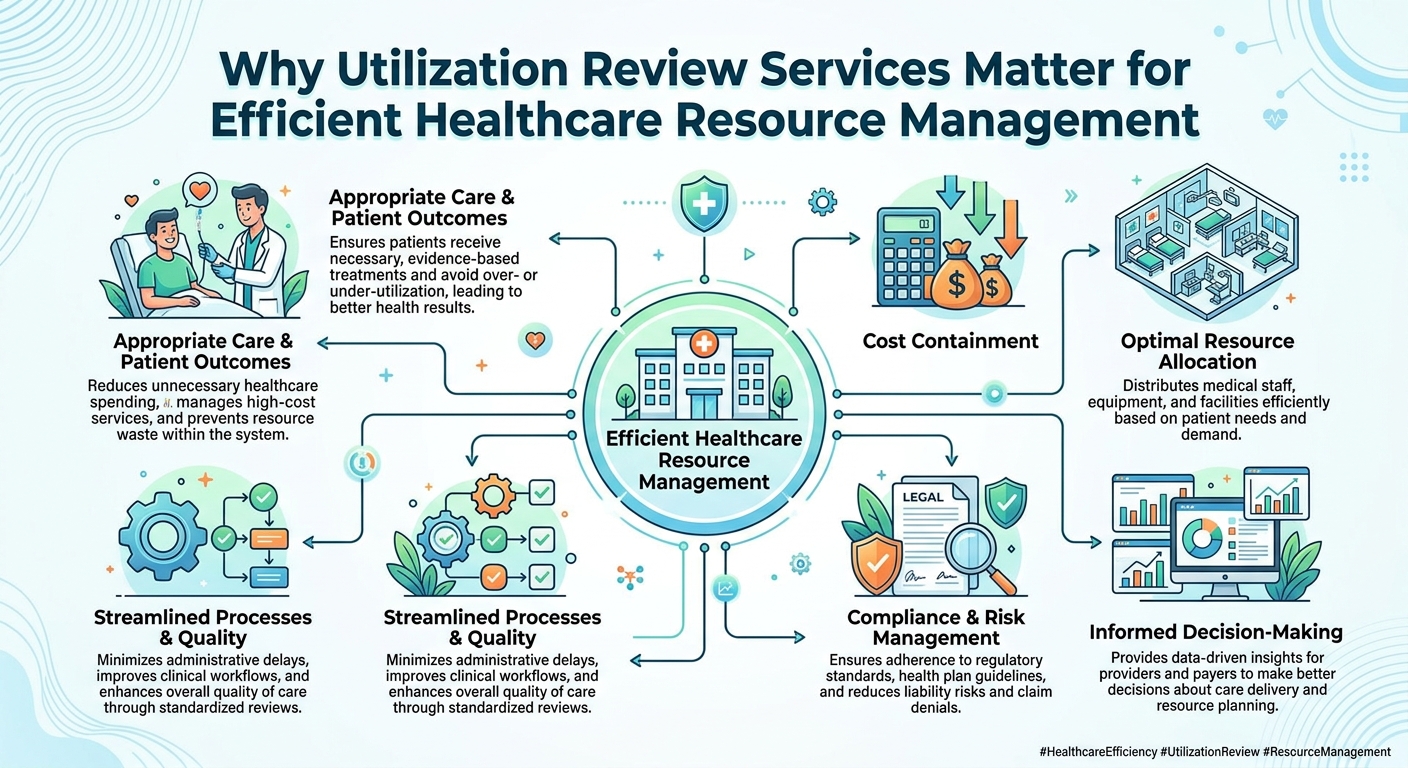
Healthcare providers have to strike a balance between growing patient demand, rising costs, and scarce resources. Organisations can determine whether medical care is necessary, appropriate, and provided in the proper setting by using utilisation review services. These services promote responsible resource allocation without sacrificing patient needs by evaluating treatment choices in light of clinical criteria.
Understanding Utilisation Review
A methodical procedure called utilisation review is used to assess medical services prior to, during, or following treatment. Reviews may take into account hospital stays, procedures, diagnostic tests, admissions, and other interventions. Determining whether the degree and duration of care are warranted by a patient’s clinical circumstances is the goal, rather than just cutting costs.
Supporting Appropriate Care
Promoting appropriate treatment is one of utilisation review’s primary advantages. Examining clinical data can reveal circumstances in which a suggested intervention might not be medically necessary or in which a different degree of care might be more appropriate. This promotes evidence-based decision-making and can cut down on needless hospital stays, avoidable procedures, and unnecessary admissions.
Improving Resource Allocation
Hospital beds, specialist time, medications, diagnostic facilities, and financial capacity are examples of healthcare resources. Inefficient use of these resources can make it harder for patients who actually need care to get it. Organisations can detect inappropriate use and allocate resources to situations where they can provide more clinical value by using a standardised review process.
Controlling Unnecessary Costs
Selecting the least expensive course of action is not a prerequisite for efficient resource management. Rather, it entails making certain that spending is linked to suitable clinical results. Duplicate investigations, prolonged stays without adequate justification, and services that deviate from accepted clinical guidelines can all be identified through utilisation review. By addressing such trends, cost control can be supported while upholding essential care standards.
Enhancing Coordination and Accountability
Communication between physicians, case managers, insurers, and healthcare administrators is also improved by utilisation reviews. A more reliable foundation for assessing care is produced by clearly documenting clinical decisions. Additionally, it can help organisations improve protocols, discharge planning, and coordination between various levels of care by highlighting persistent gaps in their processes.
Using Data to Identify Patterns
Data is being used more and more by modern healthcare organisations to comprehend utilisation trends. Frequent readmissions, odd treatment patterns, or differences between departments and providers can all be found by analysing review findings. Decision-makers can use these insights to guide quality improvement projects and create policies based on real trends rather than conjecture.
The Role of CodeMax
By providing healthcare organisations with organised procedures for coding and clinical documentation, CodeMax can be a part of the administrative and review environment. Because utilisation decisions are based on trustworthy data regarding diagnoses, procedures, and patient circumstances, accurate coding is crucial. Organisations can better understand how resources are being used, and reviewers can make more informed assessments when documentation and coding are consistent. Instead of being viewed as stand-alone cost-control measures, these functions are most beneficial when incorporated into quality, compliance, and care-management procedures.
Conclusion
Clinical necessity, patient outcomes, and responsible spending must all be balanced for effective healthcare resource management. Utilisation review establishes a methodical approach to assess that equilibrium, pinpoint areas for enhancement, and promote responsible service utilisation. Utilisation review services can assist healthcare organisations in making better use of scarce resources while maintaining a focus on timely, safe, and patient-centred care when they are backed by precise documentation, data, and coordinated decision-making.