


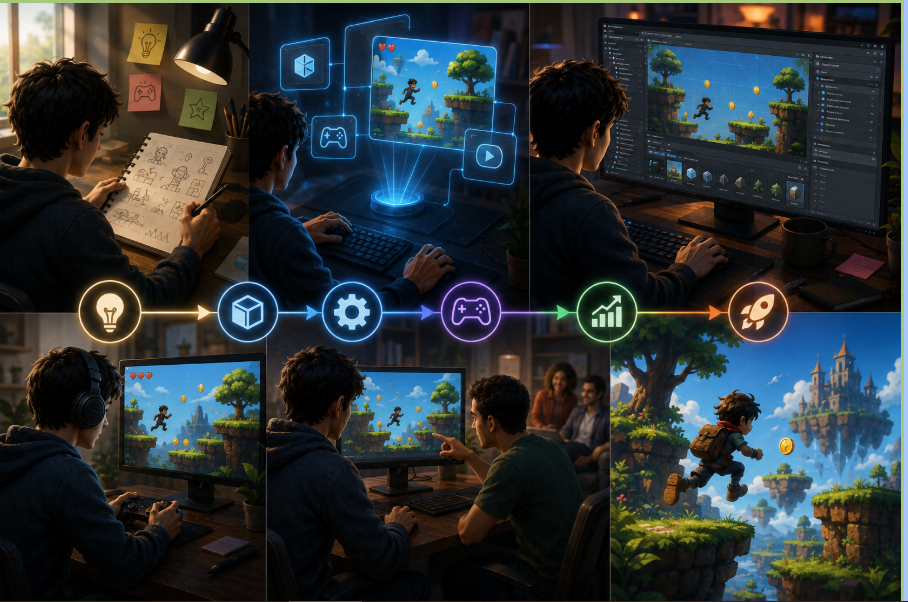
Professional development skills used to be treated as a prerequisite for making anything worth playing, as if a game’s quality depended directly on the credentials of whoever built it. That assumption never held up particularly well, and it holds up even less now. Creating a genuinely good game without any professional background is not just possible, it’s become a realistic, well-worn path.
Why Professional Skills Were Never the Actual Requirement
Design Instinct and Technical Training Are Different Things
Knowing how to code well doesn’t automatically make someone good at pacing, difficulty balance, or understanding what makes a mechanic satisfying. Plenty of professionally trained developers have shipped games that played poorly, and plenty of people with zero formal training have built genuinely addictive, well-balanced games because their instincts for what feels fun were strong from the start.
What Actually Determines Whether a Game Is Good
Players judge a game by whether it’s fun, fair, and worth returning to. They have no way of knowing, and generally don’t care, whether the person who built it has a computer science degree or learned everything from scratch over a single weekend. The credential was never really the thing that mattered.
What Replaced the Need for Professional Skills
Describing Instead of Coding
The technical execution that used to require years of professional training now happens through plain-language description. You explain what you want the player to do, and the platform translates that into a working version, no formal training required at any point in the process.
Iteration Without a Technical Background
Refining a game traditionally required enough programming skill to implement every adjustment yourself. Now, changes happen through further description rather than direct code editing, which means iterating toward something genuinely good doesn’t depend on professional-level technical ability.
A Practical Path for Someone With No Development Background
Step 1: Pick Something You Genuinely Understand as a Player
Choose a genre you already enjoy and have played enough to have real opinions about. That familiarity gives you an internal compass for what “good” feels like, which matters far more than any technical credential when evaluating your own early attempts.
Step 2: Define Your Core Mechanic in One Sentence
Before generating anything, know exactly what the player does, repeatedly, that should feel satisfying. A game like Elastic Thief 2 shows how a simple, immediately understandable mechanic can carry real appeal without needing technical complexity behind it, its strength comes from a clear, tight core action, not from sophisticated underlying systems.
Step 3: Describe It in Plain Language
Explain your idea the way you’d explain it to a friend who has no technical background either. No-code game maker platforms handle translating that description into a working prototype, removing the exact barrier that used to require professional training to clear.
Step 4: Play the Rough Version Honestly
Experience your first generated version exactly as it came out, before making any adjustments. This tells you what’s genuinely working, information no amount of professional training would substitute for at this stage.
Step 5: Refine Through Small, Targeted Changes
Adjust one element at a time and test the result before moving to the next. This is the same iterative process professional developers use, it just doesn’t require their technical background to execute.
Step 6: Get Outside Feedback
Watch someone unfamiliar with your project play it. Their honest reactions reveal problems and opportunities that no amount of internal confidence in your own instincts can fully replace.
Step 7: Polish Based on What You Observe
Once your core mechanic feels genuinely satisfying, shift attention to feel and pacing. This stage benefits from patience and careful attention, not professional credentials.
What You Don’t Need
A Computer Science Background
Understanding how code works underneath your game has essentially no bearing on whether the game is fun. That knowledge was always more relevant to execution than to design quality.
Formal Design Training
While structured design education can be valuable, plenty of genuinely great games have come from people who developed their sense of design purely through playing critically and iterating on their own projects.
A Large Budget or Team
Professional development traditionally implied significant resources, multiple specialists, dedicated tools, real budget. None of that is required to create something genuinely good using accessible, AI-assisted platforms.
What You Still Need, Regardless of Background
Genuine Curiosity About Why Things Feel Good
The people who improve fastest, professional or not, are the ones who ask why a particular version worked better than another, rather than just accepting results without examining them.
Willingness to Be Wrong Early
Your first instinct about what will feel fun is often incorrect, and that’s completely normal regardless of background. Treating that as useful information rather than personal failure is what actually drives improvement.
Patience Through Multiple Rounds of Iteration
No path to a good game, professional or otherwise, skips the process of testing, adjusting, and retesting several times before something feels right.
Common Doubts Worth Addressing
“Won’t It Be Obvious I’m Not a Real Developer?”
Players judge the experience, not the credentials behind it. A well-tested, genuinely fun game doesn’t announce the background of whoever made it, and most players never think to ask.
“What If My Idea Isn’t Technically Sophisticated Enough?”
Technical sophistication was never what made games good. Simple, well-executed mechanics consistently outperform complex, poorly-tuned ones, regardless of who built them or how.
“I Don’t Know Enough to Fix Problems When They Come Up”
Most problems in a first project are design problems, pacing, clarity, fairness, not technical ones. These are solved through playtesting and iteration, not professional technical troubleshooting.
Final Thoughts
Creating a game without professional development skills isn’t a workaround or a lesser path, it’s a legitimate route to building something genuinely good, because the credential was never actually the thing that determined quality in the first place. What matters is the same as it’s always been: a clear idea, honest playtesting, and the willingness to refine based on real feedback.
If a lack of professional training has been holding back an idea you’ve had for a while, that barrier no longer applies the way it used to. The only real requirement left is starting.