


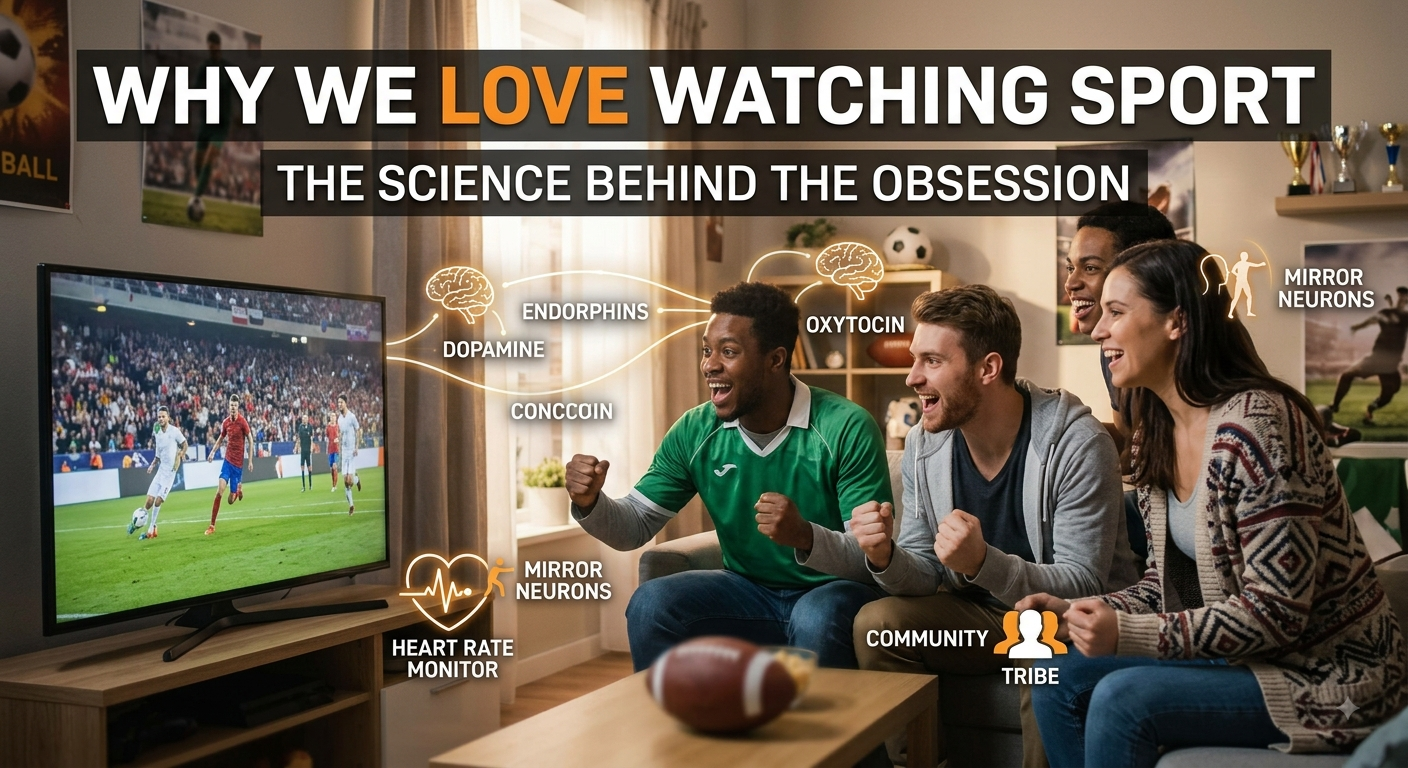
You could watch a film with better cinematography, a drama with tighter scripts, or a documentary that teaches you something new. And yet, millions of us will cancel plans, rearrange schedules and sit through three hours of football on a Tuesday night.
Sport holds a grip on us that scripted entertainment can’t quite match, and the reasons go deeper than just liking a team. Let’s take a closer look at what’s really going on in your brain when you watch sport.
Your Brain Picks a Tribe Before You Even Realise
Humans are tribal by design. Long before organised sport existed, we survived by forming tight groups and defending them against outsiders. That wiring hasn’t gone anywhere. When you support a club, you’re plugging into an ancient need to belong to something bigger than yourself.
Psychologists call this social identity theory. Your team becomes part of how you define yourself. That’s why a loss can genuinely ruin your evening and a win can carry you through a tough week. You’re not just observing the result. You’re experiencing it as if it happened to you personally.
It also explains the “we” phenomenon. Fans say “we won” after a victory and “they lost” after a defeat. It’s not delusional. It’s your brain protecting your sense of identity.
Why a Live Match Beats a Replay Every Time
Here’s a quick test. Think about the last time you recorded a match and watched it later, already knowing the score. It wasn’t the same, was it? That’s because a huge part of sport’s appeal comes from unpredictability.
Your brain’s reward system runs on dopamine, and dopamine doesn’t just respond to good outcomes. It responds most strongly to uncertain ones. A last-minute goal, a photo finish, a comeback from two sets down. These moments flood your brain with more dopamine than a predictable win ever could. It’s the same chemical mechanism behind why slot machines are more addictive than vending machines. The uncertainty is the product.
Scripted entertainment can surprise you once. Sport can surprise you every single week.
The Social Glue You Don’t Notice
Sport gives people a shared language. You can walk into a pub, an office or a barbershop and strike up a conversation with a total stranger about last night’s match. Very few things in modern life offer that kind of instant common ground.
Research in behavioural science has shown that shared emotional experiences, particularly ones involving tension and release, strengthen social bonds quickly. Watching your team scrape a win in added time with a room full of strangers will bond you faster than months of small talk.
When You Have Something Riding on the Outcome
Prediction is a big part of why sport keeps us locked in. Even casually guessing the score before kick-off changes how you watch a match. You’ll pay closer attention, react more strongly to key moments and remember the game in more detail afterwards. Your brain treats your prediction as a small personal stake, and that transforms you from a passive viewer into an active participant.
This is why fantasy football leagues are so popular. They give fans a reason to care about matches they’d otherwise ignore. You’ll happily watch Brentford vs Wolves if your fantasy midfielder is on the pitch.
The same principle scales up when real stakes are involved. The growing availability of betting offers across major sporting events reflects how many fans want that extra layer of engagement. Having something tangible connected to the outcome, even something small, sharpens focus in a way that pure spectating doesn’t.
Sport Tells Stories Without a Script
Every season is a narrative arc. Promotion battles, relegation scraps, underdog cup runs, ageing legends chasing one last trophy. These storylines emerge naturally from competition, and because they’re unscripted, they carry an emotional weight that fiction struggles to replicate.
You can’t write a character more compelling than Leicester winning the Premier League at 5000-1. You can’t script the tension of a fifth-set tiebreak at Wimbledon. The drama is real, and your brain knows the difference.
More Than Just a Game
Sport works on us because it hits several psychological buttons at once. It satisfies our need to belong, rewards us with dopamine, gives us social currency and tells stories we genuinely can’t predict. That’s a combination no screenwriter can manufacture. So next time someone asks why you’re watching “just a game,” you’ll know the answer runs a lot deeper than that.