


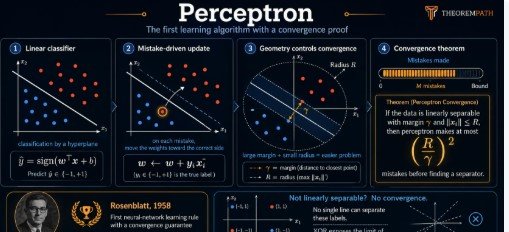
Machine learning has a very long pedigree of elegant mathematical guarantees and the Perceptron Convergence Theorem is one of the most fundamental of these. It was introduced in conjunction with the Perceptron model itself by Frank Rosenblatt in 1958 and it provides a very elegant proof that the Perceptron learning algorithm will always find a correct solution if the data it is learning from is linearly separable. It’s absolutely essential that you understand this theorem if you’re at all serious about machine learning or if you’re doing artificial intelligence training Bangalore.
What Is a Perceptron?
A perceptron is the simplest form of artificial neural network. It takes a number of inputs, assigns a weight to each one, calculates a weighted sum and then produces a binary output (usually 0 or 1) depending on whether that sum exceeds a certain threshold.
Mathematically, the perceptron makes a decision using the following rule:
- Output = 1, if (w . x + b) >= 0
- Output = 0, otherwise
Here w is the weight vector, x is the input vector and b is the bias term. During training the perceptron will adjust its weights each time it makes a mistake. That’s the update rule that the convergence theorem is concerned with.
The Convergence Theorem Explained
The Perceptron Convergence Theorem says that if the data is linearly separable (i.e. there exists a straight line, or hyperplane in higher dimensions, that can separate the two classes) then the perceptron learning algorithm will converge to a correct set of weights in a finite number of steps.
Three conditions must hold for the theorem to apply:
- Linear separability: the two classes must be separable by a hyperplane.
- Finite dataset: the training data must be a finite set of points.
- Standard update rule: weights are updated as w = w + y.x for each misclassified point, where y is the true label (+1 or -1).
When those conditions are met the theorem ensures termination. The upper bound on the number of mistakes the algorithm will make before it converges is given by:
Number of mistakes <= (R / gamma)^2
In this bound R is the maximum Euclidean norm of any input vector and gamma is the geometric margin (i.e. the minimum distance from any data point to the separating hyperplane). The smaller the margin and the larger the input vectors, the more mistakes you’ll have before convergence is achieved, but convergence is always guaranteed.
Why Linear Separability Matters
The guarantee of the theorem is entirely predicated on linear separability. If the data is not linearly separable then the perceptron will just go round and round in its weight updates and will never converge to a solution.
This isn’t a bug, it’s a well defined boundary condition. It tells you precisely when you can trust the algorithm and when you need to look elsewhere (e.g. soft margin SVMS, multi-layer networks). Knowing where the algorithm applies is just as important as knowing how it works.
Real world problems often have data that isn’t linearly separable in the raw input space. You can however get the data into a higher dimensional space via feature engineering or kernel methods such that it is linearly separable and the theorem applies once more.
Practical Significance in Modern AI Learning
Although modern deep learning architectures are vastly more complex than a single perceptron, the Convergence Theorem is still relevant for a number of reasons.
First off there’s the concept of a learning guarantee (a mathematical proof that an algorithm will in fact converge to the correct answer under certain conditions). That concept then gets carried through into the analysis of SVMS, logistic regression and indeed into various aspects of neural network optimisation.
Secondly it provides a geometric interpretation of classification. You can visualise the decision boundary as a hyperplane and understand the role of the margin. That in turn gives you a really good intuitive feel for how more sophisticated classifiers work.
For students doing an AI training in Bangalore the Perceptron and the Perceptron Convergence Theorem are pretty much the first formal ML theory thing you come across and they’re the thing that act as a bridge between the maths and the actual design of the algorithms.
Conclusion
The Perceptron Convergence Theorem is a very concise but extremely powerful result. It states that a perceptron will converge on a correct classification of linearly separable data in a finite (bounded) number of steps, and it gives you an explicit formula for that bound. More significantly it teaches you a general lesson that mathematical rigour and practical learning algorithms are inextricably linked. You learn from it that you can in fact have both. It is a key lesson in building the analytical capability to go on and assess, compare and design learning algorithms with some degree of confidence.