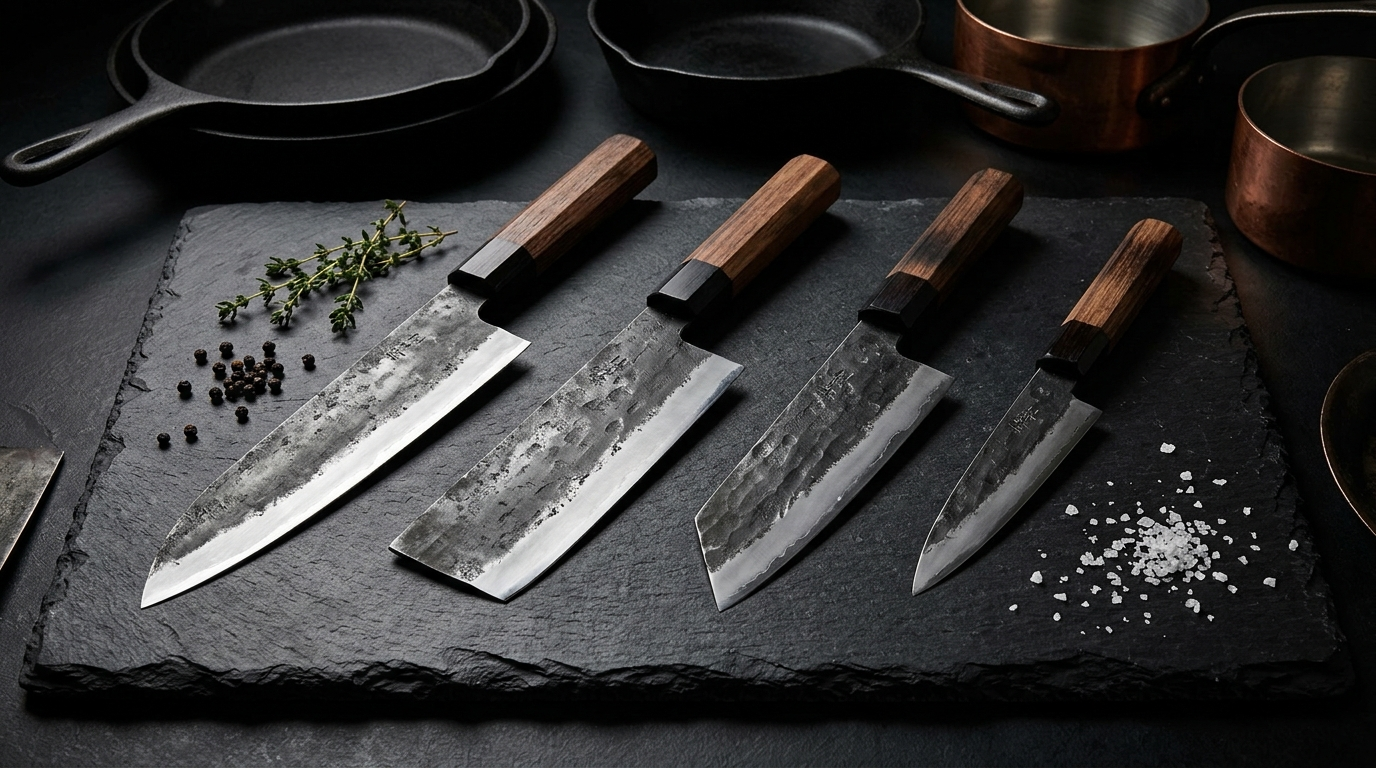
Picture two chef’s knives side by side on a cutting board. One is mirror-polished, perfectly symmetrical, and identical to thousands of others from the same production line. The other is dark and rough near the spine, unusually tall, and so light that you lift it twice to be sure. Which one would you trust with a ripe tomato?
More and more cooks are reaching for the second knife. One of the most distinctive examples comes from Niimi, a small city in the hills of Okayama Prefecture, where Takeda knives are still forged by hand. Their story shows why hand-forged Japanese knives keep winning loyal fans in an age of mass production.
A Family Forge With a Personal Vision
The Takeda workshop, known as Takeda Hamono, was founded in 1920 and moved to Niimi in 1951. Today its name is inseparable from Shosui Takeda, a third-generation master blacksmith who has spent decades refining his own idea of what a kitchen knife should be.
That idea has little to do with factory perfection. He aims for a tool that feels alive in the hand, cuts with very little effort, and holds up to years of daily use. Every knife is forged, heat-treated, sharpened, and finished in the workshop, and every one carries visible traces of the hand that made it.
The Shape You Notice First
Pick up one of these knives and the profile is the first surprise. The blades are taller than most Japanese chef’s knives, which gives your knuckles generous clearance above the board. Yet they are remarkably light for their size.
The real secret sits just behind the edge. Takeda grinds his blades extremely thin there, so the knife meets very little resistance as it moves through food. Onions split cleanly, herbs are sliced rather than crushed, and the blade is less likely to wedge in dense vegetables halfway through a cut.
This geometry gives Takeda knives a strong personality, and it divides opinion. Some cooks find the tall blade awkward at first. Others never want to go back. Either way, these are not neutral, generic tools, and that is exactly the point.
Aogami Super: Hard Steel, Long-Lasting Edge
At the core of Takeda’s NAS series is Aogami Super steel, often called “Blue Super.” It is a Japanese high-carbon steel with added chromium, tungsten, molybdenum, and vanadium, prized above all for edge retention. Heat-treated to roughly 63–64 HRC on the Rockwell hardness scale, it holds a keen edge far longer than a typical Western kitchen knife, which usually sits closer to 56–58 HRC.
High hardness comes with a trade-off. A very hard edge is less forgiving than a softer one, so it can chip if it is twisted, dropped, or driven into bone. These knives are built for precise slicing and push-cutting, not for hacking through a chicken carcass.
The NAS line of Takeda Hamono knives adds a practical twist. The Aogami Super core is clad in stainless steel, so the sides of the blade resist rust far better than a fully reactive carbon knife. Only the very edge remains exposed carbon steel. You get the cutting performance of one of the best carbon steels available, with much less daily worry.
Why the Kurouchi Finish Stays
Many Takeda blades keep a dark, slightly rough coating along the upper part of the blade. This is the kurouchi finish, which translates loosely as “black forged.” It is the layer of scale that forms on the steel during forging, left in place rather than polished away.
The kurouchi finish does three things. It adds a little protection against corrosion, and it keeps the look of the forge on the finished knife. It also makes every knife slightly different: two blades of the same size can vary in height, weight, finish, and balance. For collectors, that variation is a feature: each knife is a one-of-a-kind piece.
Carbon Steel Knife Care: Simple Habits That Matter
Even with stainless cladding, the exposed Aogami Super edge needs a little attention. These habits will keep it performing for years:
- Rinse and dry the blade right after each use, especially after cutting acidic foods like citrus or tomatoes.
- Never leave the knife wet on the board or soaking in the sink.
- Avoid bones, frozen foods, and other very hard items.
- Use a good wooden or plastic cutting board. Glass, stone, and ceramic surfaces dull and chip hard edges fast.
- Sharpen on Japanese water stones when the edge starts to lose its bite, rather than with a pull-through sharpener.
Over time, the exposed edge will develop a gray or bluish patina. That is normal, and it even helps protect the steel. Orange rust, on the other hand, is a sign the knife stayed wet too long.
What a Takeda Knife Teaches Us
In a kitchen full of tools designed to look identical, Takeda knives are a reminder that craft still has a voice. They are tall but light, rustic in appearance yet refined in performance, and a little demanding in care but generous in return. They will not suit everyone, and they don’t try to.
That honesty may be the best lesson a hand-forged blade can offer. A great tool is not the one that pleases everyone. It is the one that fits the person using it.
Do you prefer a knife with visible character, like a kurouchi finish and a hand-forged profile, or a polished, uniform blade? Share your choice and your reasons in the comments.