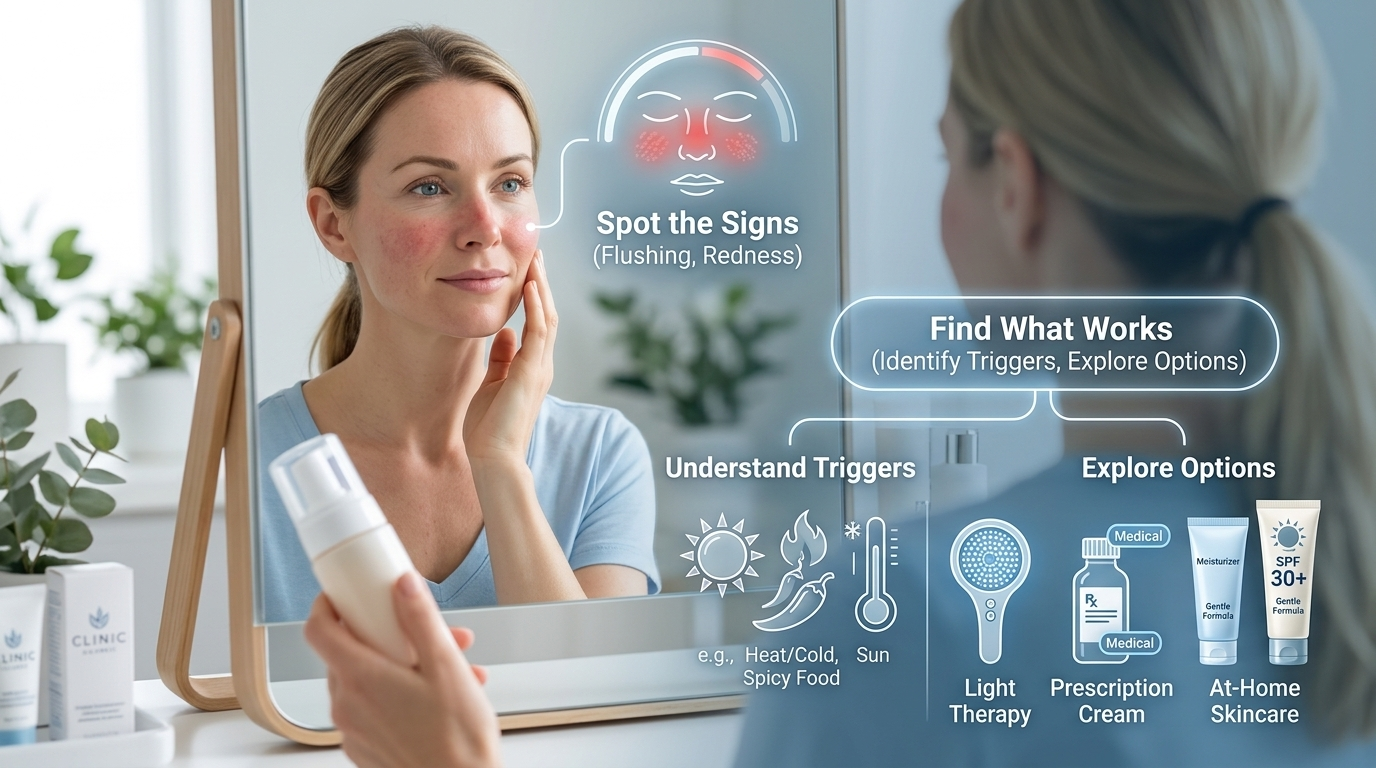
You step into a warm café after a long walk in the cold and, within minutes, your cheeks are on fire. The heat spreads to your nose, and the flush lingers long after you’ve taken off your coat.
If that keeps happening, you’ve probably started to wonder: is this just sensitive skin, or something that won’t go away on its own? Rosacea is a very common adult skin condition, and it often goes undiagnosed for years.
This guide will help you recognize the signs, understand what sets off flare-ups, tell rosacea apart from couperose, and explore the rosacea treatment options available today.
What Is Rosacea?
Rosacea is a chronic inflammatory skin condition that mainly affects the center of the face: the cheeks, nose, chin, and forehead. It comes and goes in flare-ups, with calmer periods in between. It usually appears after age 30, in women and men alike, and tends to be more visible on fair skin.
Its exact cause is still not fully understood. Researchers point to a mix of factors: overreactive small blood vessels, a family predisposition, and a more reactive skin immune response. In some people, a high density of Demodex, a microscopic mite that naturally lives on the skin, also seems to play a role.
Rosacea Symptoms to Watch For
Rosacea doesn’t look the same on everyone. These are the most common rosacea symptoms to keep an eye on.
✅ Flushing: your face suddenly turns red in response to heat, emotion, or spicy food. At first, the redness fades within minutes or hours.
✅ Persistent redness: over time, the redness settles in the center of the face and no longer fades completely. It may come with a feeling of warmth or stinging.
✅ Visible blood vessels: thin red or purple vessels appear on the cheeks and around the nose. These are called telangiectasias, and they’re what people usually mean by couperose.
✅ Bumps without blackheads: red bumps and pustules can appear and look a lot like acne. Unlike acne, though, they don’t come with blackheads or whiteheads.
✅ Irritated eyes: some people feel dryness, burning, or a gritty sensation in their eyes. These eye symptoms call for prompt medical advice.
Couperose or Rosacea: What’s the Difference?
The two words are often used interchangeably, which causes plenty of confusion. Couperose mostly refers to the vascular side of things: the small dilated vessels that stay visible on the surface of the skin.
Rosacea is the broader condition. It can include couperose, but also flushing, inflamed bumps and, more rarely, thickening of the skin on the nose.
Diffuse redness with no visible vessels is sometimes just temporary reactivity. To better understand your own symptoms, this overview of facial redness explains the possible causes and how they are assessed.
Common Rosacea Triggers
Triggers vary from one person to the next. Keeping a simple flare-up journal for a few weeks is often the easiest way to spot yours.
Environmental Factors
Sun exposure tops the list: UV rays worsen redness and weaken blood vessels. Temperature swings matter too, like going from winter cold into an overheated room, wind, or a very hot bath. Fragranced or harsh skincare products can also reignite inflammation.
Lifestyle Habits
Alcohol (red wine in particular), hot drinks, and spicy foods frequently cause flushing. Stress and intense exercise also temporarily increase blood flow to the face. Identifying your rosacea triggers won’t cure the condition, but it often reduces how frequently flare-ups happen.
Rosacea Treatment: Your Options
No treatment makes rosacea disappear for good, but several approaches can keep it well under control. Most of the time, they’re combined based on the type of rosacea and what bothers you most.
Medical Treatments
Diagnosis and prescription treatments are a physician’s job. Depending on the type of rosacea, a doctor may prescribe an anti-inflammatory cream or gel, a gel that temporarily constricts blood vessels, or an oral treatment for forms with bumps. These mainly target inflammation and how often flare-ups occur.
Light-Based Treatments
Persistent redness and visible vessels often respond poorly to creams alone. That’s where IPL photorejuvenation comes in: it targets dilated capillaries to gradually reduce the appearance of couperose. A typical protocol involves three to four sessions spaced about a month apart.
Intense pulsed light (IPL) is not a laser, even though the two are often confused. It isn’t suitable for tanned or recently sun-exposed skin, and darker skin tones require a specific assessment. LED light therapy can complement these sessions to help calm the skin.
At-Home Care
A gentle routine supports every treatment. Use a soap-free, fragrance-free cleanser, a moisturizer that strengthens the skin barrier, and a sunscreen with an SPF of 30 or higher every day, even in winter. Avoid scrubs, cleansing brushes, and products containing alcohol.
Managing Rosacea, One Step at a Time
Rosacea is a chronic condition, but it doesn’t have to run your life. By recognizing the signs early, identifying your triggers, and combining medical follow-up, gentle skincare and, when needed, light-based sessions such as LED light therapy, you can significantly reduce redness.
If the redness becomes permanent or your eyes become irritated, seeing a doctor is always the first step. What about you: which trigger affects your skin the most, the cold, the sun, or stress?