


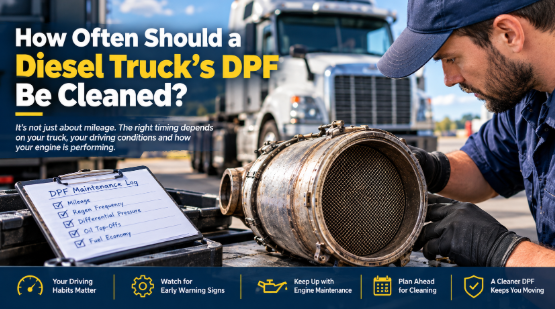
There’s no shortage of mileage figures floating around for this. Shop owners quote one number, engine makers publish another, and the guy at the next fuel island swears by a third. Part of the confusion is that dpf filter cleaning isn’t really a mileage job at all. It depends on what the truck does all day, and two trucks with identical odometers can have filters in completely different shape.
Soot goes quickly, ash doesn’t go at all
Most of what a filter catches is soot, and soot mostly takes care of itself. Regeneration burns it off, either passively on a long highway pull or actively when the ECM injects extra fuel to raise exhaust temperature. Ash is the problem child. It’s what’s left after a little lube oil gets burned in the cylinders, plus the oil’s additive package, and no regen is hot enough to get rid of it. Cummins’ director of customer technical support told Overdrive back in 2010 that regeneration doesn’t create ash, and that what collects comes mainly from the sulfated ash in the oil.
So the ash just sits there, and the filter slowly loses room to hold soot. A partly ash-loaded filter doesn’t build much backpressure by itself. The trouble is that it gets in the way of burning soot. Mack’s David McKenna told the same magazine that the first sign of a full ash load is regens coming more often, which is easy to mistake for a fuel or software issue.
Same odometer, different filter
Take two trucks that both show 250,000 miles. One is a day cab hauling regional freight, loaded and moving at highway speed most of the day. The other is a dump truck that idles at job sites and creeps through town between them.
The first truck’s filter has had a pretty easy life. The second one hasn’t, and there’s a hidden cost beyond the soot. Caterpillar’s Brad Everett told Overdrive that light loads and long idle times can shorten the cleaning interval, since piston rings don’t seal as well when cylinder pressure is low. More oil slips past the rings, so more ash reaches the filter. Pickups that mostly make short trips, delivery vans, anything running a PTO: they all sit closer to the dump truck than the day cab.
A fleet with a mixed yard sees this constantly. The same filter part number, the same service interval on paper, and a spread of results that has little to do with miles. There’s a longer rundown of what drives premature DPF clogging outside of highway duty if you want the full list.
What fleets watch instead
The ones that stay ahead of this usually keep a simple log and watch the trend. Regen frequency is the obvious entry. A truck that went from a regen every week to one every other day has changed, whether or not a light has come on. Differential pressure across the filter, read at similar conditions with a scan tool, shows restriction building. Oil top-offs belong in the log too, because ash starts at the oil. Fuel economy drift counts as well, though it’s noisy: weather and drivers move it as much as the filter does.
Even a pencil log in the glove box beats memory. Date, mileage, regens, oil added.
No single entry says “clean it today.” Together they give you a window, and the idea is to use that window during a scheduled PM instead of after the truck derates with a load on somewhere in Nebraska. A planned cleaning usually costs less than an emergency one, mostly because the cleaning isn’t the expensive part. The tow, the missed delivery and the days off the road are. Pickup or mail-in service, which 30 Minute DPF Clean offers among others, helps keep a unit from sitting for a week.
Fixing what’s feeding the filter
If the engine is making too much soot or ash, cleaning the filter on schedule just means cleaning it more often. The Overdrive piece spent a lot of time on basics: oil that meets the engine maker’s spec, oil changes on time, a tight air intake and charge air cooler, fuel filters changed when due, and a maintained dosing system for active regens. A clogged air cleaner or a charge air leak cuts airflow and sends more unburned particulate down the exhaust.
Turbo failures deserve their own warning. Because the DPF now catches what used to show up as smoke, a failing turbo can go unnoticed. McKenna said sudden power loss with turbine or compressor noise means shutting the engine down right away. Keep running and the filter can take on so much oil that the catalyst and the filter both need replacing.
Where published intervals fit
That 2010 article listed ash-cleaning intervals from about 160,000 miles at the low end to 400,000 or more for some over-the-road Cummins customers. Engines and oils have changed since, so check the current guidance for your engine instead of leaning on a number that old.
From there, let the truck move the date. Regens getting more frequent, restriction creeping up, oil going in between changes: any of them argues for pulling the filter sooner. And if the schedule keeps shrinking even after cleanings, look at the engine instead of the filter.