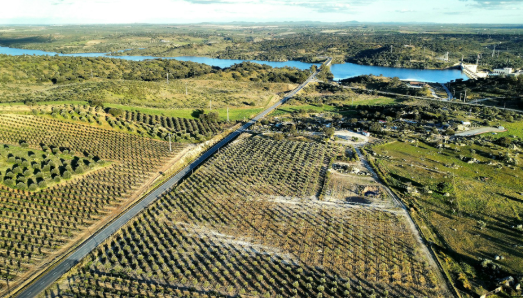
Lisbon, Porto and the Algarve are often thought of when people mention Portugal but a lot of the country offers a very different experience. Smaller cities, historic towns and inland areas can offer lower population density, access to nature and a slower pace of life.
These areas can provide international residents with an alternative to the increasingly expensive markets in the Portuguese metropolis and coast.
There are some investment-based residence strategies as well.Under the Portugal Golden Visa regime, eligible investments made in officially designated low-density areas can benefit from lower minimum thresholds.
It’s important to understand the distinction between lifestyle appeal and the legal definition of a low-density area.
What Does Low Density Mean in Portugal?
For Golden Visa purposes, “low density” has a specific legal meaning.
The relevant territories are defined under Portuguese legislation and generally have fewer than 100 inhabitants per square kilometre or gross domestic product per capita below 75% of the national average.
This means low density is not simply another term for countryside.
A location can feel quiet or rural without necessarily satisfying the legal classification used for investment incentives.
Investors should therefore verify the official designation rather than relying on geography alone. The Portugal Golden Visa low-density areas framework explains how the classification affects qualifying investments.
Why Consider Portugal Beyond Lisbon and Porto?
One of the biggest reasons to consider lower-density Portugal is lifestyle.
Smaller towns can offer less congestion, outdoor activities and a closer connection to traditional Portuguese life.
Housing may also be cheaper than central Lisbon, Cascais or other very popular locations, although prices vary greatly from region to region.
For retirees and remote professionals, living outside of the largest cities can be particularly attractive when daily commuting is not a factor.
The trade-off is that public transportation, international schools, specialized healthcare and some professional services may be less accessible.
Where Are Portugal’s Low-Density Regions?
Many officially classified low-density territories are located in Portugal’s interior.
Broadly speaking, these include areas across the north and centre of the country, the Alentejo and selected territories elsewhere.
Cities and towns such as Bragança, Guarda, Castelo Branco, Évora and Beja illustrate the range of lifestyles available beyond Portugal’s largest metropolitan centres, although the precise legal classification must always be checked at the relevant territorial level.
Portugal’s islands and coastal regions require similar care because investment classifications do not always correspond neatly with popular geographical descriptions.
For immigration purposes, the official list matters more than whether a destination is commonly considered rural.
Lower Density Can Mean a Different Cost Structure
One potential advantage of moving away from Portugal’s main urban centres is housing.
Lisbon has experienced substantial increases in both property prices and rents, and other international hotspots have followed a similar pattern.
Inland communities, smaller in size, could offer more space for the same housing budget.
But lower housing costs do not necessarily mean lower total costs.
A household in a rural location may need one or two cars, while someone living in central Lisbon can rely heavily on public transportation.
Heating and cooling costs can also differ significantly according to climate, property condition and energy efficiency.
The right comparison is therefore overall lifestyle cost rather than rent alone.
Low-Density Portugal and the Golden Visa
Portugal’s Golden Visa, formally the Residence Permit for Investment Activity or ARI, remains available through several qualifying investment categories.
The programme no longer accepts real estate purchases as qualifying investments for new Golden Visa applications.
However, Portuguese law provides a 20% reduction for certain investment activities when they take place in qualifying low-density territories.
The reduction applies to job creation, scientific research and cultural investment.
It does not apply to every Golden Visa category.
For example, the €500,000 qualifying investment-fund route does not receive a low-density discount.
Cultural Investment Is Particularly Relevant
The cultural Golden Visa has become one of the most discussed applications of Portugal’s low-density rules.
The standard qualifying amount for investment in or support of artistic production, recovery or maintenance of Portuguese cultural heritage is €250,000.
Portuguese law allows the applicable investment requirement to be reduced by 20% when the qualifying activity takes place in low-density territory.
This creates opportunities to connect residence investment with projects supporting Portuguese culture and heritage.
Investors interested in this route should examine how Portugal Golden Visa cultural projects are structured and certified before committing funds.
What Can Cultural Investment Support?
The cultural route is broader than simply making a donation to a museum.
Portuguese legislation allows qualifying investment or support for artistic production and for the recovery or maintenance of national cultural heritage through specified eligible public and cultural entities.
Projects can therefore relate to different areas of Portugal’s cultural ecosystem.
The critical issue is whether the investment satisfies the Golden Visa legislation and receives the necessary certification.
A project being culturally interesting or located in a historic town does not automatically make it Golden Visa eligible.
Legal and investment due diligence should take place before funds are transferred.
Research and Job Creation Can Also Benefit
Cultural investment is not the only category affected by low-density rules.
The Golden Visa research route normally requires a €500,000 capital transfer into qualifying scientific research activities. In low-density territory, the statutory 20% reduction lowers that requirement.
The employment route normally requires the creation of at least 10 jobs. In qualifying low-density territory, the requirement can be reduced by 20% to eight jobs.
These incentives reflect a broader policy objective: directing economic activity and investment toward territories that may benefit from additional development.
Residency Does Not Mean You Must Live There Full Time
An important distinction is that making a qualifying low-density Golden Visa investment does not necessarily mean the investor must make that region their permanent home.
The Golden Visa is designed around relatively limited physical-presence requirements.
AIMA currently states that Golden Visa holders must spend at least seven days in Portugal during the first year and 14 days during subsequent two-year periods.
Investors may therefore support an eligible project in a low-density territory while maintaining their principal residence elsewhere, subject to the programme’s requirements.
This distinguishes the Golden Visa from residence routes designed for people moving permanently to Portugal.
Low-Density Living Is Not for Everyone
For people genuinely considering relocation, smaller Portuguese communities should be evaluated on practical criteria.
Healthcare access, airports, schools, broadband, public transport and everyday services can be more important than population density.
Some international residents value the privacy, nature and community offered by inland Portugal. Others prefer the convenience and international environment of Lisbon, Porto or established coastal destinations.
Spending time in a region before relocating is therefore advisable.
A beautiful holiday destination does not necessarily provide the infrastructure someone wants throughout the year.
Conclusion
Portugal’s low-density regions offer more than an investment incentive. They represent a different side of the country, with smaller communities, historic landscapes and potentially lower housing costs.
For Golden Visa investors, certain qualifying activities in officially designated low-density territories can also benefit from a 20% reduction in the applicable minimum requirement.
The incentive is limited to specific categories, including job creation, scientific research and cultural investment. It does not apply automatically to every Golden Visa option.
Whether the objective is residence investment or a genuine lifestyle change, low-density Portugal deserves consideration beyond the familiar destinations of Lisbon, Porto and the Algarve.