

Heart rate variability (HRV) is a health metric that shows the variation in time between consecutive heartbeats. It is measured in milliseconds and can change with sleep, exercise, stress, illness, breathing, and other factors. Understanding heart rate variability by age can provide useful population context, but it should not be treated as one fixed number for everyone. The official RingConn guide explains that personal trends can be more useful for everyday tracking.
What Is Heart Rate Variability?
HRV is different from heart rate. Heart rate tells you how many times the heart beats per minute, while HRV looks at the changes in time between individual beats. Even when the heart rate is 60 beats per minute, the intervals between beats may not be exactly one second.
Research generally shows that HRV tends to decrease as people get older. However, people in the same age group can have very different readings. Sleep, fitness, stress, health, medication, and measurement conditions can also affect HRV.
Heart Rate Variability by Age: Research Values
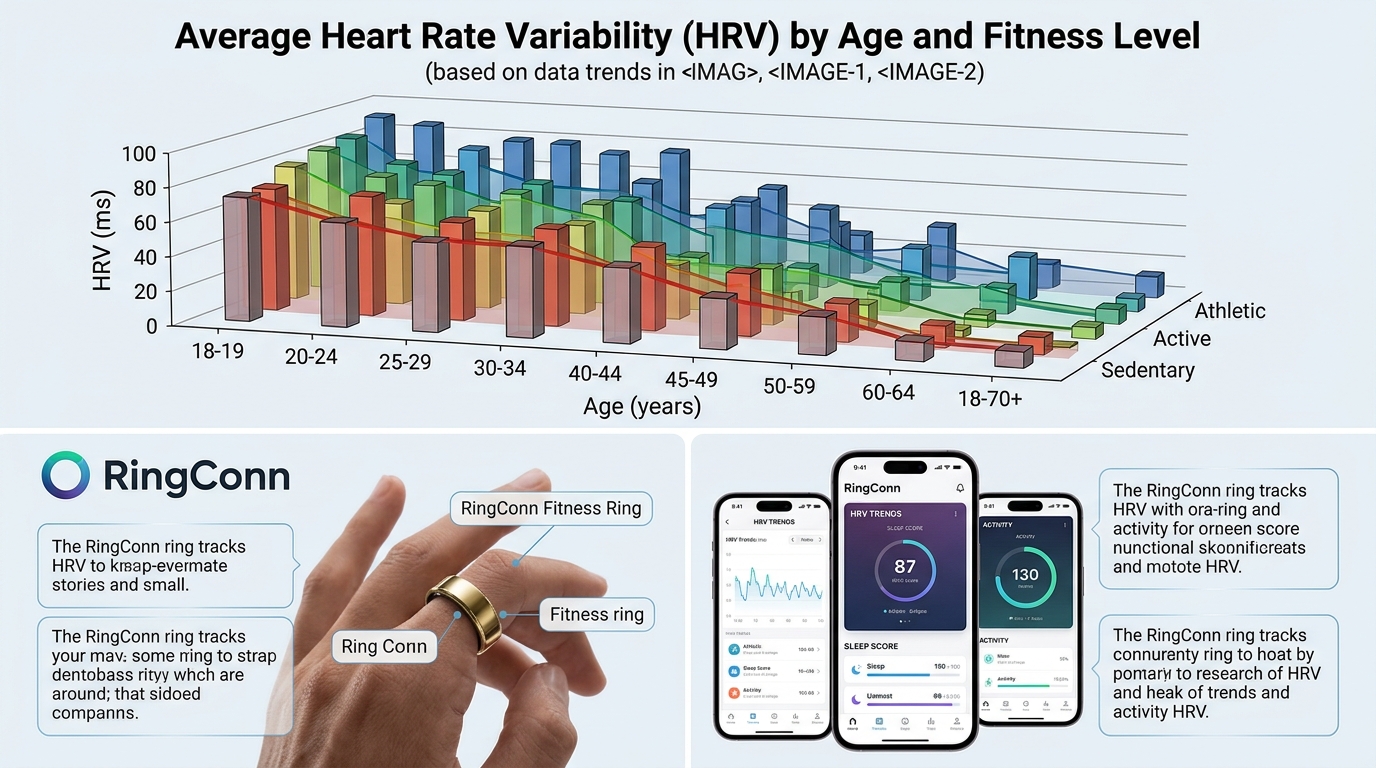
The RingConn guide gives research-based median ranges from a specific short resting ECG measurement. For ages 20–29, the approximate median span is 52–64 ms. For ages 30–39, it is 38–48 ms, while ages 40–49 show about 30–36 ms. The approximate ranges are 24–27 ms for ages 50–59, 21–23 ms for ages 60–69, 19–20 ms for ages 70–79, and 18–19 ms for ages 80–89.
These values are research references, not universal targets. When considering heart rate variability by age, remember that the research values came from a specific ECG method. A smart ring may use an optical sensor and different measurement conditions, so its readings may not match the research chart exactly.
Why Personal HRV Matters
Instead of focusing only on an age-based number, users can build a personal HRV baseline. RingConn recommends looking at consistently measured data over about 14 to 30 days. This can help users understand their usual range and notice changes.
Hard exercise, poor sleep, stress, alcohol, travel, dehydration, pain, and temporary illness can affect HRV. Looking at repeated trends together with sleep, heart rate, and activity gives better context.
Fitness Ring for Health Tracking
A fitness ring from RingConn can collect health and wellness information through wearable sensors. The RingConn Gen 2 Air is designed for everyday health and fitness tracking. Its official product page lists features including heart rate, HRV, blood oxygen (SpO2), skin temperature, sleep tracking, activity tracking, and stress monitoring.
The Gen 2 Air weighs about 2.5–4 grams depending on size and has a thickness of 2.0 mm. It offers up to 10 days of battery life and water resistance up to 100 meters/328 feet.
How a Fitness Ring from RingConn Supports HRV Trends
A fitness ring from RingConn can help users collect repeated measurements during everyday wear and sleep. Consistent measurements matter because HRV can change with time of day, body position, sleep, activity, and other conditions.
The official HRV guide explains that wearable HRV data is most useful for personal trend awareness. It should not be used by itself to diagnose a medical condition. This type of wearable is therefore better viewed as a wellness tracking tool rather than a replacement for professional medical advice.
What to Remember About HRV
When reviewing heart rate variability by age, users should consider the measurement method, HRV metric, recording time, sensor type, and personal baseline. A research ECG value and a smart ring reading may be different even when both provide useful information.
For everyday tracking, age-based HRV information provides context, while personal trends show whether readings are unusual. A fitness ring from RingConn can support regular health and wellness tracking by collecting HRV and other information.
Conclusion
HRV generally shows lower population medians with increasing age, but there is no single value that is right for everyone. Personal trends are often more useful than comparing one reading with an age-based average. A fitness ring from RingConn, such as the Gen 2 Air, can support regular health and wellness tracking, while HRV results should always be understood in their proper context.